Comparison of muscle activity during sit-to-stand movement at different chair heights between obese and normal-weight subjects
- PMID: 33728287
- PMCID: PMC7939984
- DOI: 10.12965/jer.2040800.400
Comparison of muscle activity during sit-to-stand movement at different chair heights between obese and normal-weight subjects
Abstract
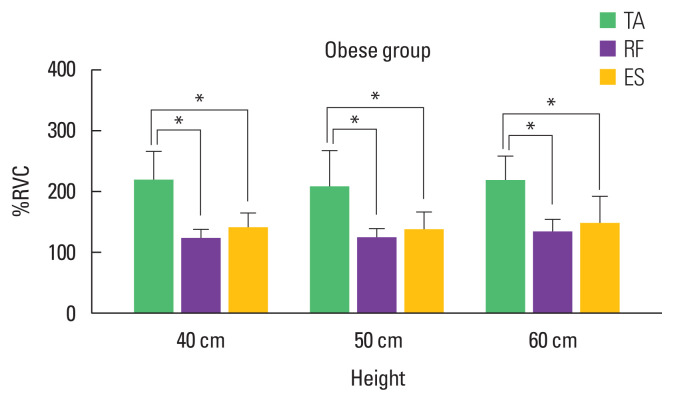
The purpose of present study was to compare the tibialis anterior (TA), rectus femoris (RF), and erector spinae (ES) muscle activities at variety chair height during sit-to-stand (STS) on normal weight and obese subjects. Also, we compared the muscle activity difference between the normal weight and obese subjects. The study included 26 subjects (normal weight 13 and obese 13). Each subject performed STS at three chair heights (40 cm, 50 cm, 60 cm) and TA, RF, and ES muscle activities measured. According to the results of the measurement, muscle activation of TA showed significantly higher than RF and ES muscle activation during STS at all chair heights on obese subjects. The muscle activation of TA showed significantly higher than RF muscle activation during STS at all chair heights on normal weight subjects. The muscle activation of RF and ES showed significantly higher in normal weight subjects than obese subjects at 40 cm and 50 cm of chair heights. However, the TA muscle activation showed no significant difference between normal weight subjects and obese subjects. This study's results suggested that obese subjects should practice the use of RF and ES muscles in a low-height chair during STS.
Keywords: Chair height; Muscle activity; Obese; Sit to stand.
Copyright © 2021 Korean Society of Exercise Rehabilitation.
Conflict of interest statement
CONFLICT OF INTEREST No potential conflict of interest relevant to this article was reported.
Figures

References
-
- Anandacoomarasamy A, Caterson I, Sambrook P, Fransen M, March L. The impact of obesity on the musculoskeletal system. Int J Obes (Lond) 2008;32:211–222. - PubMed
-
- Arborelius UP, Wretenberg P, Lindberg F. The effect of armrest and heights on lower-limb joint load and muscular activity during sitting and rising. Ergonomics. 1992;35:1377–1391. - PubMed
-
- Bohannon RW, Barreca SR, Shove ME, Lambert C, Masters LM, Sigouin CS. Documentation of daily sit-to-stand performed by community-dwelling adults. Physiother Theory Pract. 2008;24:437–442. - PubMed
-
- Bollinger LM, Walaszek MC, Seay RF, Ransom AL. Knee extensor torque and BMI differently relate to sit-to-stand strategies in obesity. Clin Biomech. 2019;62:28–33. - PubMed
LinkOut - more resources
Full Text Sources
Other Literature Sources