


Tissue effects of a newly developed diode pumped pulsed Thulium:YAG laser compared to continuous wave Thulium:YAG and pulsed Holmium:YAG laser
- PMID: 33728503
- PMCID: PMC8510916
- DOI: 10.1007/s00345-021-03634-4
Tissue effects of a newly developed diode pumped pulsed Thulium:YAG laser compared to continuous wave Thulium:YAG and pulsed Holmium:YAG laser
Abstract
Purpose: The objective of this study is to evaluate the laser-tissue effects of laser radiation emitted by a newly developed high frequency pulsed Tm:YAG laser in comparison to the continuous wave Tm:YAG laser and the pulsed Ho:YAG laser.
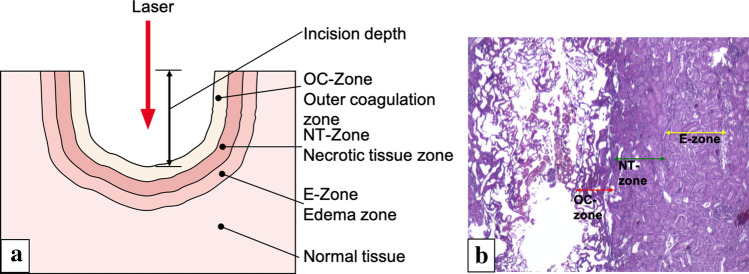
Methods: Ex-vivo experiments were performed on freshly slaughtered porcine kidneys in a physiological saline solution. Experiments were performed using two different laser devices in different settings: A Tm:YAG laser was operated in a pulsed mode up to 300 Hz and in a continuous wave (CW) mode. Results were compared with a 100 W standard pulsed Ho:YAG laser system. Comparative tissue experiments were performed at 5 W, 40 W and 80 W. The incision depth and the laser damage zone were measured under a microscope using a calibrated ocular scale.
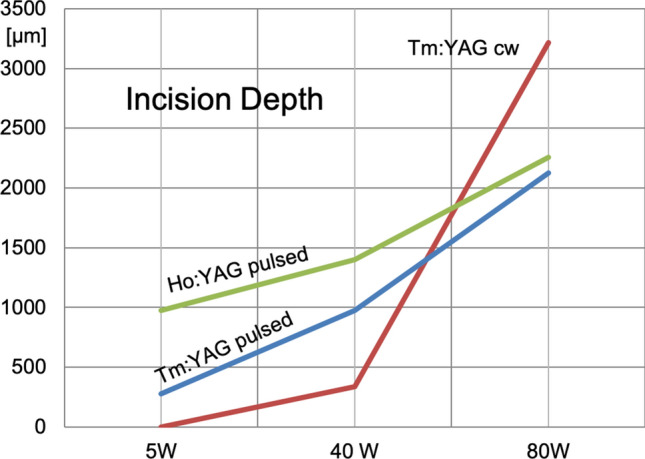
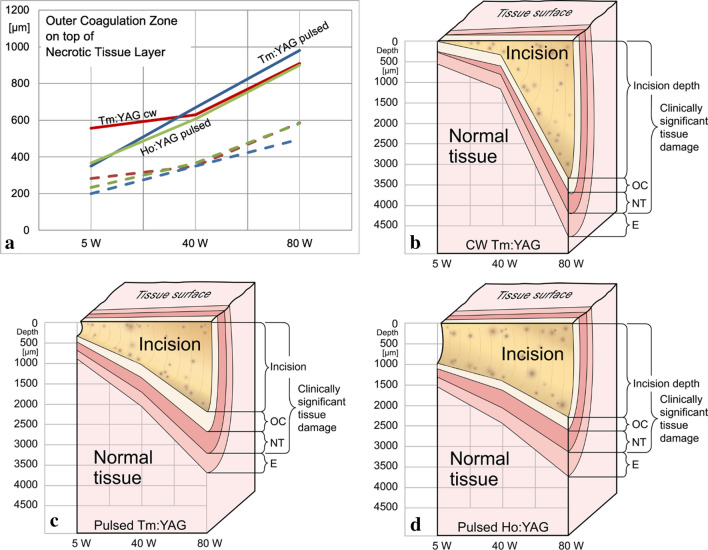
Results: Increased laser power resulted in increased incision depth and increased laser damage zone for all investigated lasers in this set-up. The Ho:YAG created the largest combined tissue effect at the 5 W power setting and seems to be the least controllable laser at low power for soft tissue incisions. The CW Tm:YAG did not incise at all at 5 W, but created the largest laser damage zone. For the new pulsed Tm:YAG laser the tissue effect grew evenly with increasing power.
Conclusion: Among the investigated laser systems in this setting the pulsed Tm:YAG laser shows the most controllable behavior, insofar as both the incision depth and the laser damage zone increase evenly with increasing laser power.
Keywords: Continuous wave Thulium:YAG laser (CW); Holmium:YAG laser; Pulsed Thulium:YAG laser; Tissue interaction.
© 2021. The Author(s).
Conflict of interest statement
S Huusmann: consultant for Boston Scientific and LISA Laser. HO Teichmann: consultant for LISA Laser. R Muschter: consultant for LISA Laser. TRW Herrmann: consultant for Karl Storz.
Figures
References
Publication types
MeSH terms
Substances
LinkOut - more resources
Full Text Sources
Other Literature Sources
Medical
