


miRNAs derived from circulating small extracellular vesicles as diagnostic biomarkers for nasopharyngeal carcinoma
- PMID: 33728743
- PMCID: PMC8177774
- DOI: 10.1111/cas.14883
miRNAs derived from circulating small extracellular vesicles as diagnostic biomarkers for nasopharyngeal carcinoma
Abstract
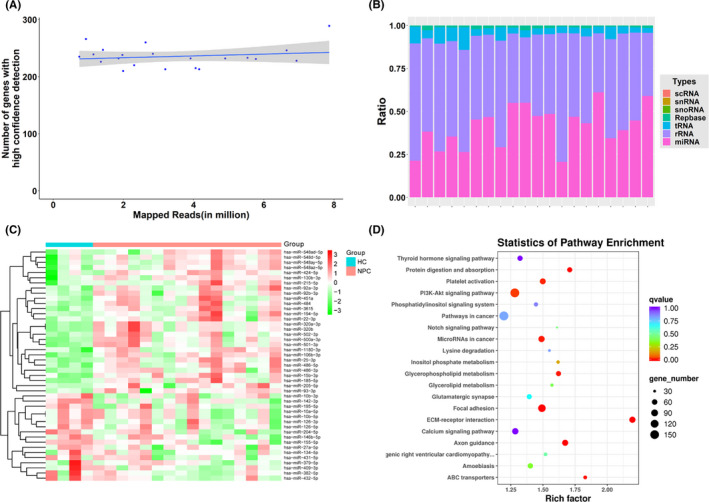
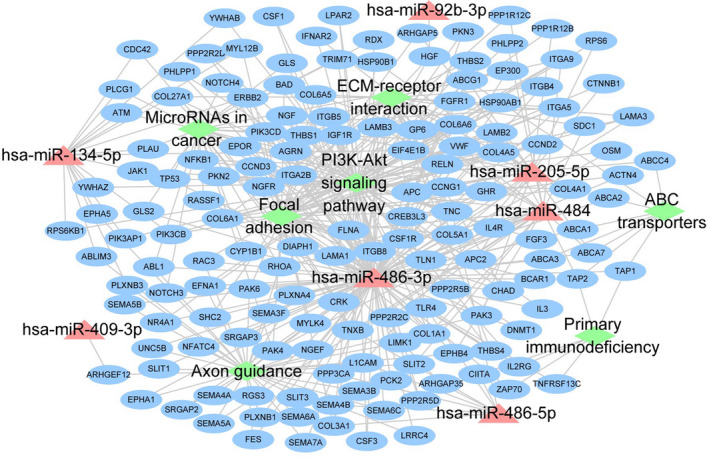
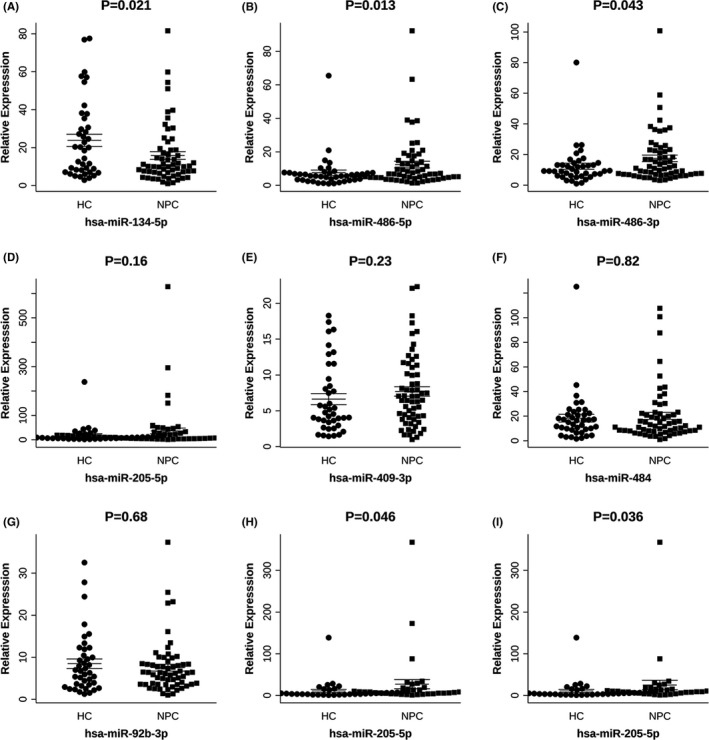
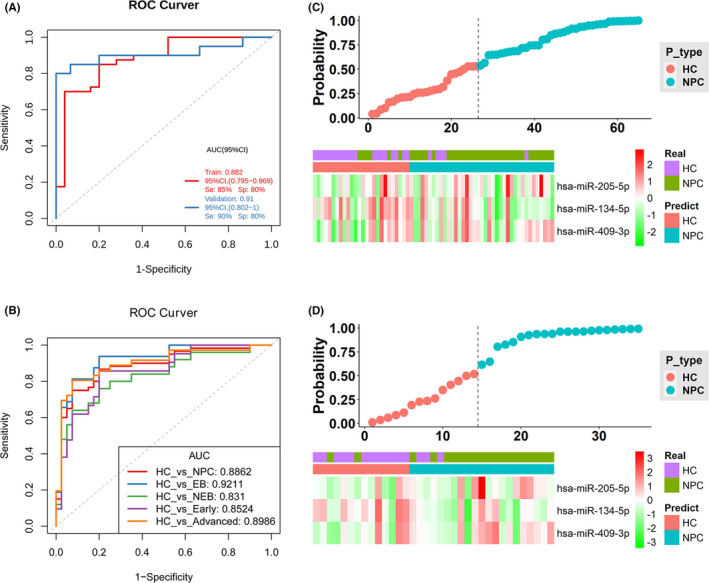
The microRNAs (miRNAs) in circulating small extracellular vesicles (sEVs) have been suggested as potential biomarkers in cancer diagnosis. This study was designed to evaluate the circulating sEV-derived miRNAs as biomarkers for the diagnosis of nasopharyngeal carcinoma (NPC). We compared the miRNA profiles in plasma-derived sEVs between 16 patients with NPC and 5 healthy controls (HCs). A distinct set of miRNAs that were differentially expressed between patients with NPC and HCs was determined by means of integrative bioinformatics approaches. Kyoto Encyclopedia of Genes and Genomes (KEGG) enrichment pathway analysis revealed that the target genes of the differentially expressed miRNAs (DEMs) were mainly involved in cancer-associated signaling pathways. Seven representative DEMs were selected and further validated in an additional 60 patients with NPC and 40 HCs using quantitative reverse-transcription PCR analysis (qRT-PCR). Receiver operating characteristic (ROC) curve analysis was used to assess the accuracy of the sEV-miRNA-based model for diagnosis. The 3 miRNA-based model, comprising miR-134-5p, miR-205-5p, and miR-409-3p, showed good discriminating power with an area under the curve (AUC) value of 0.88 in the training set and 0.91 in the validation set. Furthermore, the diagnostic model had an excellent classification ability to distinguish patients with NPC at different clinical stages or Epstein-Barr virus infection status from HCs. In conclusion, our findings indicated that sEV-derived miRNA levels were altered in the plasma of patients with NPC in comparison with those in HCs. The model based on the 3 sEV-derived miRNAs could potentially act as an alternative or complementary approach for diagnosing NPC.
Keywords: biomarker; diagnosis; microRNA; nasopharyngeal carcinoma; small extracellular vesicle.
© 2021 The Authors. Cancer Science published by John Wiley & Sons Australia, Ltd on behalf of Japanese Cancer Association.
Conflict of interest statement
The authors declare no competing interests (both financial and non‐financial).
Figures

References
-
- Chen W, Zheng R, Baade PD, et al. Cancer statistics in China, 2015. CA Cancer J Clin. 2016;66:115‐132. - PubMed
-
- Mao YP, Xie FY, Liu LZ, et al. Re‐evaluation of 6th edition of AJCC staging system for nasopharyngeal carcinoma and proposed improvement based on magnetic resonance imaging. Int J Radiat Oncol Biol Phys. 2009;73:1326‐1334. - PubMed
MeSH terms
Substances
Grants and funding
- Guike AB18281003/the Key Research and Development Program of Guangxi
- S2017020/Guangxi Medical and Health Appropriate Technology Development and Promotion Application Project
- 2018KY0134/Middle-aged and Young Teachers' Basic Ability Promotion Project of Guangxi
- GK AD17129013/Guangxi Science and Technology Program Project
- 82060019/National Natural Science Foundation of China
LinkOut - more resources
Full Text Sources
Other Literature Sources
