


Prevalence and determinants of concurrent wasting and stunting and other indicators of malnutrition among children 6-59 months old in Kersa, Ethiopia
- PMID: 33728748
- PMCID: PMC8189198
- DOI: 10.1111/mcn.13172
Prevalence and determinants of concurrent wasting and stunting and other indicators of malnutrition among children 6-59 months old in Kersa, Ethiopia
Abstract
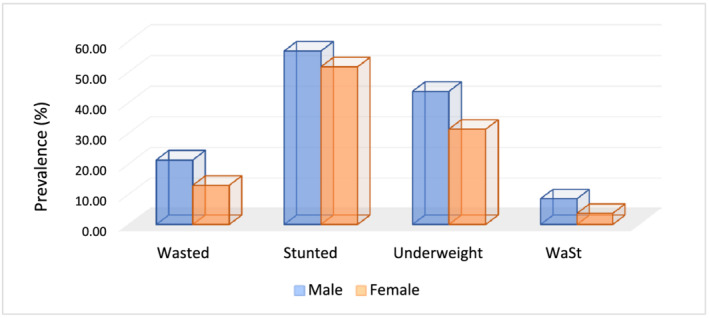
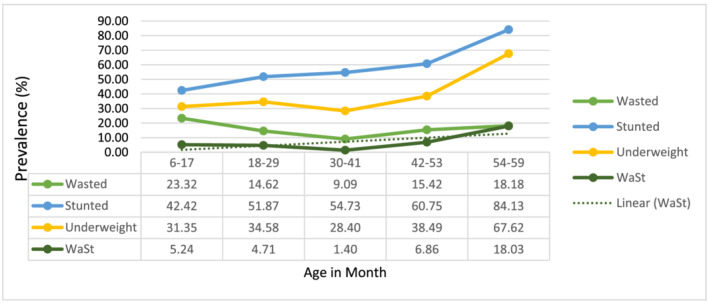
Malnutrition is the leading cause of poor child health in Ethiopia, and progress to avert it is unacceptably slow. In addition, little is known about the magnitude and factors associated with concurrent wasting and stunting (WaSt). Therefore, this study aimed to assess the prevalence and factors associated with WaSt, wasting, stunting and underweight among children 6-59 months in Kersa Health and Demographic Surveillance System, Ethiopia. Data from a total of 1091 children and their parents' were analysed from a cross-sectional study. Household questionnaires and anthropometric measurements were used for data collection. Height-for-age, weight-for-height and weight-for-age indices are expressed as standard deviation units from the mean for the reference group. Multivariate analyses were conducted to identify factors associated with WaSt, wasting, stunting and underweight. Statistical significance was declared at p < 0.05. The prevalence of indicators of malnutrition was WaSt (5.8%), wasting (16.8%), stunting (53.9%) and underweight (36.9%). Children aged 6-17 months had a higher odds of wasting (adjusted odds ratio [aOR] 1.8, 95% confidence interval [CI] 1.12-2.75) compared with those aged 36-59 months, whereas children aged 18-35 months (aOR 2.4, 95% CI 1.65-3.47) and 36-59 months (aOR 1.6, 95% CI 1.07-2.37) had higher odds of stunting compared with those aged 6-17 months. Similarly, children aged 18-35 months (aOR 1.6, 95% CI 1.07-2.37) and 36-59 months (aOR 2.2, 95% CI 1.52-3.10) had higher odds of underweight compared with children aged 6-17 months. Households that did not treat drinking water at point of use were at higher odds of WaSt (aOR 3.3, 95% CI 1.16-9.27) and stunting (aOR 1.9, 95% CI 1.31-2.85) compared with those who did treat drinking water. Boys were more likely to be WaSt, wasted, stunted and underweight. Cough was associated with WaSt, wasting and underweight. Furthermore, maternal education, maternal occupation and maternal age were significantly associated with wasting. Maternal body mass index (BMI) of less than 18.5 kg/m2 and maternal BMI between 18.5 and 25 kg/m2 were associated with child stunting. In Kersa, the prevalence of WaSt, wasting, stunting and underweight is very high and requires urgent public health intervention. This study highlights point-of-use water treatment, maternal education, hygiene and sanitation, child health service utilization and maternal BMI as important areas to improve to target child malnutrition. Furthermore, a community-based programmatic and policy direction for early identification and management of WaSt in addition to other indicators of malnutrition is recommended.
Keywords: Ethiopia; Kersa HDSS; WaSt; concurrent wasting and stunting; point-of-use water treatment; stunting; underweight; wasting.
© 2021 The Authors. Maternal & Child Nutrition published by John Wiley & Sons Ltd.
Conflict of interest statement
The authors declare that they have no conflicts of interest.
Figures
References
-
- Bilukha, O. , & Leidman, E. (2018). Concordance between the estimates of wasting measured by weight‐for‐height and by mid‐upper arm circumference for classification of severity of nutrition crisis: Analysis of population‐representative surveys from humanitarian settings. BMC Nutrition, 4, 24–24. 10.1186/s40795-018-0232-0 - DOI - PMC - PubMed
Publication types
MeSH terms
LinkOut - more resources
Full Text Sources
Other Literature Sources
Medical
