Observational Study
. 2021 Apr 6;10(7):e018593.
doi: 10.1161/JAHA.120.018593. Epub 2021 Mar 17.

Physiological Evaluation of Anomalous Aortic Origin of a Coronary Artery Using Computed Tomography-Derived Fractional Flow Reserve

Collaborators, Affiliations
Observational Study

Physiological Evaluation of Anomalous Aortic Origin of a Coronary Artery Using Computed Tomography-Derived Fractional Flow Reserve

Julien Adjedj et al. J Am Heart Assoc. .

Abstract

Background With the emergence of coronary computed tomography (CT) angiography, anomalous aortic origin of a coronary artery (ANOCOR) is more frequently diagnosed. Fractional flow reserve derived from CT (FFRCT) is a noninvasive functional test providing anatomical and functional evaluation of the overall coronary tree. These unique features of anatomical and functional evaluation derived from CT could help for the management of patients with ANOCOR. We aimed to retrospectively evaluate the physiological and clinical impact of FFRCT analysis in the ANOCOR registry population. Methods and Results The ANOCOR registry included patients with ANOCOR detected during invasive coronary angiography or coronary CT angiography between January 2010 and January 2013, with a planned 5-year follow-up. We retrospectively performed FFRCT analysis in patients with coronary CT angiography of adequate quality. Follow-up was performed with a clinical composite end point (cardiac death, myocardial infarction, and unplanned revascularization). We obtained successful FFRCT analyses and 5-year clinical follow-up in 54 patients (average age, 60±13 years). Thirty-eight (70%) patients had conservative treatment, and 16 (30%) patients had coronary revascularization after coronary CT angiography. The presence of an ANOCOR course was associated with a moderate reduction of FFRCT value from 1.0 at the ostium to 0.90±0.10 downstream the ectopic course and 0.82±0.11 distally. No significant difference in FFRCT values was identified between at-risk and not at-risk ANOCOR. After a 5-year follow-up, only one unplanned percutaneous revascularization was reported. Conclusions The presence of ANOCOR was associated with a moderate hemodynamic decrease of FFRCT values and associated with a low risk of cardiovascular events after a 5-year follow-up in this middle-aged population.

Keywords: anomalous aortic origin of coronary arteries; coronary computed tomography angiography; fractional flow reserve; fractional flow reserve computed tomography.


Conflict of interest statement

None.

Figures
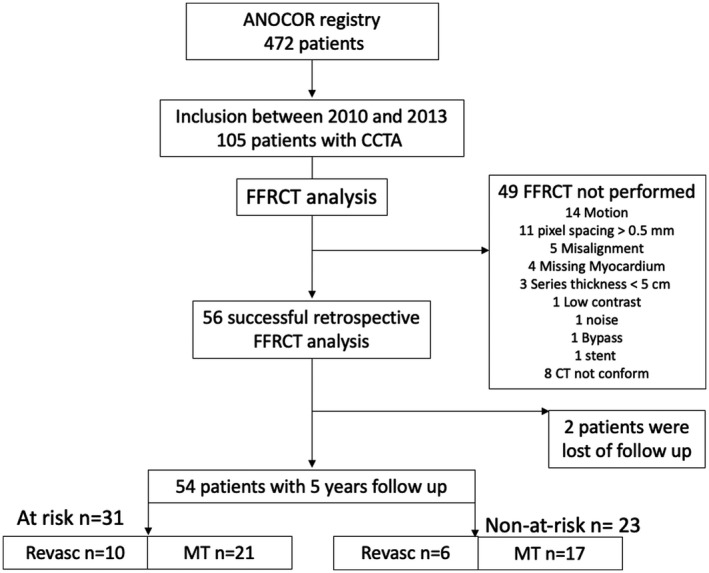
Figure 1
Figure 1. Flowchart.
ANOCOR indicates anomalous aortic origin of a coronary artery; CCTA, coronary CT angiography; CT, computed tomography; FFRCT, fractional flow reserve derived from CT; MT, medical therapy; and Revasc, revascularization.
Figure 2
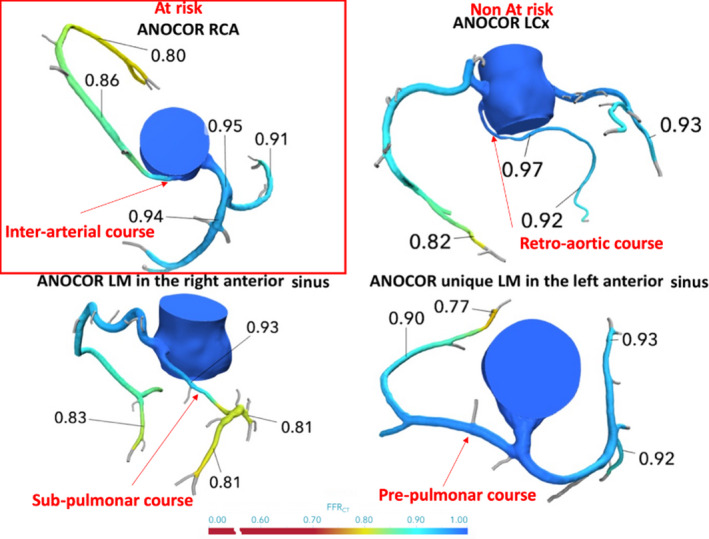
Figure 2. Anomalous aortic origin of a coronary artery (ANOCOR) types: examples of fractional flow reserve derived from computed tomography (FFRCT) in the conservation group.
LCx indicates left circumflex; LM, left main; and RCA, right coronary artery.
Figure 3
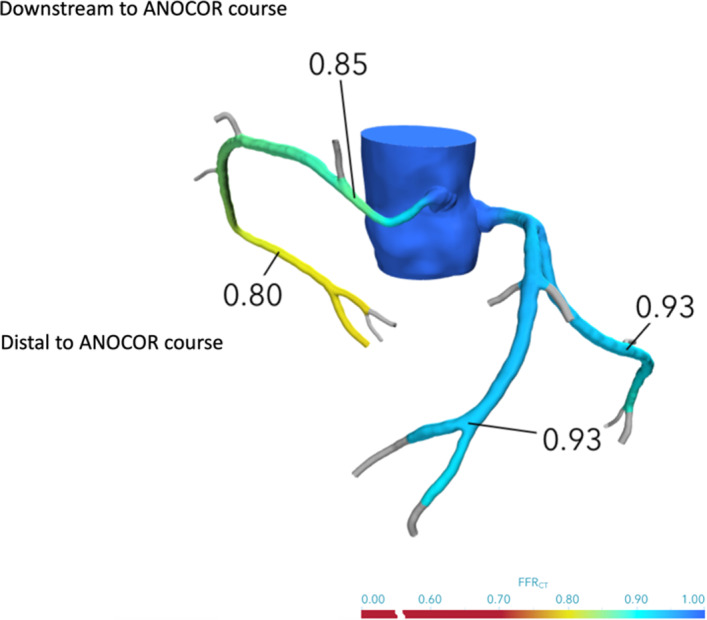
Figure 3. Anomalous aortic origin of a coronary artery (ANOCOR), fractional flow reserve derived from computed tomography (FFRCT) analysis example.
Figure 4
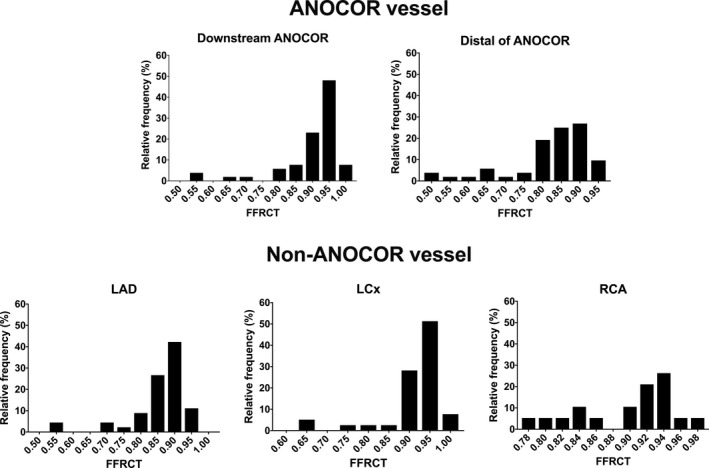
Figure 4. Frequency distribution of anomalous aortic origin of a coronary artery (ANOCOR) vessel and non‐ANOCOR vessel.
FFRCT indicates fractional flow reserve derived from computed tomography; LAD, left anterior descending; LCx, left circumflex; and RCA, right coronary artery.
Figure 5
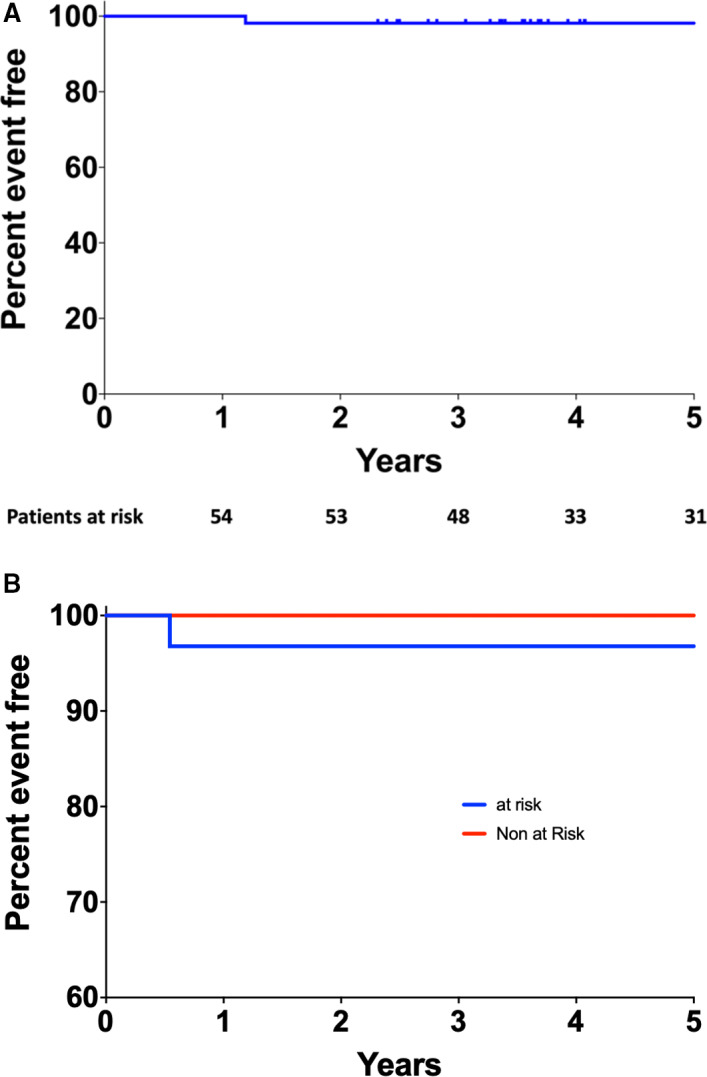
Figure 5. Kaplan‐Meier curve of event‐free rate of patients at 5 years of follow‐up in the overall population and according to the anatomical feature at risk.
A, Kaplan‐Meier curve of event‐free rate of patients at 5 years of follow‐up. Number of patients at risk are presented below in the figure. B, Kaplan‐Meier curves of event‐free rate of patients at 5 years of follow‐up, according to anatomical feature at risk. No statistical differences were observed with log‐rank test (P=0.39).

References

    1. Lluri G, Aboulhosn J. Coronary arterial development: a review of normal and congenitally anomalous patterns. Clin Cardiol. 2014;37:126–130.DOI: 10.1002/clc.22237. - DOI - PMC - PubMed
    1. Angelini P. Coronary artery anomalies: an entity in search of an identity. Circulation. 2007;115:1296–1305.DOI: 10.1161/CIRCULATIONAHA.106.618082. - DOI - PubMed
    1. Jacobs ML, Mavroudis C. Anomalies of the coronary arteries: nomenclature and classification. Cardiol Young. 2010;20(suppl 3):15–19.DOI: 10.1017/S1047951110001046. - DOI - PubMed
    1. Cheezum MK, Liberthson RR, Shah NR, Villines TC, O'Gara PT, Landzberg MJ, Blankstein R. Anomalous aortic origin of a coronary artery from the inappropriate sinus of Valsalva. J Am Coll Cardiol. 2017;69:1592–1608. DOI: 10.1016/j.jacc.2017.01.031. - DOI - PubMed
    1. Brothers J, Carter C, McBride M, Spray T, Paridon S. Anomalous left coronary artery origin from the opposite sinus of Valsalva: evidence of intermittent ischemia. J Thorac Cardiovasc Surg. 2010;140:e27–e29.DOI: 10.1016/j.jtcvs.2009.06.029. - DOI - PubMed

Publication types

MeSH terms