Assessment of the Frequency of Dual Allergy to Penicillins and Cefazolin: A Systematic Review and Meta-analysis
- PMID: 33729459
- PMCID: PMC7970387
- DOI: 10.1001/jamasurg.2021.0021
Assessment of the Frequency of Dual Allergy to Penicillins and Cefazolin: A Systematic Review and Meta-analysis
Abstract
Importance: Cefazolin is the preoperative antibiotic of choice because it is safer and more efficacious than second-line alternatives. Surgical patients labeled as having penicillin allergy are less likely to prophylactically receive cefazolin and more likely to receive clindamycin or vancomycin, which results in higher rates of surgical site infections.
Objective: To examine the incidence of dual allergy to cefazolin and natural penicillins.
Data sources: MEDLINE/PubMed, Web of Science, and Embase were searched without language restrictions for relevant articles published from database inception until July 31, 2020.
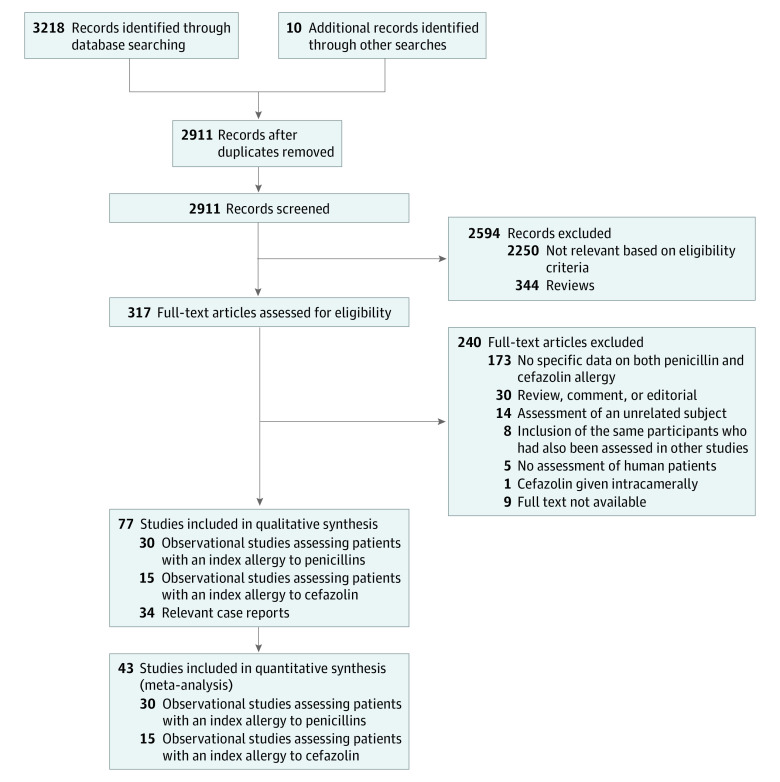
Study selection: In this systematic review and meta-analysis, a search of MEDLINE/PubMed, Web of Science, and Embase was performed for articles published from database inception to July 31, 2020, for studies that included patients who had index allergies to a natural penicillin and were tested for tolerability to cefazolin or that included patients who had index allergies to cefazolin and were tested for tolerability to a natural penicillin. A total of 3228 studies were identified and 2911 were screened for inclusion.
Data extraction and synthesis: Data were independently extracted by 2 authors. Bayesian meta-analysis was used to estimate the frequency of allergic reactions.
Main outcomes and measures: Dual allergy to cefazolin and a natural penicillin.
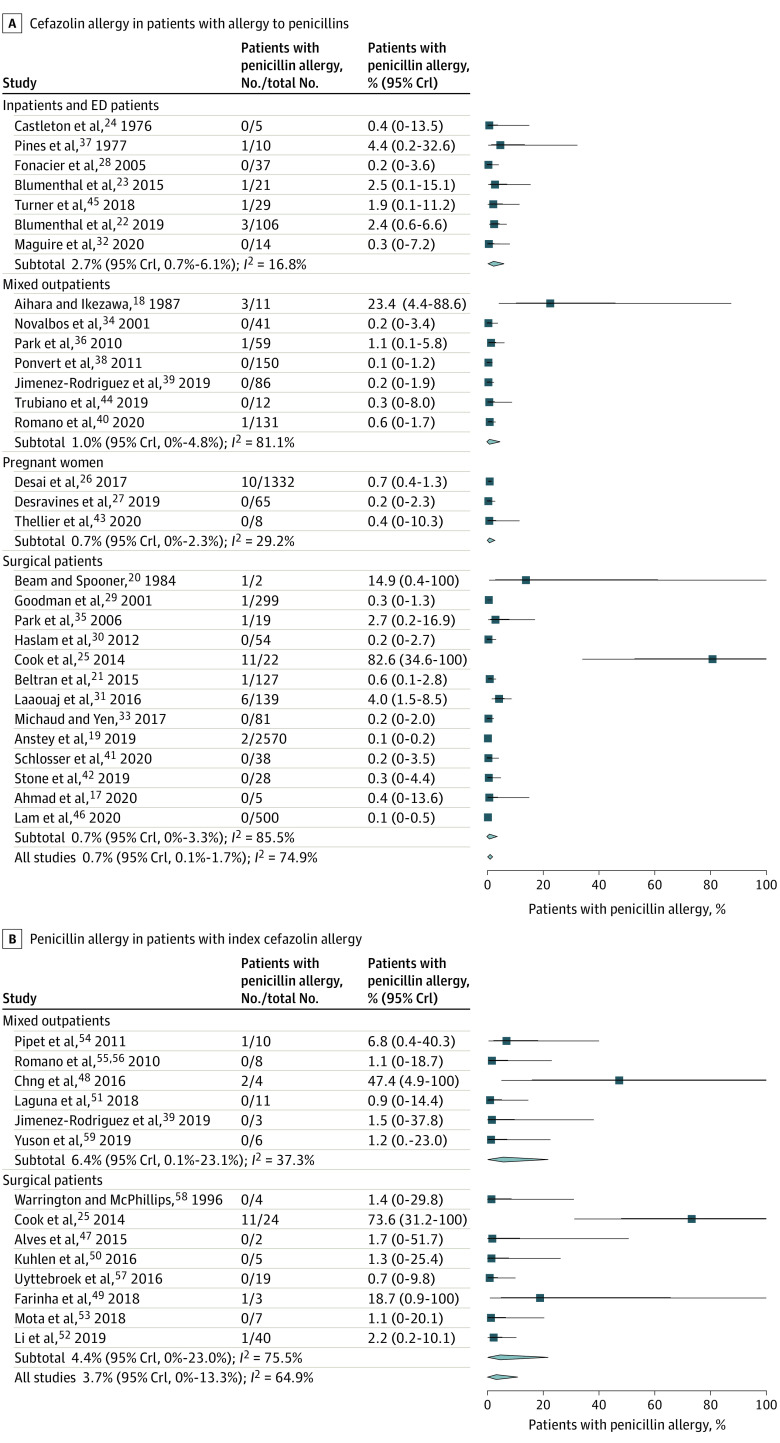
Results: Seventy-seven unique studies met the eligibility criteria, yielding 6147 patients. Cefazolin allergy was identified in 44 participants with a history of penicillin allergy, resulting in a dual allergy meta-analytical frequency of 0.7% (95% credible interval [CrI], 0.1%-1.7%; I2 = 74.9%). Such frequency was lower for participants with unconfirmed (0.6%; 95% CrI, 0.1%-1.3%; I2 = 54.3%) than for those with confirmed penicillin allergy (3.0%; 95% CrI, 0.01%-17.0%; I2 = 88.2%). Thirteen studies exclusively assessed surgical patients (n = 3884), among whom 0.7% (95% CrI, 0%-3.3%; I2 = 85.5%) had confirmed allergy to cefazolin. Low heterogeneity was observed for studies of patients with unconfirmed penicillin allergy who had been exposed to perioperative cefazolin (0.1%; 95% CrI, 0.1%-0.3%; I2 = 13.1%). Penicillin allergy was confirmed in 16 participants with a history of cefazolin allergy, resulting in a meta-analytical frequency of 3.7% (95% CrI, 0.03%-13.3%; I2 = 64.4%). The frequency of penicillin allergy was 4.4% (95% CrI, 0%-23.0%; I2 = 75%) for the 8 studies that exclusively assessed surgical patients allergic to cefazolin.
Conclusions and relevance: These findings suggest that most patients with a penicillin allergy history may safely receive cefazolin. The exception is patients with confirmed penicillin allergy in whom additional care is warranted.
Conflict of interest statement
Figures
Comment in
-
Dual Allergy to Penicillin and Cefazolin-Does Anaphylaxis Matter?JAMA Surg. 2021 Dec 1;156(12):1184. doi: 10.1001/jamasurg.2021.3760. JAMA Surg. 2021. PMID: 34431963 No abstract available.
-
Dual Allergy to Penicillin and Cefazolin-Does Anaphylaxis Matter?-Reply.JAMA Surg. 2021 Dec 1;156(12):1184-1185. doi: 10.1001/jamasurg.2021.3761. JAMA Surg. 2021. PMID: 34431966 No abstract available.
-
Infection and Inflammation of the Genitourinary Tract.J Urol. 2021 Dec;206(6):1496-1497. doi: 10.1097/JU.0000000000002214. Epub 2021 Sep 9. J Urol. 2021. PMID: 34496604 No abstract available.
References
-
- McDermott KW, Freeman WJ, Elixhauser A. Overview of Operating Room Procedures During Inpatient Stays in U.S. Hospitals. Statistical Brief 233. Healthcare Cost and Utilization Project (HCUP) Statistical Briefs. Agency for Healthcare Research and Quality; 2014. - PubMed
-
- Bratzler DW, Dellinger EP, Olsen KM, et al. ; American Society of Health-System Pharmacists (ASHP); Infectious Diseases Society of America (IDSA); Surgical Infection Society (SIS); Society for Healthcare Epidemiology of America (SHEA) . Clinical practice guidelines for antimicrobial prophylaxis in surgery. Surg Infect (Larchmt). 2013;14(1):73-156. doi: 10.1089/sur.2013.9999 - DOI - PubMed
Publication types
MeSH terms
Substances
LinkOut - more resources
Full Text Sources
Other Literature Sources
Medical
Miscellaneous