. 2021 Jul 14;28(7):1440-1450.
doi: 10.1093/jamia/ocab023.

Research Integrated Network of Systems (RINS): a virtual data warehouse for the acceleration of translational research

Affiliations

Research Integrated Network of Systems (RINS): a virtual data warehouse for the acceleration of translational research

Wenjun He et al. J Am Med Inform Assoc. .

Abstract

Objective: Integrated, real-time data are crucial to evaluate translational efforts to accelerate innovation into care. Too often, however, needed data are fragmented in disparate systems. The South Carolina Clinical & Translational Research Institute at the Medical University of South Carolina (MUSC) developed and implemented a universal study identifier-the Research Master Identifier (RMID)-for tracking research studies across disparate systems and a data warehouse-inspired model-the Research Integrated Network of Systems (RINS)-for integrating data from those systems.

Materials and methods: In 2017, MUSC began requiring the use of RMIDs in informatics systems that support human subject studies. We developed a web-based tool to create RMIDs and application programming interfaces to synchronize research records and visualize linkages to protocols across systems. Selected data from these disparate systems were extracted and merged nightly into an enterprise data mart, and performance dashboards were created to monitor key translational processes.

Results: Within 4 years, 5513 RMIDs were created. Among these were 726 (13%) bridged systems needed to evaluate research study performance, and 982 (18%) linked to the electronic health records, enabling patient-level reporting.

Discussion: Barriers posed by data fragmentation to assessment of program impact have largely been eliminated at MUSC through the requirement for an RMID, its distribution via RINS to disparate systems, and mapping of system-level data to a single integrated data mart.

Conclusion: By applying data warehousing principles to federate data at the "study" level, the RINS project reduced data fragmentation and promoted research systems integration.

Keywords: application programming interfaces; clinical data warehouse; health information interoperability; learning health system.


Figures

Figure 1.
Figure 1.
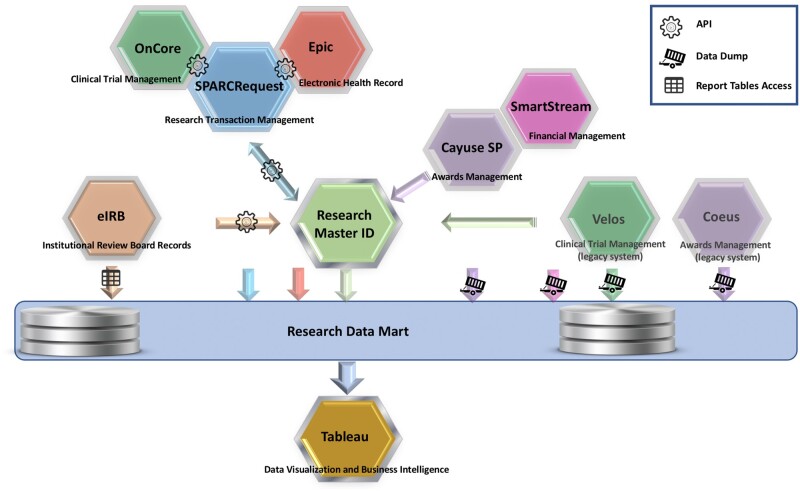
The Research Master ID is the centerpiece that enables the Research Integrated Network of Systems to bridge research systems at the Medical University of South Carolina via RESTFul application programming interfaces (APIs) and then to export select information from those systems into a research data mart. Abbreviations: API, application programming interface; eIRB, electronic institutional review board.
Figure 2.
Figure 2.
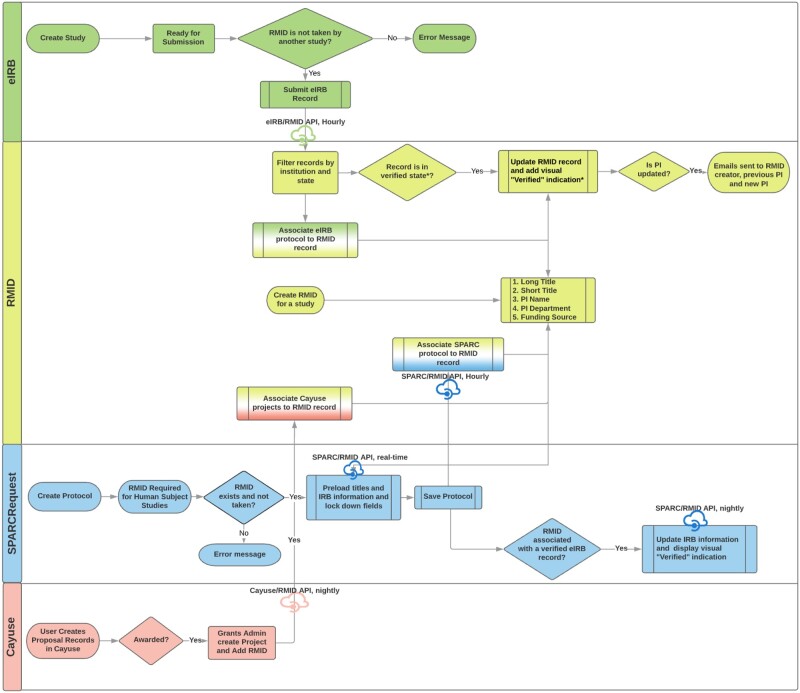
Flow charts illustrating the Research Master ID (RMID) and its application programming interfaces (APIs) during study record maintenance in the Research Integrated Network of Systems. Abbreviations: eIRB, electronic institutional review board; PI, principal investigator; SPARCRequest, services, pricing, & application for research centers.
Figure 3.
Figure 3.
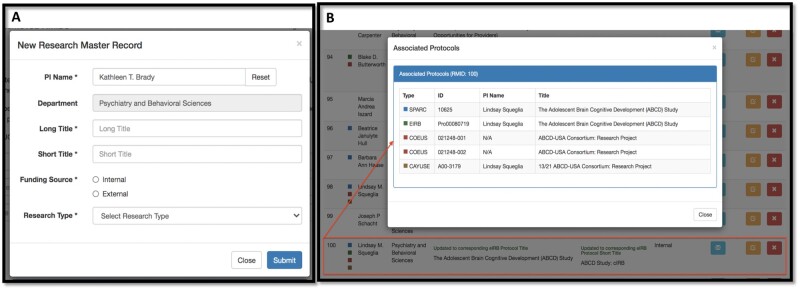
Front-end user interface of the Research Master ID application. Shown here are the window for creating a new Research Master Record (A) and another window displaying the inventory of all systems associated with the selected RMID record (B).
Figure 4.
Figure 4.
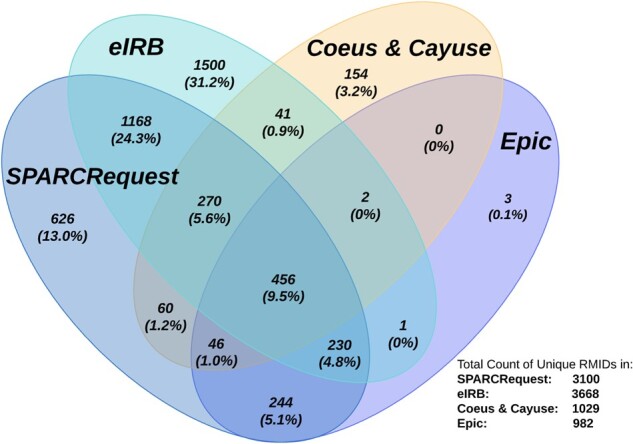
Venn diagram showing the number (percentage) of Research Master IDs shared among different research systems at the Medical University of South Carolina as of October 13, 2020. The denominator used to determine all percentages was the total number of RMIDs associated with at least 1 research system (4801). Calculations were performed using an online tool by BioinfoGP group.
Figure 5.
Figure 5.
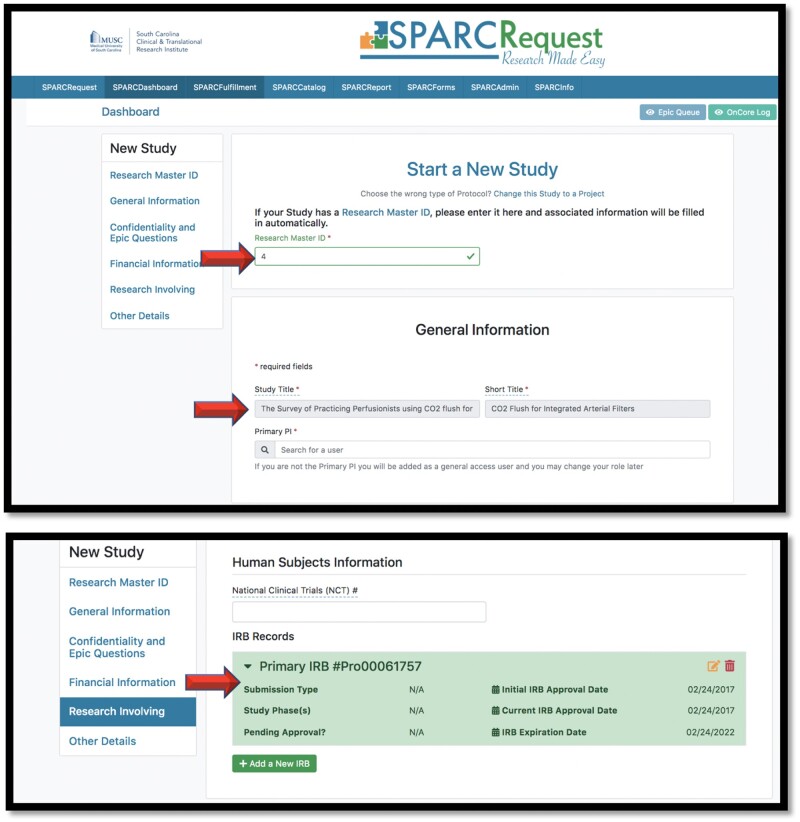
Screenshots from SPARCRequest showing fields that are automatically filled via the SPARC/RMID API. Abbreviations: API, application programming interface; RMID, Research Master ID; SPARC (SPARCRequest): services, pricing, & application for research centers.
Figure 6.
Figure 6.
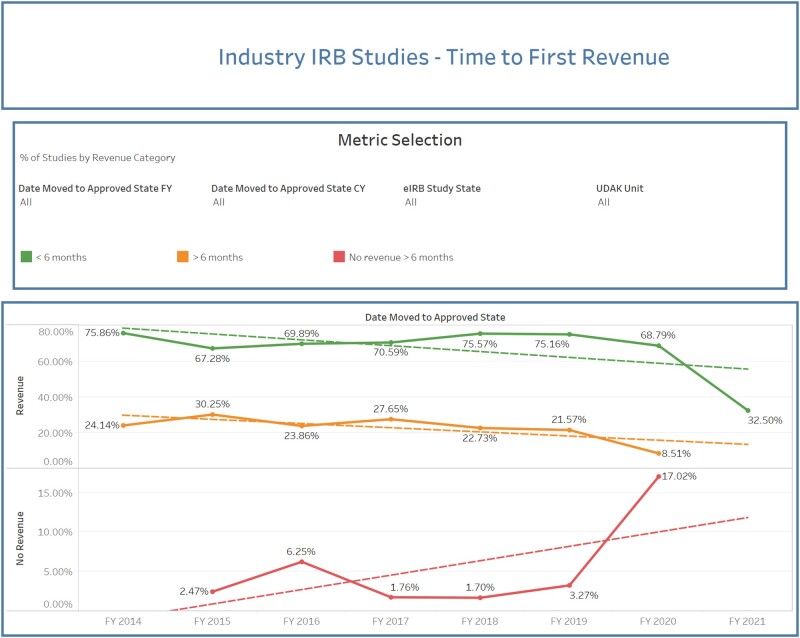
Performance dashboard showing time to first revenue for industry studies. Studies with no revenue are indicated in red, those with revenue after 6 months in orange, and those with revenue in less than 6 months in green. Solid lines in the graph connect the data points, and dotted lines show the trends using linear fitting. Abbreviations: CY, current year; eIRB, electronic institutional review board; FY, fiscal year; UDAK = financial account number.
Figure 7.
Figure 7.
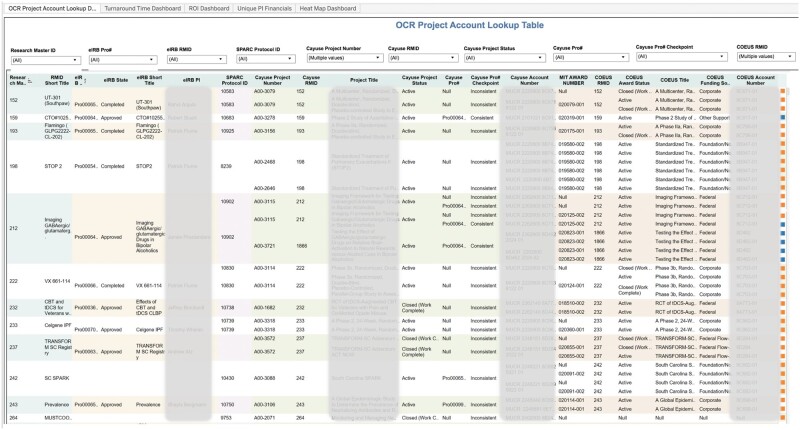
The project account lookup dashboard shows the linkage among research systems using Research Master ID records, with different colors of columns indicating different research systems. Abbreviation: OCR, Office of Clinical Research.

References

    1. Rodrigues RJ. Information systems: the key to evidence-based health practice. Bull World Health Organ 2000; 78 (11): 1344–51. 2001/01/06]. - PMC - PubMed
    1. Kruse CS, Goswamy R, Raval Y, Marawi S.. Challenges and opportunities of big data in health care: a systematic review. JMIR Med Inform 2016; 4 (4): e38.2016/11/23]. - PMC - PubMed
    1. Luo J, Wu M, Gopukumar D, Zhao Y.. Big data application in biomedical research and health care: a literature review. Biomed Inform Insights 2016; 8: BII.S31559.1-10 2016/02/05]. - PMC - PubMed
    1. Institute of Medicine (US). Forum on Drug Discovery, Development, and Translation. Transforming Clinical Research in the United States: Challenges and Opportunities: Workshop Summary. Washington, DC: National Academies Press; 2010. - PubMed
    1. Embi PJ, Payne PR.. Clinical research informatics: challenges, opportunities, and definition for an emerging domain. J Am Med Inform Assoc 2009; 16 (3): 316–27. - PMC - PubMed

Publication types