


Prognostic factors of time to first abortion after sexual debut among fragile state Congolese women: a survival analysis
- PMID: 33731079
- PMCID: PMC7968319
- DOI: 10.1186/s12889-021-10599-x
Prognostic factors of time to first abortion after sexual debut among fragile state Congolese women: a survival analysis
Erratum in
-
Correction: Prognostic factors of time to first abortion after sexual debut among fragile state Congolese women: a survival analysis.BMC Public Health. 2024 May 15;24(1):1318. doi: 10.1186/s12889-024-18697-2. BMC Public Health. 2024. PMID: 38750511 Free PMC article. No abstract available.
Abstract
Background: Despite the common restrictive abortion laws, abortion remains widespread in sub-Saharan Africa (SSA) countries. Women still utilize abortion services and put their lives and health at risk because abortion can only be procured illegally in private facilities such as mid-level or small patent medicine store that may be manned by unskilled providers or through a non-medicated approach. The objective of this study was to investigate the prevalence of abortion, the reasons women had abortions, median years to first abortion after sexual debut and examine the factors of time to first abortion among women of reproductive age in the Republic of Congo.
Methods: We used data from the most recent Republic of Congo Demographic and Health Survey (DHS). A total sample of 3622 women aged 15-49 years was analyzed. We estimated the overall prevalence of abortion and median years to first abortion. Furthermore, we examined the factors of time to first abortion after sexual debut using multivariable Cox regression and reported the estimates using adjusted Hazard Ratio (aHR) and 95% confidence intervals (CI). Statistical significance was determined at p < 0.05.
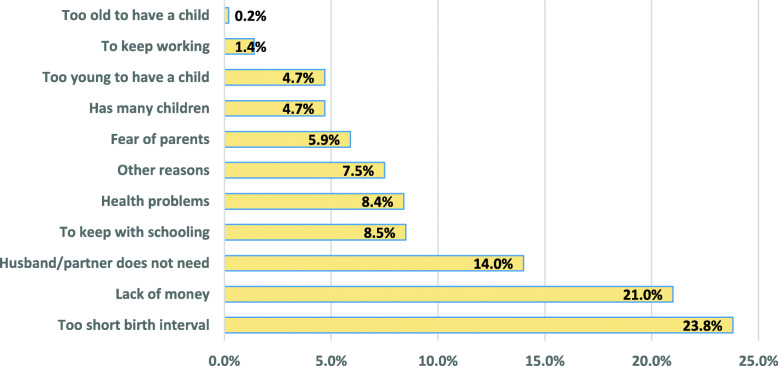
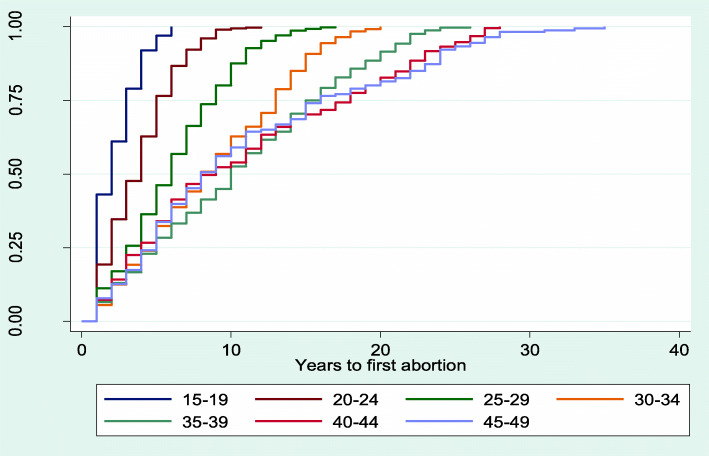
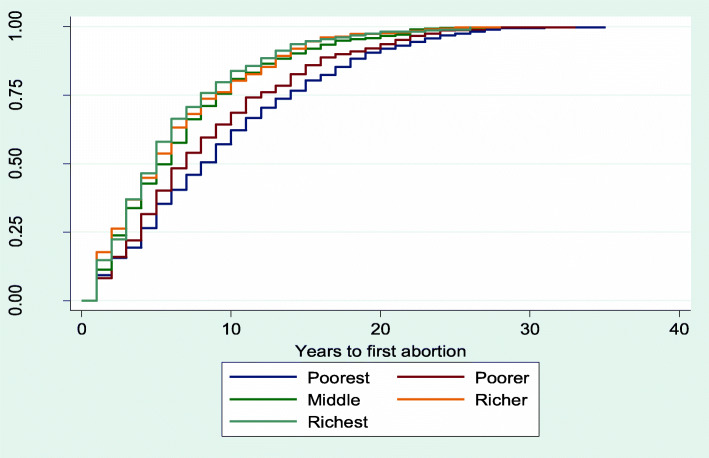
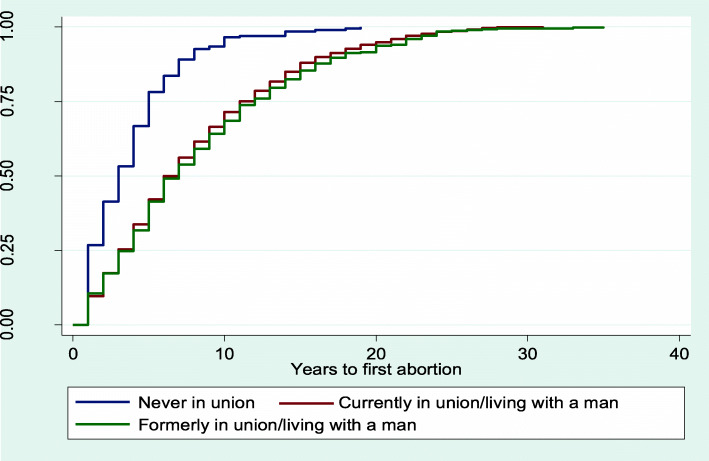
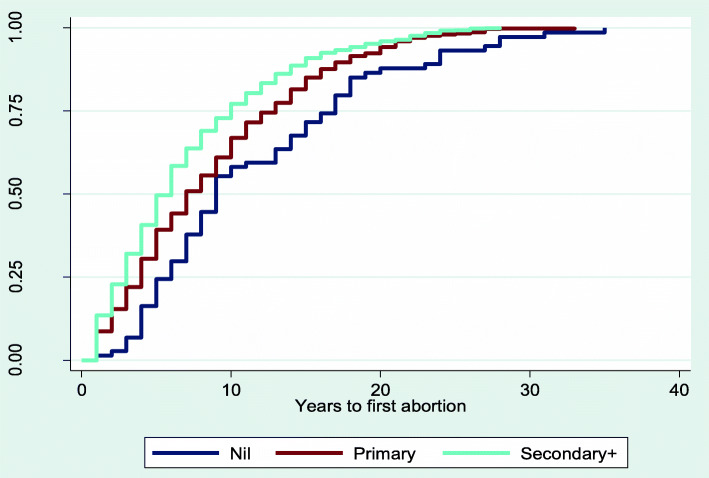
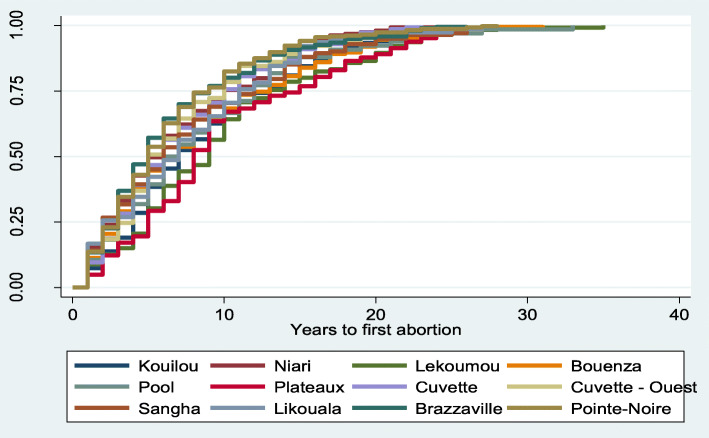
Results: The prevalence of abortion was 60.0% and median years of time to first abortion after sexual debut was 9.0. The prominent reasons for abortion were due to too short birth interval (23.8%), lack of money (21.0%) and that husband/partner did not need a child at that time (14.0%). Women's age and region were notable factors in timing to first abortion. Furthermore, women from poorer, middle, richer and richest households had 34, 67, 86 and 94% higher risk of abortion respectively, when compared with women from poorest households (all p < 0.05). Women currently in union/living with a man and formerly in union had 41 and 29% reduction in the risk of abortion respectively, when compared with those never in union (all p < 0.05). In addition, women with primary and secondary+ education had 42 and 76% higher risk of abortion respectively, when compared with women with no formal education (all p < 0.05).
Conclusion: There was high prevalence of abortion with short years at first abortion. Abortion was associated with women's characteristics. There is need for unwanted pregnancy prevention intervention and the improvement in pregnancy care to reduce adverse pregnancy outcomes among women.
Keywords: Pregnancy; Termination; Unintended; Unsafe abortion; Unwanted; Women’s health.
Conflict of interest statement
The authors declare that the research was conducted in the absence of any commercial or financial relationships that could be construed as a potential conflict of interest.
Figures
References
-
- Alkema L, Chou D, Hogan D, Zhang S, Moller A-B, Gemmill A, Fat DM, Boerma T, Temmerman M, Mathers C, Say L, United Nations Maternal Mortality Estimation Inter-Agency Group collaborators and technical advisory group Global, regional, and national levels and trends in maternal mortality between 1990 and 2015, with scenario-based projections to 2030: a systematic analysis by the UN Maternal Mortality Estimation Inter-Agency Group. Lancet. 2016;387(10017):462–474. doi: 10.1016/S0140-6736(15)00838-7. - DOI - PMC - PubMed
MeSH terms
LinkOut - more resources
Full Text Sources
Other Literature Sources
Medical
Research Materials
