


Negative Affectivity, Authoritarianism, and Anxiety of Infection Explain Early Maladjusted Behavior During the COVID-19 Outbreak
- PMID: 33732177
- PMCID: PMC7959709
- DOI: 10.3389/fpsyg.2021.583883
Negative Affectivity, Authoritarianism, and Anxiety of Infection Explain Early Maladjusted Behavior During the COVID-19 Outbreak
Abstract
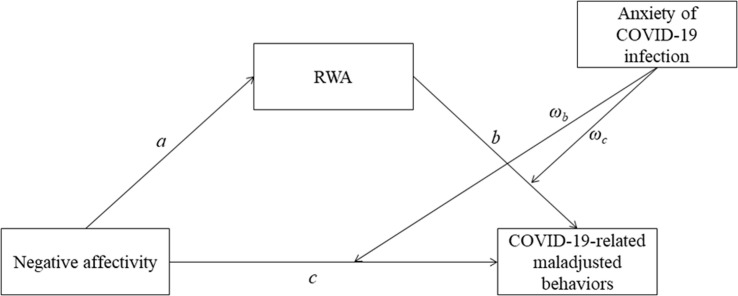
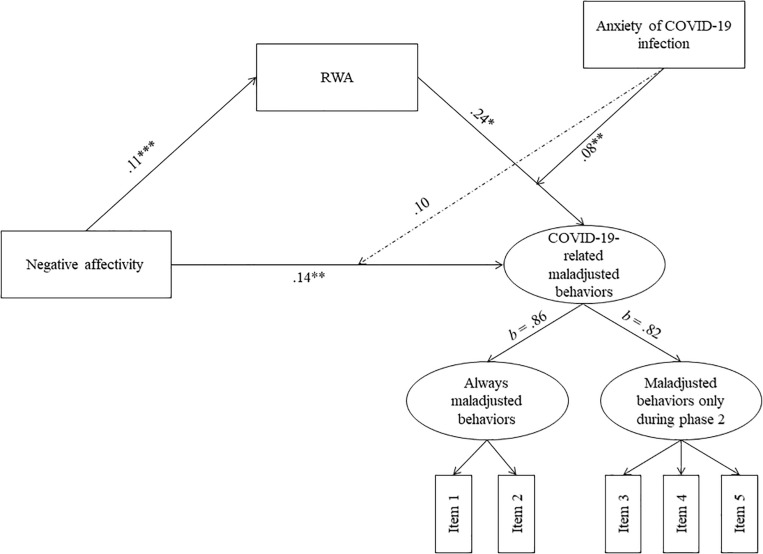
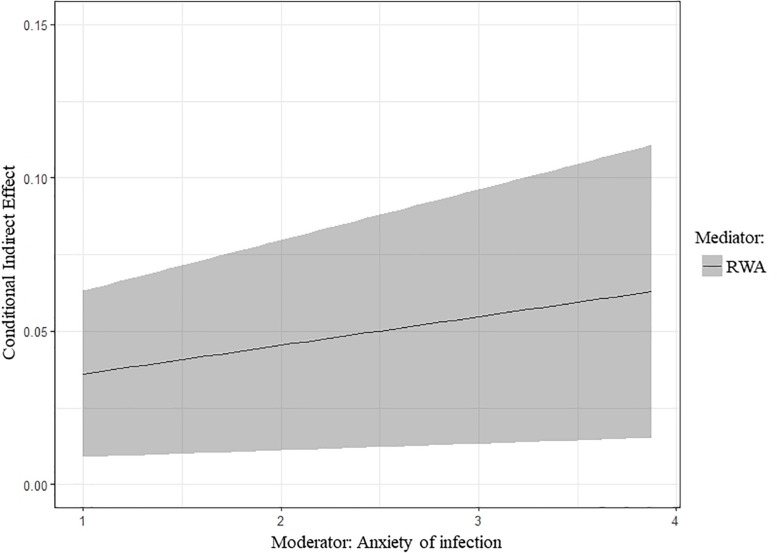
During the first phase of the COVID-19 outbreak, Italy experienced problems of public order and maladjusted behavior. This study assessed the role of negative affectivity, right-wing authoritarianism, and anxiety of COVID-19 infection in explaining a variety of the maladjusted behaviors (i.e., "China-phobic" discrimination, panic buying) observed with an Italian sample. Specifically, we examined the effect of Negative Affectivity and Right-Wing Authoritarianism on maladjusted behaviors, and the moderating role of anxiety of infection. Seven hundred and fifty-seven Italian participants completed an online survey between March 3rd to the 7th 2020, which was immediately before the lockdown. A moderated-mediation model was tested using a structural equation modeling approach. Results indicated that both Negative Affectivity and Right-Wing Authoritarianism were positively associated with COVID-19-related maladjusted behavior, and that Right-Wing Authoritarianism mediated the relationship between Negative Affectivity and maladjusted behavior. Furthermore, the effect of Right-Wing Authoritarianism on maladjusted behavior was greater for those with high anxiety of infection, and the indirect effect of Negative Affectivity on maladjusted behavior through Right-Wing Authoritarianism was moderated by infection anxiety. Findings highlight potential psychological paths that may inform communication strategies and public health initiatives aimed at promoting healthy behavior during an outbreak.
Keywords: COVID-19 outbreak; anxiety of infection; maladjusted behavior; negative affectivity; pandemic; right-wing authoritarianism.
Copyright © 2021 Bochicchio, Winsler, Pagliaro, Pacilli, Dolce and Scandurra.
Conflict of interest statement
The authors declare that the research was conducted in the absence of any commercial or financial relationships that could be construed as a potential conflict of interest.
Figures
References
-
- Adorno T., Frenkel-Brenswik E., Levinson D. J., Sanford R. N. (2019). The Authoritarian Personality. New York, NY: Verso Books. (Original work published 1950).
-
- Altemeyer B. (1981). Right-Wing Authoritarianism. Winnipeg: The University of Manitoba Press.
-
- Altemeyer B. (1988). Enemies of Freedom. San Francisco, CA: Jossey-Bass.
-
- Altemeyer B. (1996). The Authoritarian Specter. Cambridge: Harvard University Press.
LinkOut - more resources
Full Text Sources
Other Literature Sources
