


Fusarium Head Blight From a Microbiome Perspective
- PMID: 33732223
- PMCID: PMC7956947
- DOI: 10.3389/fmicb.2021.628373
Fusarium Head Blight From a Microbiome Perspective
Abstract
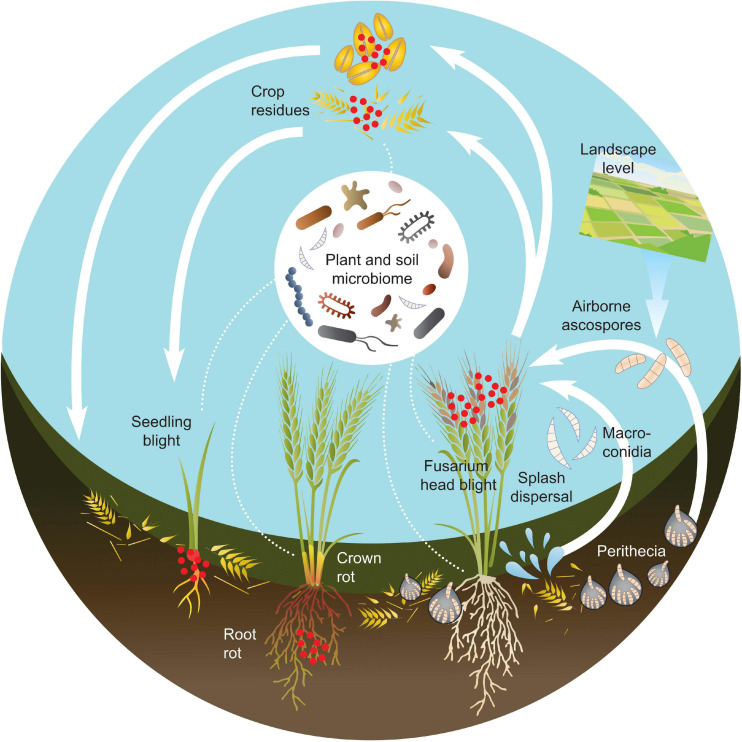
The fungal genus Fusarium causes several diseases in cereals, including Fusarium head blight (FHB). A number of Fusarium species are involved in disease development and mycotoxin contamination. Lately, the importance of interactions between plant pathogens and the plant microbiome has been increasingly recognized. In this review, we address the significance of the cereal microbiome for the development of Fusarium-related diseases. Fusarium fungi may interact with the host microbiome at multiple stages during their life cycles and in different plant organs including roots, stems, leaves, heads, and crop residues. There are interactions between Fusarium and other fungi and bacteria as well as among Fusarium species. Recent studies have provided a map of the cereal microbiome and revealed how different biotic and abiotic factors drive microbiome assembly. This review synthesizes the current understanding of the cereal microbiome and the implications for Fusarium infection, FHB development, disease control, and mycotoxin contamination. Although annual and regional variations in predominant species are significant, much research has focused on Fusarium graminearum. Surveying the total Fusarium community in environmental samples is now facilitated with novel metabarcoding methods. Further, infection with multiple Fusarium species has been shown to affect disease severity and mycotoxin contamination. A better mechanistic understanding of such multiple infections is necessary to be able to predict the outcome in terms of disease development and mycotoxin production. The knowledge on the composition of the cereal microbiome under different environmental and agricultural conditions is growing. Future studies are needed to clearly link microbiome structure to Fusarium suppression in order to develop novel disease management strategies for example based on conservation biological control approaches.
Keywords: Fusarium crown rot (FCR); Fusarium head blight (FHB); cereals; pathogen–microbe interactions; pathogen–pathogen interactions; scab.
Copyright © 2021 Karlsson, Persson and Friberg.
Conflict of interest statement
The authors declare that the research was conducted in the absence of any commercial or financial relationships that could be construed as a potential conflict of interest.
Figures
References
-
- Aamot H. U., Ward T. J., Brodal G., Vrålstad T., Larsen G. B., Klemsdal S. S., et al. (2015). Genetic and phenotypic diversity within the Fusarium graminearum species complex in Norway. Eur. J. Plant Pathol. 142 501–519. 10.1007/s10658-015-0629-4 - DOI
-
- Beccari G., Prodi A., Pisi A., Nipoti P., Onofri A., Nicholson P., et al. (2018a). Development of three Fusarium crown rot causal agents and systemic translocation of deoxynivalenol following stem base infection of soft wheat. Plant Pathol. 67 1055–1065. 10.1111/ppa.12821 - DOI
Publication types
LinkOut - more resources
Full Text Sources
Other Literature Sources
