


The Role of CXCL13 in Antibody Responses to HIV-1 Infection and Vaccination
- PMID: 33732259
- PMCID: PMC7959754
- DOI: 10.3389/fimmu.2021.638872
The Role of CXCL13 in Antibody Responses to HIV-1 Infection and Vaccination
Abstract
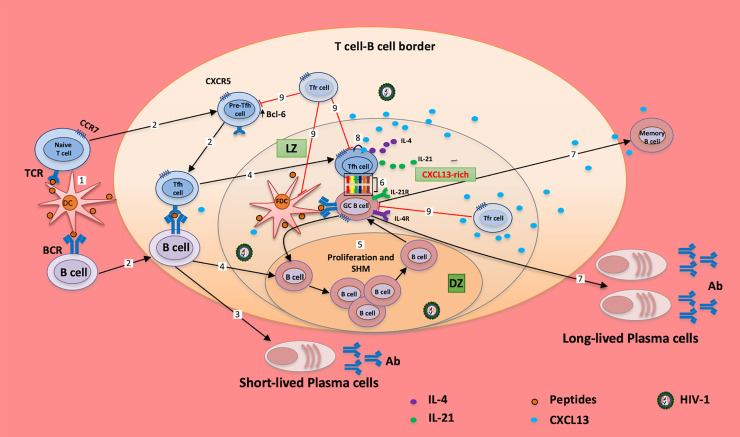
CXCL13 signals through the G protein-coupled chemokine receptor CXCR5 to drive development of secondary lymphoid tissue as well as B cell and Tfh cell trafficking to germinal centers (GC), which leads to the differentiation of B cells to plasma cells and memory B cells. CXCL13 has been proposed as a general plasma biomarker for GC activities. In HIV-1 infected individuals, plasma CXCL13 levels have been associated with the rate of disease progression to AIDS. Moreover, CXCL13 production has been reported to be increased in HIV-1-infected lymph nodes, which may drive increased downregulation of CXCR5. In this review, we address the role of CXCL13 in HIV-1 infected individuals with regard to GC formation, generation of broadly neutralizing antibodies after infection and vaccination, and AIDS-related B cell lymphoma.
Keywords: CXCL13; CXCR5; HIV-1; broadly neutralizing antibodies; vaccine.
Copyright © 2021 Bekele Feyissa, Chiodi, Sui and Berzofsky.
Conflict of interest statement
The authors declare that the research was conducted in the absence of any commercial or financial relationships that could be construed as a potential conflict of interest.
Figures
References
Publication types
MeSH terms
Substances
LinkOut - more resources
Full Text Sources
Other Literature Sources
Medical
Miscellaneous
