. 2021 Feb 26:9:641629.
doi: 10.3389/fcell.2021.641629. eCollection 2021.

Dysregulation of miR-138-5p/RPS6KA1-AP2M1 Is Associated With Poor Prognosis in AML

Affiliations

Dysregulation of miR-138-5p/RPS6KA1-AP2M1 Is Associated With Poor Prognosis in AML

Dong-Hu Yu et al. Front Cell Dev Biol. .

Abstract

Acute myeloid leukemia (AML) is a malignant disease of hematopoietic stem/progenitor cells, and most AML patients are in a severe state. Internal tandem duplication mutations in FLT3 gene (FLT3-ITD) detected in AML stem cells account for 20-30 percent of AML patients. In this study, we attempted to study the impact of the interaction of FLT3-ITD mutation and the CXCL12/CXCR4 axis in AML, and the possible mechanisms caused by the impact by bioinformatics. Gene set variation analysis (GSVA) revealed that the PI3K-Akt-mTOR pathway positively correlated with the status of FLT3-ITD mutation. Multiple survival analyses were performed on TCGA-AML to screen the prognostic-related genes, and RPS6KA1 and AP2M1 are powerful prognostic candidates for overall survival in AML. WGCNA, KEGG/GO analysis, and the functional roles of RPS6KA1 and AP2M1 in AML were clarified by correlation analysis. We found that the expression levels of RPS6KA1 and AP2M1 were significantly associated with chemoresistance of AML, and the CXCL12/CXCR4 axis would regulate RPS6KA1/AP2M1 expression. Besides, miR-138-5p, regulated by the CXCL12/CXCR4 axis, was the common miRNA target of RPS6KA1 and AP2M1. Taken together, the interaction of FLT3-ITD mutation and the CXCL12/CXCR4 axis activated the PI3K-Akt-mTOR pathway, and the increased expression of RPS6KA1 and AP2M1 caused by hsa-miR-138-5p downregulation regulates the multi-resistance gene expression leading to drug indications.

Keywords: AP2M1; GSVA; PI3K-Akt-mTOR pathway; RPS6KA1; WGCNA; acute myeloid leukemia; chemoresistance; prognosis.


Conflict of interest statement

The authors declare that the research was conducted in the absence of any commercial or financial relationships that could be construed as a potential conflict of interest.

Figures

FIGURE 1
FIGURE 1
Flowchart of data processing and analysis.
FIGURE 2
FIGURE 2
The PI3K–AKT–mTOR pathway is significantly activated in the AML patients with FLT3-ITD mutation. (A) GSVA of the GSE6891 dataset. (B) GSVA of the GSE10358 dataset. (C) GSVA of the GSE15434 dataset. (D) GSVA of the GSE61804 dataset. (E) Venn diagram of the activated gene sets in the indicated datasets. (F) Venn diagram of the suppressed gene sets in the indicated datasets. (G) KM survival analysis of the FLT3-ITD-positive group and FLT3-ITD-positive group in GSE76004. (H) Differences in immune score between AML patients with FLT3-ITD-positive and FLT3-ITD-negative. (I) Differences in tumor purity between AML patients with FLT3-ITD-positive and FLT3-ITD-negative. (J) Differences in estimate score between AML patients with FLT3-ITD-positive and FLT3-ITD-negative.
FIGURE 3
FIGURE 3
Identification of prognostic markers in TCGA-AML. (A) Forest map of the genes related to AML survival, analyzed by univariate Cox regression. (B) A coefficient distribution map for a logarithmic (λ) sequence by LASSO. (C) Selecting the best parameters for AML in the LASSO model (λ). (D) Forest map of the genes related to AML survival, analyzed by multivariate Cox regression. (E) The comprehensive effects of the mutational status of FLT3 and the expression levels of CALR in the UALCAN database. (F) The comprehensive effects of mutational status of FLT3 and the expression levels of RPS6KA1 in the UALCAN database. (G) The comprehensive effects of mutational status of FLT3 and the expression levels of AP2M1 in the UALCAN database.
FIGURE 4
FIGURE 4
Identification of the module-related chemotherapy resistance in AML by WGCNA. (A) Analysis of the scale-free fit index for various soft-thresholding powers. (B) Analysis of the mean connectivity for various soft-thresholding powers. (C) Heat map of the eigengene adjacency. (D) Heat map of the correlation between co-expressed gene module eigengenes and clinical traits of AML. (E) KEGG pathway enrichment of the genes in the green module. (F) Function analysis for the gene RPS6KA1 by guilt of association. (G) Function analysis for the gene AP2M1 by guilt of association.
FIGURE 5
FIGURE 5
The relationship between RPS6KA1/AP2M1 expression levels and chemotherapy effects of AML patients. (A) Sensitivity analysis of doxorubicin in patients with RPS6KA1 high and low expression levels in TCGA-AML. (B) Sensitivity analysis of etoposide in patients with RPS6KA1 high and low expression levels in TCGA-AML. (C) Sensitivity analysis of midostaurin in patients with RPS6KA1 high and low expression levels in TCGA-AML. (D) Sensitivity analysis of doxorubicin in patients with AP2M1 high and low expression levels in TCGA-AML. (E) Sensitivity analysis of etoposide in patients with AP2M1 high and low expression levels in TCGA-AML. (F) Sensitivity analysis of midostaurin in patients with AP2M1 high and low expression levels in TCGA-AML. (G) Analysis of relative expression of RPS6KA1 in the resistance group and sensitive group from GSE106291. (H) Analysis of relative expression of AP2M1 in the resistance group and sensitive group from GSE106291. (I) Correlations between RPS6KA1 and GSTP1, between RPS6KA1 and SLC29A1 from TCGA-AML. (J) Correlations between AP2M1 and ABCG2, between AP2M1 and ABCC4, and between AP2M1 and GSTP1 from TCGA-AML. (K) A gene network of RPS6KA1 and AP2M1 with common enzymes and transcription factors by GenCLiP 3.0. *p < 0.05; ***p < 0.001.
FIGURE 6
FIGURE 6
The relationship between the expression level of RPS6KA1/AP2M1 and leukemia stem cells. (A) The relative expression of RPS6KA1 in four different groups based on CD34± and CD38± from GSE76008. (B) The relative expression of AP2M1 in four different groups based on CD34± and CD38± from GSE76008. (C) The relative expression of RPS6KA1 in the high LSC-score group and low LSC-score group. (D) The relative expression of AP2M1 in the high LSC-score group and low LSC-score group. (E) Gene expression correlation of RPS6KA1 and KAT7 from GEPIA. (F) Gene expression correlation of AP2M1 and KAT7 from GEPIA.
FIGURE 7
FIGURE 7
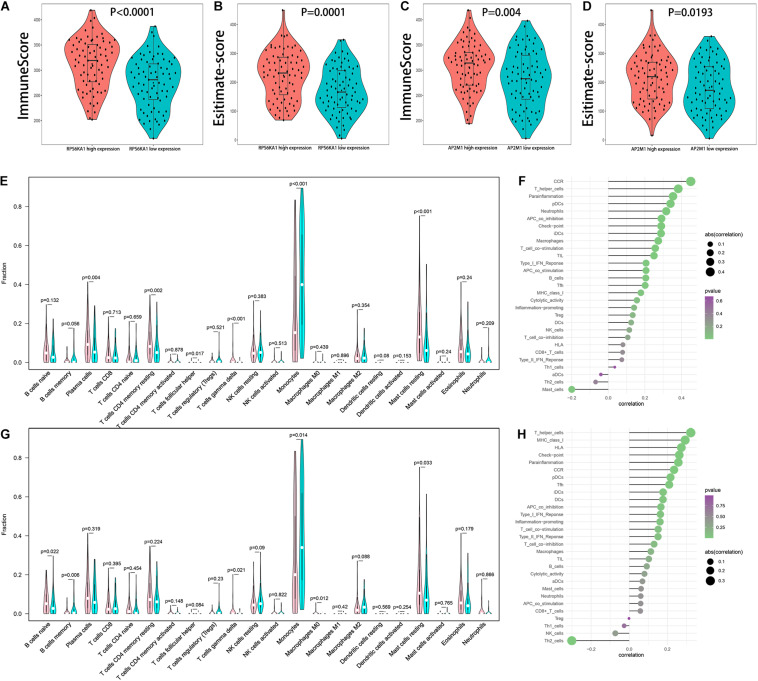
Relationship between RPS6KA1/AP2M1 and immune microenvironment in AML. (A) Differences in immune score between AML patients with RPS6KA1 high expression and RPS6KA1 low expression. (B) Differences in estimate score between AML patients with RPS6KA1 high expression and RPS6KA1 low expression. (C) Differences in immune score between AML patients with AP2M1 high expression and AP2M1 low expression. (D) Differences in estimate score between AML patients with AP2M1 high expression and AP2M1 low expression. (E) The comparison of immune infiltration level between the RPS6KA1 high expression group and RPS6KA1 low expression group based on CIBERSORT. (F) Correlation between RPS6KA1 and immune-infiltrating cells based on the ssGSEA approach. (G) The comparison of immune infiltration level between the AP2M1 high expression group and RPS6KA1 low expression group based on CIBERSORT. (H) Correlation between AP2M1 and immune-infiltrating cells based on the ssGSEA approach.
FIGURE 8
FIGURE 8
Mechanisms involved in dysregulation of RPS6KA1/AP2M1 expression. (A) Gene expression correlation of RPS6KA1 and CXCR4 from GEPIA. (B) Gene expression correlation of AP2M1 and CXCR4 from GEPIA. (C) Gene expression correlation of RPS6KA1 and AP2M1 from GEPIA. (D) The relative expression of RPS6KA1 in the control group and CXCR4 inhibitor group from GSE64623. (E) The relative expression of AP2M1 in the control group and CXCR4 inhibitor group from GSE64623. (F) Identification of the common targeted miRNAs of RPS6KA1 and AP2M1 from microT-CDS and TargetScan. (G) Correlation between RPS6KA1 expression and functional states of hypoxia based on CancerSEA. (H) Correlation between AP2M1 expression and functional states of differentiation based on CancerSEA. (I) Correlation between AP2M1 expression and functional states of metastasis based on CancerSEA.
FIGURE 9
FIGURE 9
miR-138-5p plays an important role in AML chemoresistance, as an intermediate molecule. (A) Heat map of differentially expressed miRNAs in different groups. (B) The intersection of differentially expressed miRNAs with SDF-1 α downregulation and POL6326 upregulation, which is regulated by the CXCL12/CXCR4 axis. (C) Model of the miR-138-5p/RPS6KA1-AP2M1 network and its expression and potential roles in AML chemoresistance.

References

    1. Bai X., Shao J., Zhou S., Zhao Z., Li F., Xiang R., et al. (2019). Inhibition of lung cancer growth and metastasis by DHA and its metabolite, RvD1, through miR-138-5p/FOXC1 pathway. J. Exp. Clin. Cancer Res 38:479. 10.1186/s13046-019-1478-1473 - DOI - PMC - PubMed
    1. Bertacchini J., Guida M., Accordi B., Mediani L., Martelli A. M., Barozzi P., et al. (2014). Feedbacks and adaptive capabilities of the PI3K/Akt/mTOR axis in acute myeloid leukemia revealed by pathway selective inhibition and phosphoproteome analysis. Leukemia 28 2197–2205. 10.1038/leu.2014.123 - DOI - PubMed
    1. Bertacchini J., Heidari N., Mediani L., Capitani S., Shahjahani M., Ahmadzadeh A., et al. (2015). Targeting PI3K/AKT/mTOR network for treatment of leukemia. Cell. Mol. Life Sci. 72 2337–2347. 10.1007/s00018-015-1867-1865 - DOI - PMC - PubMed
    1. Cai S. F., Levine R. L. (2019). Genetic and epigenetic determinants of AML pathogenesis. Sem. Hematol. 56 84–89. 10.1053/j.seminhematol.2018.08.001 - DOI - PMC - PubMed
    1. Cao L., Zhang W., Liu X., Yang P., Wang J., Hu K., et al. (2019a). The Prognostic Significance of PDE7B in Cytogenetically Normal Acute Myeloid Leukemia. Sci. Rep. 9:16991. 10.1038/s41598-019-53563-x - DOI - PMC - PubMed

LinkOut - more resources