


Ustekinumab in Crohn's disease: Real-world outcomes from the Sicilian network for inflammatory bowel diseases
- PMID: 33732883
- PMCID: PMC7936616
- DOI: 10.1002/jgh3.12502
Ustekinumab in Crohn's disease: Real-world outcomes from the Sicilian network for inflammatory bowel diseases
Abstract
Background and aim: Ustekinumab is approved in Europe for the treatment of moderate to severe Crohn's disease (CD). Italian real-life data are scarce, so the aim of this study was to assess the effectiveness and safety of ustekinumab in an Italian cohort of CD patients.
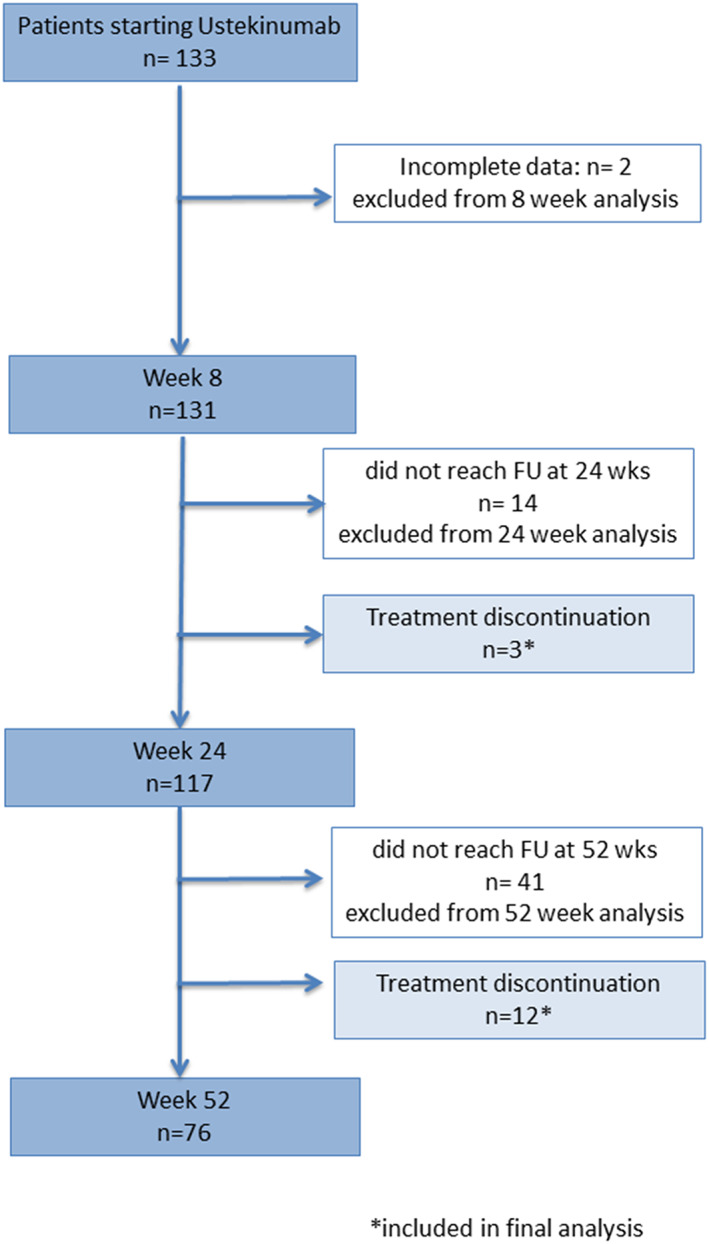
Methods: Data of patients with CD who started using ustekinumab were extracted from the cohort of the Sicilian Network for Inflammatory Bowel Disease. Primary end-points were steroid-free clinical remission at 8, 24, and 52 weeks of therapy and reduction of C-reactive protein. Secondary end-points were treatment response, treatment persistence at 12 months, and safety.
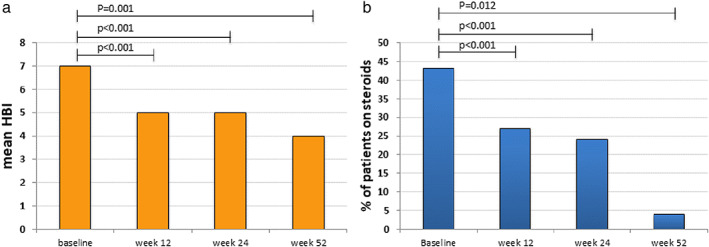
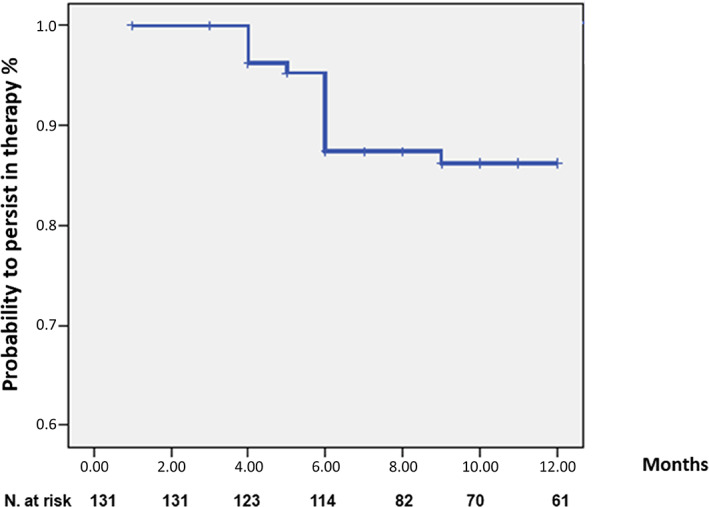
Results: A total of 131 patients (males 56%; mean age 46 years ±15) were included. All patients were biologics experienced except for one. At 24 and 52 weeks, 40% and 43% of patients achieved steroid-free clinical remission, and 64% and 62% had clinical response, respectively. At the end of follow-up, there was a significant reduction of steroid use (P = 0.012) and of the Harvey-Bradshaw Index (P = 0.001). The probability of persistence in therapy with ustekinumab after 12 months of treatment was 89%. The only factor associated with discontinuation was older age.
Conclusions: Data from our real-life cohort of treatment-refractory CD patients suggest the satisfactory effectiveness and safety profile of ustekinumab.
Keywords: anti‐interleukin‐12/23; efficacy; persistence; safety.
© 2021 The Authors. JGH Open: An open access journal of gastroenterology and hepatology published by Journal of Gastroenterology and Hepatology Foundation and John Wiley & Sons Australia, Ltd.
Figures
References
-
- Hanauer SB, Feagan BG, Lichtenstein GR et al. Maintenance infliximab for Crohn's disease: the ACCENT I randomised trial. Lancet. 2002; 359: 1541–9. - PubMed
-
- Sandborn WJ, Feagan BG, Rutgeerts P et al. Vedolizumab as induction and maintenance therapy for Crohn's disease. N. Engl. J. Med. 2013; 369: 711–21. - PubMed
-
- Sandborn WJ, Gasink C, Gao LL et al. Ustekinumab induction and maintenance therapy in refractory Crohn's disease. N. Engl. J. Med. 2012; 367: 1519–28. - PubMed
-
- Sandborn WJ, Feagan BG, Fedorak RN et al. A randomized trial of Ustekinumab, a human interleukin‐12/23 monoclonal antibody, in patients with moderate‐to‐severe Crohn's disease. Gastroenterology. 2008; 135: 1130–41. - PubMed
LinkOut - more resources
Full Text Sources
Other Literature Sources
Medical
Research Materials
