


Vasopressin V1B Receptor Antagonists as Potential Antidepressants
- PMID: 33733667
- PMCID: PMC8278797
- DOI: 10.1093/ijnp/pyab013
Vasopressin V1B Receptor Antagonists as Potential Antidepressants
Abstract
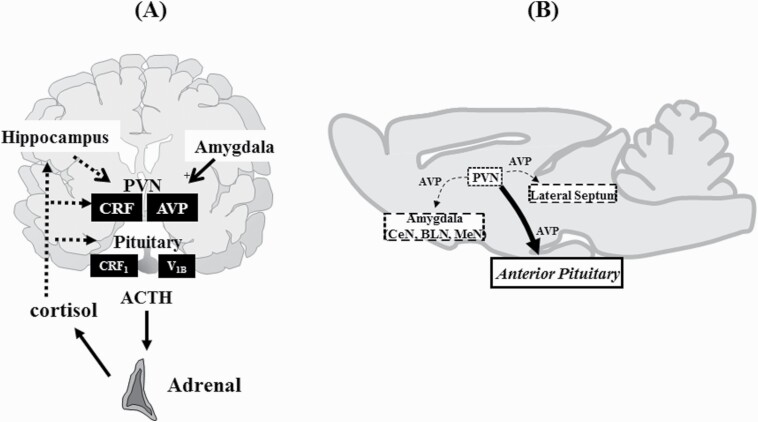
Accumulating evidence shows that certain populations of depressed patients have impaired hypothalamus-pituitary-adrenal (HPA) axis function. Arginine-vasopressin (AVP) is one of the primary factors in HPA axis regulation under stress situations, and AVP and its receptor subtype (V1B receptor) play a pivotal role in HPA axis abnormalities observed in depression. Based on this hypothesis, several non-peptide V1B receptor antagonists have been synthesized, and the efficacies of some V1B receptor antagonists have been investigated in both animals and humans. V1B receptor antagonists exert antidepressant-like effects in several animal models at doses that attenuate the hyperactivity of the HPA axis, and some of their detailed mechanisms have been delineated. These results obtained in animal models were, at least partly, reproduced in clinical trials. At least 2 V1B receptor antagonists (TS-121 and ABT-436) showed tendencies to reduce the depression scores of patients with major depressive disorder at doses that attenuate HPA axis hyperactivity or block the pituitary V1B receptor. Importantly, TS-121 showed a clearer efficacy for patients with higher basal cortisol levels than for those with lower basal cortisol levels, which was consistent with the hypothesis that V1B receptor antagonists may be more effective for patients with HPA axis hyperactivity. Therefore, V1B receptor antagonists are promising approaches for the treatment of depression involving HPA axis impairment such as depression.
Keywords: ABT-436; SSR149415; TS-121; V1B receptor antagonist; hypothalamus-pituitary-adrenal axis.
© The Author(s) 2021. Published by Oxford University Press on behalf of CINP.
Figures

References
-
- Abelson JL, Le Mellédo J, Bichet DG (2001) Dose response of arginine vasopressin to the CCK-B agonist pentagastrin. Neuropsychopharmacology 24:161–169. - PubMed
-
- Aguilera G, Rabadan-Diehl C (2000) Vasopressinergic regulation of the hypothalamic-pituitary-adrenal axis: implications for stress adaptation. Regul Pept 96:23–29. - PubMed
-
- Allaman-Exertier G, Reymond-Marron I, Tribollet E, Raggenbass M (2007) Vasopressin modulates lateral septal network activity via two distinct electrophysiological mechanisms. Eur J Neurosci 26:2633–2642. - PubMed
-
- Alonso R, Griebel G, Pavone G, Stemmelin J, Le Fur G, Soubrié P (2004) Blockade of CRF(1) or V(1b) receptors reverses stress-induced suppression of neurogenesis in a mouse model of depression. Mol Psychiatry 9:278–286; 224. - PubMed
-
- Altemus M, Pigott T, Kalogeras KT, Demitrack M, Dubbert B, Murphy DL, Gold PW (1992) Abnormalities in the regulation of vasopressin and corticotropin releasing factor secretion in obsessive-compulsive disorder. Arch Gen Psychiatry 49:9–20. - PubMed
Publication types
MeSH terms
Substances
LinkOut - more resources
Full Text Sources
Other Literature Sources
Medical
Miscellaneous
