


A prenatal programming perspective on the intergenerational transmission of maternal adverse childhood experiences to offspring health problems
- PMID: 33734799
- PMCID: PMC7995605
- DOI: 10.1037/amp0000762
A prenatal programming perspective on the intergenerational transmission of maternal adverse childhood experiences to offspring health problems
Abstract
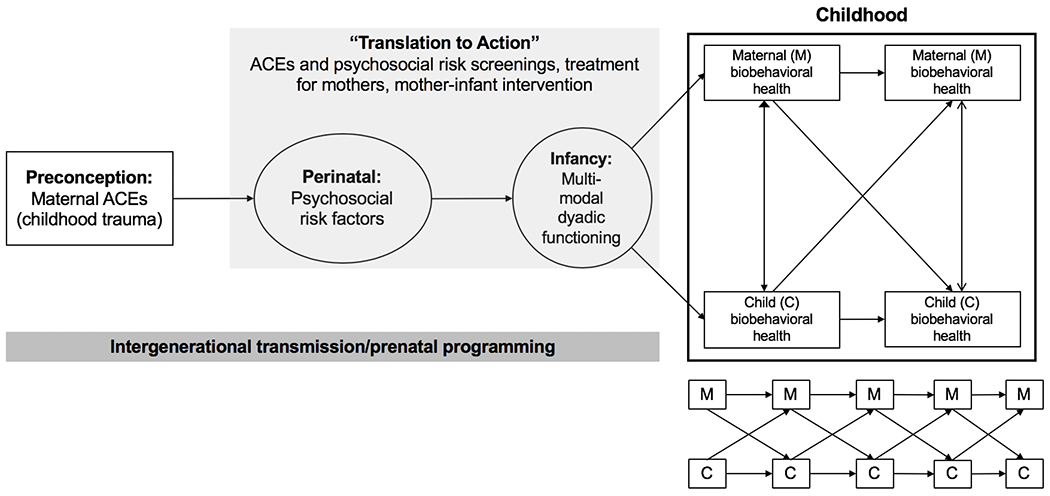
Decades of research indicate that individuals exposed to childhood adversity are at risk for poor physical and mental health across their life span. More recently, intergenerational transmission of trauma and prenatal programming frameworks suggest an even longer reach for adverse childhood experiences (ACEs), with consequences that extend to subsequent generations. Beyond the individual-level consequences typically observed by empirical studies of ACEs, mothers' experiences of early adversity may also compromise the maternal-child dyadic relationship. We propose a conceptual model whereby mothers' ACEs impact maternal-infant dyadic functioning and later biobehavioral health outcomes through heightened perinatal psychosocial risk. We provide support for the proposed paths and mechanistic processes in our model with data drawn from Las Madres Nuevas, a longitudinal study of low-income Mexican-origin families who participated in a series of home and laboratory visits from the prenatal period through early childhood. Higher ACEs exposure among Las Madres Nuevas participants was associated with numerous perinatal psychosocial risk factors, which predicted poorer mother-infant dyadic functioning. Compromised dyadic functioning during infancy was associated with later maternal mental health and child behavior problems. We conclude with discussion of prevention and treatment strategies that can buffer against proposed risk pathways, including perinatal assessment of maternal ACEs and psychosocial risk, perinatal treatment of maternal distress, and mother-infant therapy in the postpartum period. It is our hope that the proposed conceptual model will serve as a guide for future research to examine the lasting consequences of childhood adversities within and across generations among high-risk populations. (PsycInfo Database Record (c) 2021 APA, all rights reserved).
Conflict of interest statement
Figures
References
-
- American College of Obstetricians and Gynecologists. (2018). ACOG committee opinion no. 736: optimizing postpartum care. Obstetrics and Gynecology, 131(5), e140–e150. - PubMed
-
- Ångerud K, Annerbäck EM, Tydén T, Boddeti S, & Kristiansson P (2018). Adverse childhood experiences and depressive symptomatology among pregnant women. Acta Obstetricia et Gynecologica Scandinavica, 97(6), 701–708. - PubMed
-
- Baker CE, Brooks-Gunn J, & Gouskova N (2019). Reciprocal relations between maternal depression and child behavior problems in families served by Head Start. Child Development. - PubMed
-
- Bronfenbrenner U, & Morris PA (1998). The ecology of developmental processes. In Damon W & Lerner RM (Eds.), Handbook of child psychology: Theoretical models of human development (p. 993–1028). John Wiley & Sons Inc.
Publication types
MeSH terms
Grants and funding
LinkOut - more resources
Full Text Sources
Other Literature Sources
Medical