Update on the genetic risk for thoracic aortic aneurysms and acute aortic dissections: implications for clinical care
- PMID: 33736427
- PMCID: PMC8513124
- DOI: 10.23736/S0021-9509.21.11816-6
Update on the genetic risk for thoracic aortic aneurysms and acute aortic dissections: implications for clinical care
Abstract
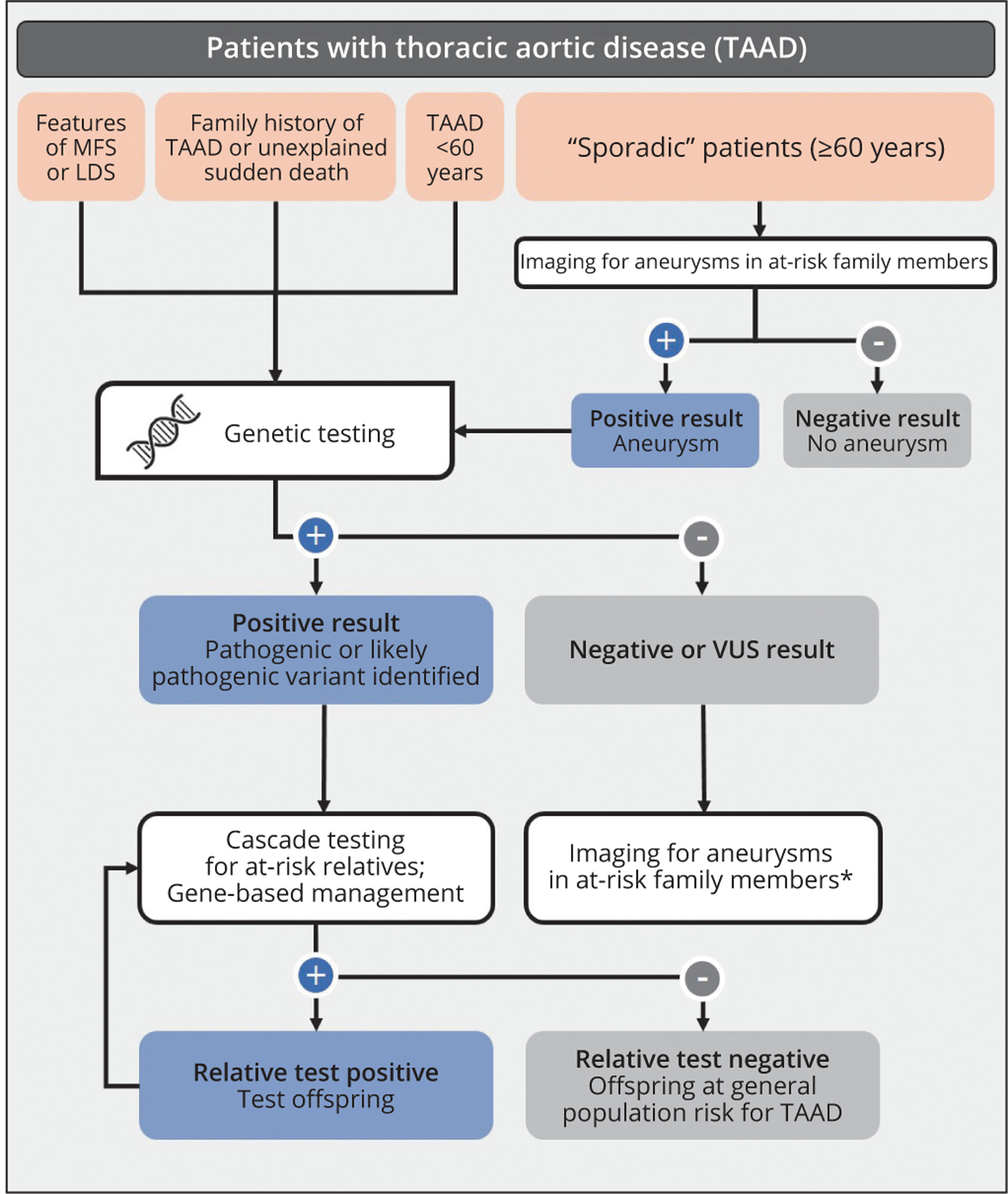
Genetic variation plays a significant role in predisposing individuals to thoracic aortic aneurysms and dissections. Advances in genomic research have led to the discovery of 11 genes validated to cause heritable thoracic aortic disease (HTAD). Identifying the pathogenic variants responsible for aortic disease in affected patients confers substantial clinical utility by establishing a definitive diagnosis to inform tailored treatment and management, and enables identification of at-risk relatives to prevent downstream morbidity and mortality. The availability and access to clinical genetic testing has improved dramatically such that genetic testing is considered an integral part of the clinical evaluation for patients with thoracic aortic disease. This review provides an update on our current understanding of the genetic basis of thoracic aortic disease, practical recommendations for genetic testing, and clinical implications.
Conflict of interest statement
Figures
References
-
- Hiratzka LF, Bakris GL, Beckman JA, Bersin RM, Carr VF, Casey DE Jr, et al.; American College of Cardiology Foundation/American Heart Association Task Force on Practice Guidelines; American Association for Thoracic Surgery; American College of Radiology; American Stroke Association; Society of Cardiovascular Anesthesiologists; Society for Cardiovascular Angiography and Interventions; Society of Interventional Radiology; Society of Thoracic Surgeons; Society for Vascular Medicine. 2010 ACCF/AHA/AATS/ACR/ASA/SCA/SCAI/SIR/STS/SVM guidelines for the diagnosis and management of patients with Thoracic Aortic Disease: a report of the American College of Cardiology Foundation/American Heart Association Task Force on Practice Guidelines, American Association for Thoracic Surgery, American College of Radiology, American Stroke Association, Society of Cardiovascular Anesthesiologists, Society for Cardiovascular Angiography and Interventions, Society of Interventional Radiology, Society of Thoracic Surgeons, and Society for Vascular Medicine. Circulation 2010;121:e266–369. - PubMed
-
- Pape LA, Tsai TT, Isselbacher EM, Oh JK, O’gara PT, Evangelista A, et al.; International Registry of Acute Aortic Dissection (IRAD) Investigators. Aortic diameter >or = 5.5 cm is not a good predictor of type A aortic dissection: observations from the International Registry of Acute Aortic Dissection (IRAD). Circulation 2007;116:1120–7. - PubMed
-
- Biddinger A, Rocklin M, Coselli J, Milewicz DM. Familial thoracic aortic dilatations and dissections: a case control study. J Vasc Surg 1997;25:506–11. - PubMed
-
- Albornoz G, Coady MA, Roberts M, Davies RR, Tranquilli M, Riz-zo JA, et al. Familial thoracic aortic aneurysms and dissections—incidence, modes of inheritance, and phenotypic patterns. Ann Thorac Surg 2006;82:1400–5. - PubMed
-
- Milewicz DM, Chen H, Park ES, Petty EM, Zaghi H, Shashidhar G, et al. Reduced penetrance and variable expressivity of familial thoracic aortic aneurysms/dissections. Am J Cardiol 1998;82:474–9. - PubMed
Publication types
MeSH terms
Grants and funding
LinkOut - more resources
Full Text Sources
Other Literature Sources