


Mesenchymal stem/stromal cells as a valuable source for the treatment of immune-mediated disorders
- PMID: 33736695
- PMCID: PMC7971361
- DOI: 10.1186/s13287-021-02265-1
Mesenchymal stem/stromal cells as a valuable source for the treatment of immune-mediated disorders
Retraction in
-
Retraction Note: Mesenchymal stem/stromal cells as a valuable source for the treatment of immune-mediated disorders.Stem Cell Res Ther. 2024 Apr 22;15(1):110. doi: 10.1186/s13287-024-03733-0. Stem Cell Res Ther. 2024. PMID: 38644488 Free PMC article. No abstract available.
Abstract
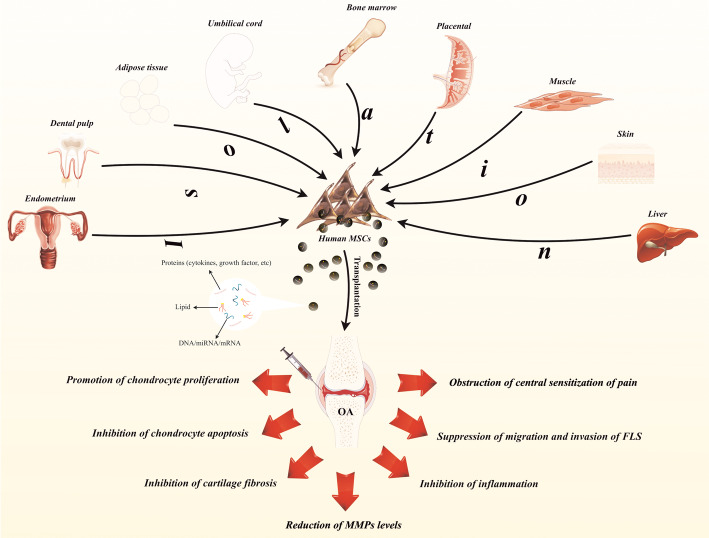
Over recent years, mesenchymal stem/stromal cells (MSCs) and their potential biomedical applications have received much attention from the global scientific community in an increasing manner. Firstly, MSCs were successfully isolated from human bone marrow (BM), but in the next steps, they were also extracted from other sources, mostly from the umbilical cord (UC) and adipose tissue (AT). The International Society for Cellular Therapy (ISCT) has suggested minimum criteria to identify and characterize MSCs as follows: plastic adherence, surface expression of CD73, D90, CD105 in the lack of expression of CD14, CD34, CD45, and human leucocyte antigen-DR (HLA-DR), and also the capability to differentiate to multiple cell types including adipocyte, chondrocyte, or osteoblast in vitro depends on culture conditions. However, these distinct properties, including self-renewability, multipotency, and easy accessibility are just one side of the coin; another side is their huge secretome which is comprised of hundreds of mediators, cytokines, and signaling molecules and can effectively modulate the inflammatory responses and control the infiltration process that finally leads to a regulated tissue repair/healing or regeneration process. MSC-mediated immunomodulation is a direct result of a harmonic synergy of MSC-released signaling molecules (i.e., mediators, cytokines, and chemokines), the reaction of immune cells and other target cells to those molecules, and also feedback in the MSC-molecule-target cell axis. These features make MSCs a respectable and eligible therapeutic candidate to be evaluated in immune-mediated disorders, such as graft versus host diseases (GVHD), multiple sclerosis (MS), Crohn's disease (CD), and osteoarthritis (OA), and even in immune-dysregulating infectious diseases such as the novel coronavirus disease 2019 (COVID-19). This paper discussed the therapeutic applications of MSC secretome and its biomedical aspects related to immune-mediated conditions. Sources for MSC extraction, their migration and homing properties, therapeutic molecules released by MSCs, and the pathways and molecular mechanisms possibly involved in the exceptional immunoregulatory competence of MSCs were discussed. Besides, the novel discoveries and recent findings on immunomodulatory plasticity of MSCs, clinical applications, and the methods required for their use as an effective therapeutic option in patients with immune-mediated/immune-dysregulating diseases were highlighted.
Keywords: Coronavirus disease 2019 (COVID-19); Graft versus host diseases (GVHD); Mesenchymal stem/stromal cells (MSCs); Multiple sclerosis (MS); Osteoarthritis (OA).
Conflict of interest statement
There is no conflict of interests.
Figures
References
-
- Ding D-C, Shyu W-C, Lin S-Z. Mesenchymal stem cells. Cell Transplant. 2011;20:5–14. - PubMed
-
- Friedenstein A, Piatetzky-Shapiro I, Petrakova K. Osteogenesis in transplants of bone marrow cells. Development. 1966;16:381–390. - PubMed
-
- Stefańska K, Bryl R, Moncrieff L, Pinto N, Shibli JA, Dyszkiewicz-Konwińska M. Mesenchymal stem cells–a historical overview. Med J Cell Biol. 2020;8:83–87.
-
- Tavakoli S, Ghaderi Jafarbeigloo HR, Shariati A, Jahangiryan A, Jadidi F, Jadidi Kouhbanani MA, Hassanzadeh A, Zamani M, Javidi K, Naimi A. Mesenchymal stromal cells; a new horizon in regenerative medicine. J Cell Physiol. 2020;235:9185–9210. - PubMed
Publication types
MeSH terms
LinkOut - more resources
Full Text Sources
Other Literature Sources
Medical
Research Materials
Miscellaneous
