


Newborns With Neonatal Abstinence Syndrome Are Concentrated in Poorer-Quality Hospitals
- PMID: 33737332
- PMCID: PMC8120655
- DOI: 10.1542/hpeds.2020-003145
Newborns With Neonatal Abstinence Syndrome Are Concentrated in Poorer-Quality Hospitals
Abstract
Objectives: To determine the extent to which newborns with neonatal abstinence syndrome (NAS) are concentrated in some hospitals as compared with newborns without NAS and whether care quality and safety differed among these hospitals. We hypothesized that newborns with NAS would be cared for in poorer-quality hospitals.
Methods: Secondary analysis of 3 2016 data sets: (1) the panel study of effects of changes in nursing on patient outcomes-US survey of hospital registered nurses regarding work conditions and safety, (2) inpatient discharge abstracts, and (3) the American Hospital Association annual survey. Newborns in 266 hospitals from the 4 states where the panel study of effects of changes in nursing on patient outcomes was conducted were included. We used Lorenz curves to determine if newborns with NAS were concentrated in different hospitals than newborns without NAS and whether care quality and safety differed among those hospitals. Quality and safety were assessed by staff nurses by using standard survey questions.
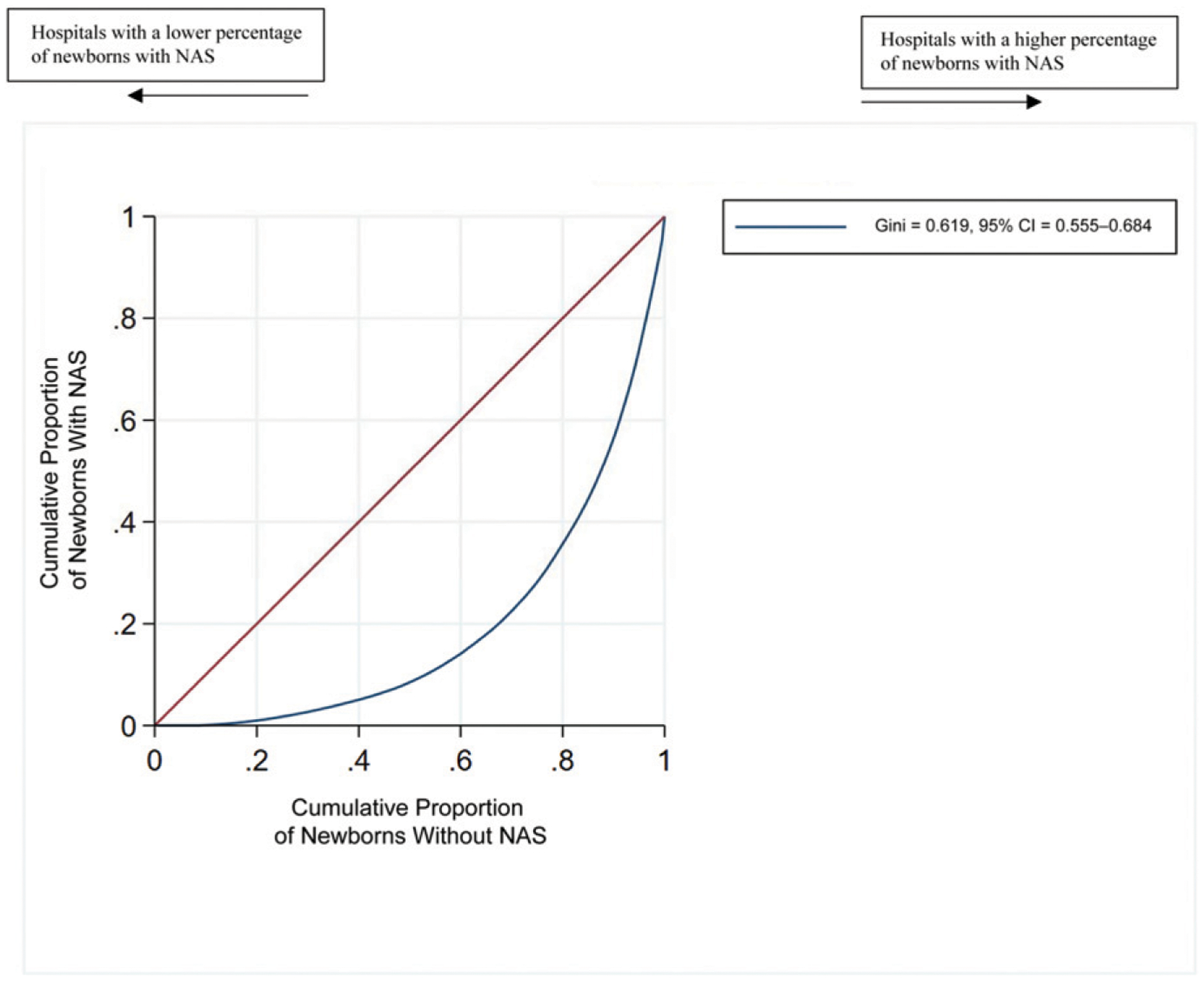
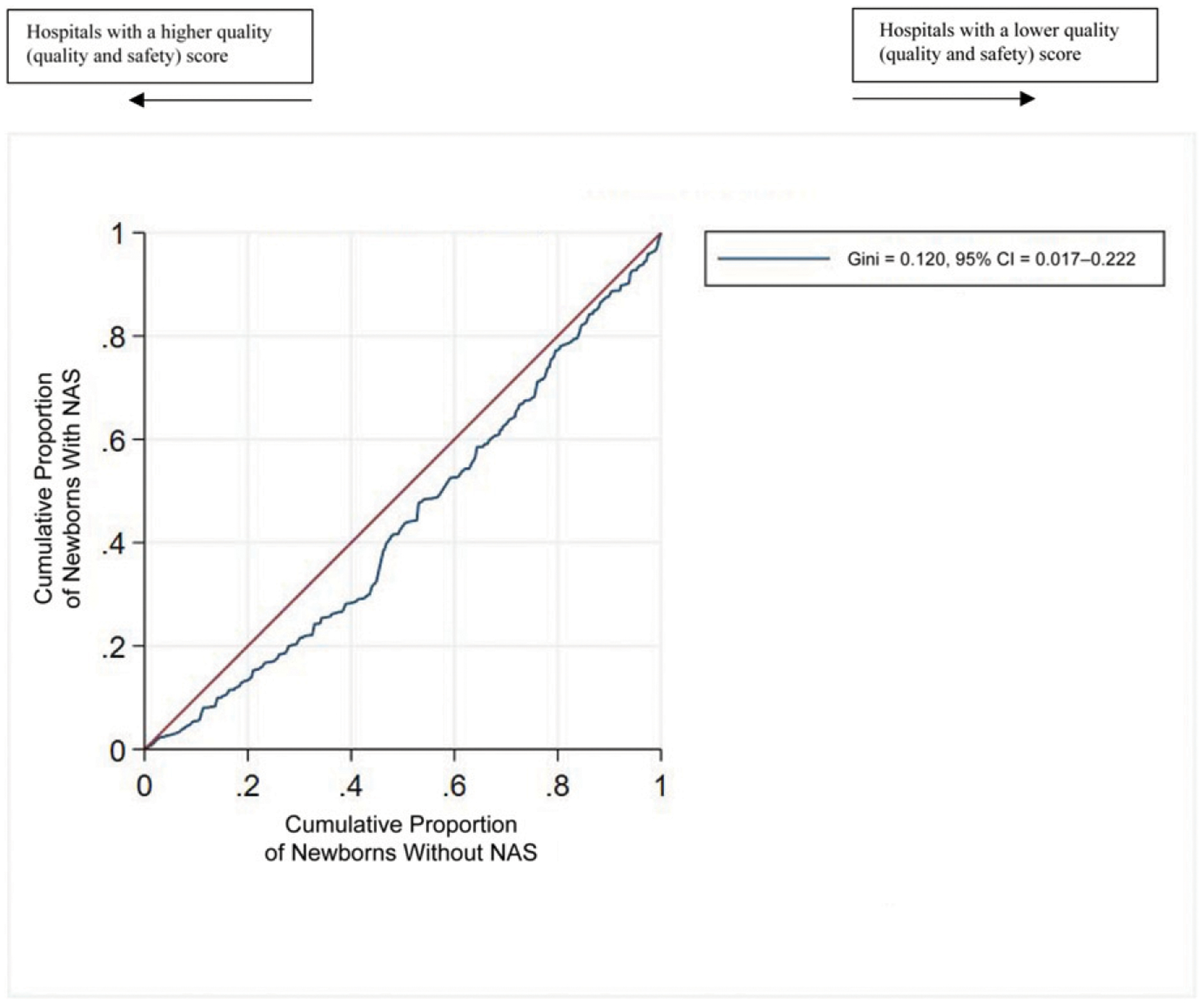
Results: Of the 659 403 newborns in this study, 3130 were diagnosed with noniatrogenic NAS. We found that newborns with NAS were cared for in different hospitals compared with newborns without NAS (Gini coefficient 0.62, 95% confidence interval, 0.56-0.68) and that the hospitals in which they received care were rated as having poorer quality and safety (Gini coefficient 0.12, 95% confidence interval, 0.01-0.23).
Conclusions: Newborns with NAS are cared for in poorer-quality hospitals than other newborns. Our findings are of concern because poorer-quality care is linked to patient outcomes. As stakeholders seek to address the opioid epidemic and improve outcomes of newborns with NAS, our findings suggest the importance of examining hospital factors.
Copyright © 2021 by the American Academy of Pediatrics.
Conflict of interest statement
COMPANION PAPER: A companion to this article can be found online at www.hosspeds.org/cgi/doi/10.1542/hpeds.2020-003863 POTENTIAL CONFLICT OF INTEREST: The authors have indicated they have no potential conflicts of interest to disclose.
Figures
References
-
- Reddy UM, Davis JM, Ren Z, Greene MF; Opioid Use in Pregnancy, Neonatal Abstinence Syndrome, and Childhood Outcomes Workshop Invited Speakers. Opioid use in pregnancy, neonatal abstinence syndrome, and childhood outcomes: executive summary of a Joint Workshop by the Eunice Kennedy Shriver National Institute of Child Health and Human Development, American College of Obstetricians and Gynecologists, American Academy of Pediatrics, Society for Maternal-Fetal Medicine, Centers for Disease Control and Prevention, and the March of Dimes Foundation. Obstet Gynecol. 2017;130(1):10–28 - PMC - PubMed
-
- Ramphul K, Mejias SG, Joynauth J. An update on the burden of neonatal abstinence syndrome in the United States. Hosp Pediatr. 2020;10(2):181–184 - PubMed
-
- Milliren CE, Gupta M, Graham DA, Melvin P, Jorina M, Ozonoff A. Hospital variation in neonatal abstinence syndrome incidence, treatment modalities, resource use, and costs across pediatric hospitals in the United States, 2013 to 2016. Hosp Pediatr. 2018;8(1):15–20 - PubMed
Publication types
MeSH terms
Substances
Grants and funding
LinkOut - more resources
Full Text Sources
Other Literature Sources
Research Materials
