. 2021 Mar 18;11(1):6350.
doi: 10.1038/s41598-021-85788-0.

Metabolomics analysis reveals a modified amino acid metabolism that correlates with altered oxygen homeostasis in COVID-19 patients

Affiliations

Metabolomics analysis reveals a modified amino acid metabolism that correlates with altered oxygen homeostasis in COVID-19 patients

José C Páez-Franco et al. Sci Rep. .

Abstract

We identified the main changes in serum metabolites associated with severe (n = 46) and mild (n = 19) COVID-19 patients by gas chromatography coupled to mass spectrometry. The modified metabolic profiles were associated to an altered amino acid catabolism in hypoxic conditions. Noteworthy, three α-hydroxyl acids of amino acid origin increased with disease severity and correlated with altered oxygen saturation levels and clinical markers of lung damage. We hypothesize that the enzymatic conversion of α-keto-acids to α- hydroxyl-acids helps to maintain NAD recycling in patients with altered oxygen levels, highlighting the potential relevance of amino acid supplementation during SARS-CoV-2 infection.


Conflict of interest statement

The authors declare no competing interests.

Figures
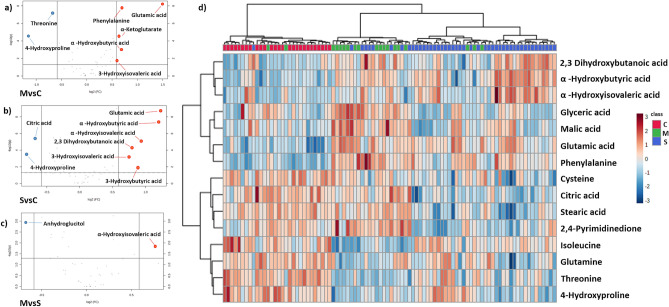
Figure 1
Figure 1
Changes in serum metabolites of controls vs COVID-19 patients. Volcano plots of metabolites that increase (red) or decrease (blue) in (a) mild COVID-19 versus controls, (b) severe COVID-19 vs controls and (c) severe versus mild COVID-19. Cut off fold change > 0.5, p value < 0.05. (d) Heatmap visualization and clustering analysis of differential metabolites among controls (C), mild (M) and severe (S) COVID-19 patients. Only the 15 metabolites with the lowest p values (by ANOVA) are shown.
Figure 2
Figure 2
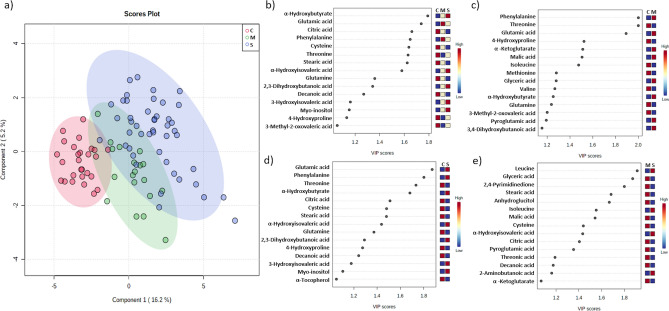
Partial least squares-discriminate analysis (PLS-DA) plot of differential metabolites from control and COVID-19 patients and their corresponding VIP values. (a) PLSDA score plots for control (H-red), mild (M-green) and severe (S-blue) patients .VIP schematic scores of PLS-DA analysis for CvsMvsS (b), CvsM (c), CvsS (d), and MvsS (e) groups.
Figure 3
Figure 3
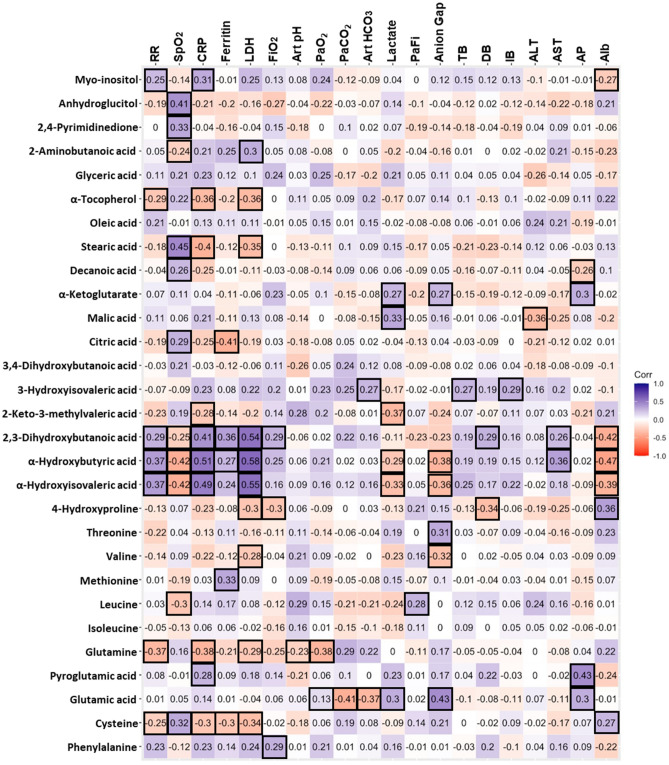
Spearman’s correlation analysis. Correlation analysis of the modified metabolites in severe COVID-19 patients and the clinical parameters considered. Blue numbers indicate a positive association. Red numbers denote a negative association. Squared values denote associations with values p < 0.05. RR = Respiratory rate, SpO2 = Oxygen saturation, LDH = Lactate dehydrogenase, FiO2 = Fraction of inspired oxygen, Art pH = Arterial pH, PaO2 = Partial pressure of oxygen, PaCO2 = Partial pressure of CO2, Art HCO3 = Arterial bicarbonate, PaFi = PaO2/ FiO2, TB = Total bilirubin, DB = Direct bilirubin, IB = Indirect bilirubin, ALT = Alanine aminotransferase, AST = Aspartate aminotransferase, AP = Alkaline phosphatase, Alb = Albumin. Exact p values are referred in Supplemental Table 2.
Figure 4
Figure 4
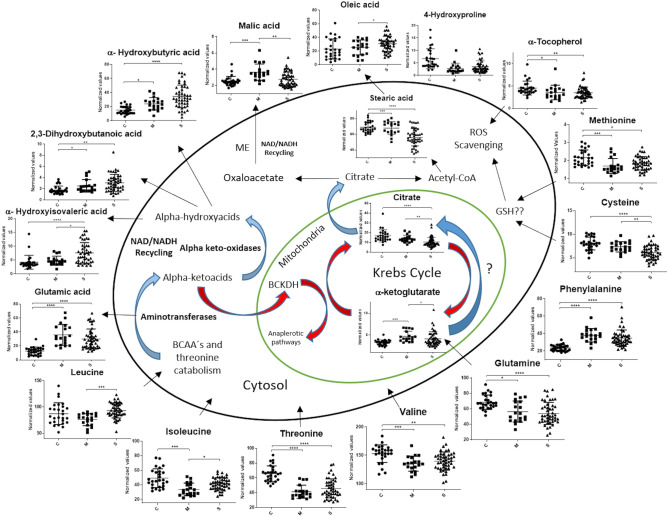
Proposed model for the serum metabolic changes observed in COVID-19 patients. Red arrows represent metabolic flux inhibited during hypoxia. Blue arrows represent increased flux in hypoxia. ME Malic enzyme. The graphs were constructed with the normalized values from control subjects (C), mild (M), and severe (S) patients. Asterisks indicate statistical significance according to the Dunn test. p* < 0.05 ** < 0.01, *** < 0.001, **** < 0.0001.

References

    1. Lake MA. What we know so far: COVID-19 current clinical knowledge and research. Clin. Med. 2020;20:124–127. doi: 10.7861/clinmed.2019-coron. - DOI - PMC - PubMed
    1. Geier MR, Geier DA. Respiratory conditions in coronavirus disease 2019 (COVID-19): Important considerations regarding novel treatment strategies to reduce mortality. Med. Hypotheses. 2020;140:109760. doi: 10.1016/j.mehy.2020.109760. - DOI - PMC - PubMed
    1. Michiels C. Physiological and pathological responses to hypoxia. Am. J. Pathol. 2004;164:1875–1882. doi: 10.1016/S0002-9440(10)63747-9. - DOI - PMC - PubMed
    1. Majmundar AJ, Wong WJ, Simon MC. Hypoxia-inducible factors and the response to hypoxic stress. Mol. Cell. 2010;40:294–309. doi: 10.1016/j.molcel.2010.09.022. - DOI - PMC - PubMed
    1. Gray LR, Tompkins SC, Taylor EB. Regulation of pyruvate metabolism and human disease. Cell. Mol. Life Sci. 2014;71:2577–2604. doi: 10.1007/s00018-013-1539-2. - DOI - PMC - PubMed

Publication types