. 2021 Mar 12:13:2349-2357.
doi: 10.2147/CMAR.S300495. eCollection 2021.

Cardioprotective Effect of Quercetin and Sitagliptin in Doxorubicin-Induced Cardiac Toxicity in Rats

Affiliations

Cardioprotective Effect of Quercetin and Sitagliptin in Doxorubicin-Induced Cardiac Toxicity in Rats

Tavga Ahmed Aziz. Cancer Manag Res. .

Abstract

Objective: A previous study revealed a pronounced protective effect of combining quercetin (QC) with sitagliptin (STN) in testicular tissue. Accordingly, this study was designed to evaluate the cardioprotective effects of QC and STN each alone or in combination in doxorubicin (DOX)-induced cardiotoxicity in the rats.

Methodology: Thirty male adult Wistar rats were divided into five groups: the first group (control) treated with sodium chloride, the second group treated with DOX (3 mg/kg I.P. injection), the third group treated with DOX with a combination of QC (80 mg/kg), and STN (10 mg/kg), the fourth group treated with DOX and QC and the fifth group treated with DOX and STN. Blood was collected on day 22 and used for assessment of serum troponin, lactate dehydrogenase (LDH), creatine phosphokinase (CPK), total lipid profile, C-reactive protein (CRP), and total antioxidant capacity (TAOC). Atherogenic indices were also calculated. Cardiac tissue was sent for histopathological analysis.

Results: DOX produced a significant increase in the level of troponin, LDH, CKP, CRP, total cholesterol (TC), low-density lipoprotein (LDL), triglycerides (TG), and atherogenic index of plasma; and significantly decreased TAOC. The combination of quercetin and sitagliptin was more effective than each treatment alone in restoring the level of troponin, LDH, CKP, CRP, Cholesterol, LDL, TG, atherogenic index of plasma and significantly increased TAOC compared to DOX treated group. The histopathological finding also supports the biochemical results.

Conclusion: The study revealed the cardioprotective effects of the combination of QC and STN which could be attributed to the additive effects of this combination through antioxidant, anti-inflammatory, lipid lowering and anti-atherogenic activities; suggesting it as a good therapeutic candidate to be tested in the clinical setting.

Keywords: cardiotoxicity; doxorubicin; quercetin; rats; sitagliptin.


Conflict of interest statement

The author reports no conflicts of interest in this work.

Figures
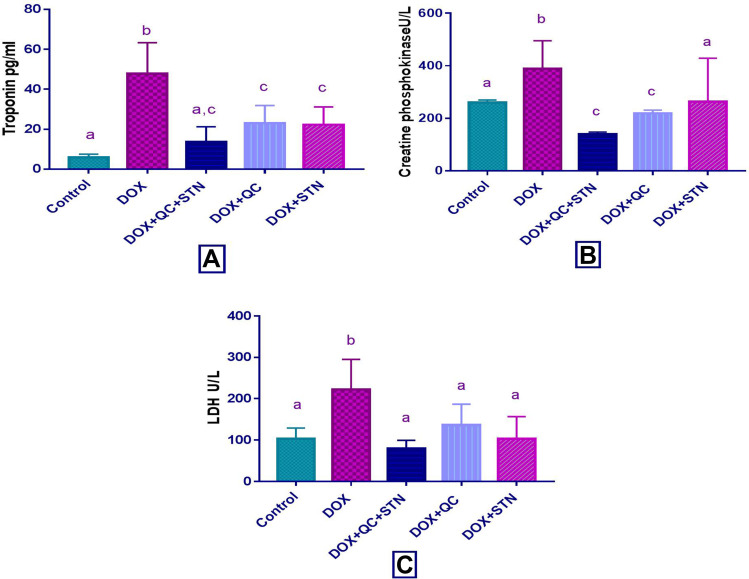
Figure 1
Figure 1
Effect of quercetin and/or sitagliptin on serum level of (A) troponin, (B) CPK and (C) LDH. Values were presented as mean ± S.D (n= 6 animals in each group); values with non-identical letters (a, b, c) are significantly different using ANOVA and post hoc test (p < 0.05).
Figure 2
Figure 2
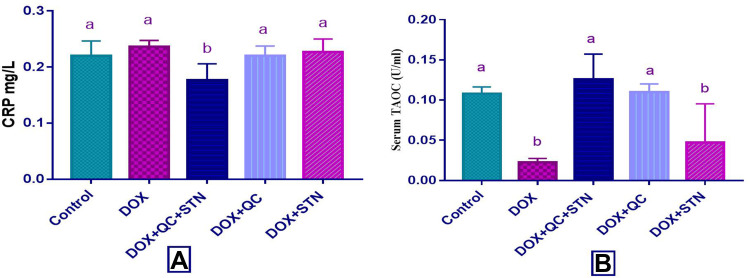
Effect of quercetin and/or sitagliptin on serum level of (A) CRP and (B) TAOC. Values were presented as mean ± S.D (n= 6 animals in each group); values with non-identical letters (a, b) are significantly different using ANOVA and post hoc test (p < 0.05).
Figure 3
Figure 3
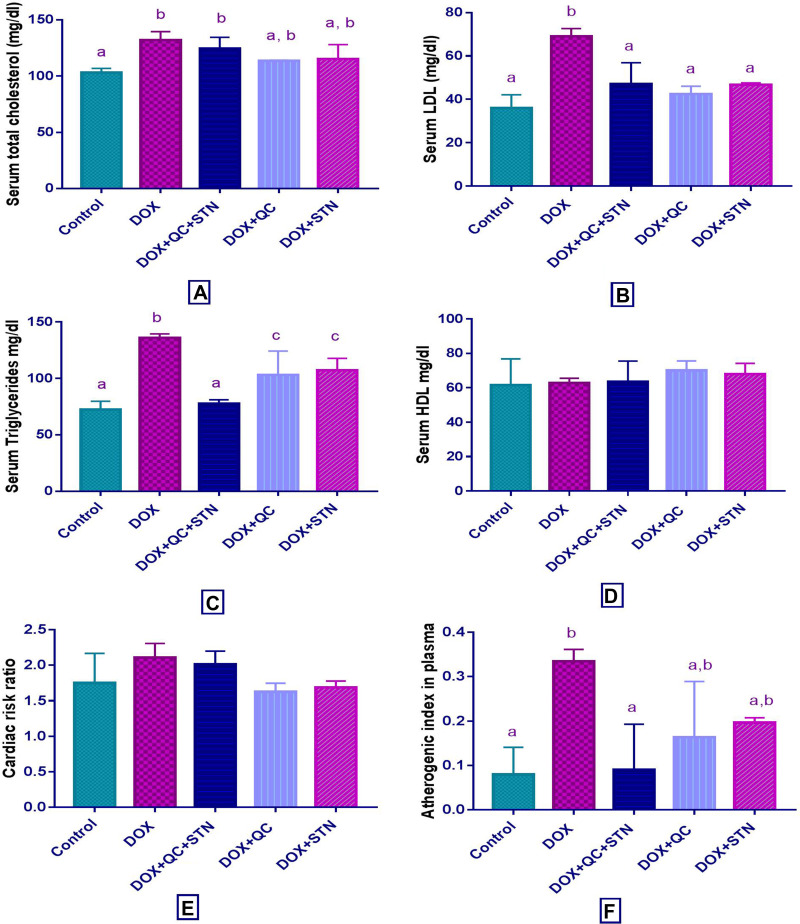
Effect of quercetin and/or sitagliptin on serum lipid profile and atherogenic indices (A) total cholesterol, (B) LDL, (C) triglycerides, (D) HDL, (E) cardiac risk ratio and (F) atherogenic index in plasma. Values were presented as mean ± S.D (n= 6 animals in each group); values with non-identical letters (a, b, c) are significantly different using ANOVA and post hoc test (p < 0.05).
Figure 4
Figure 4
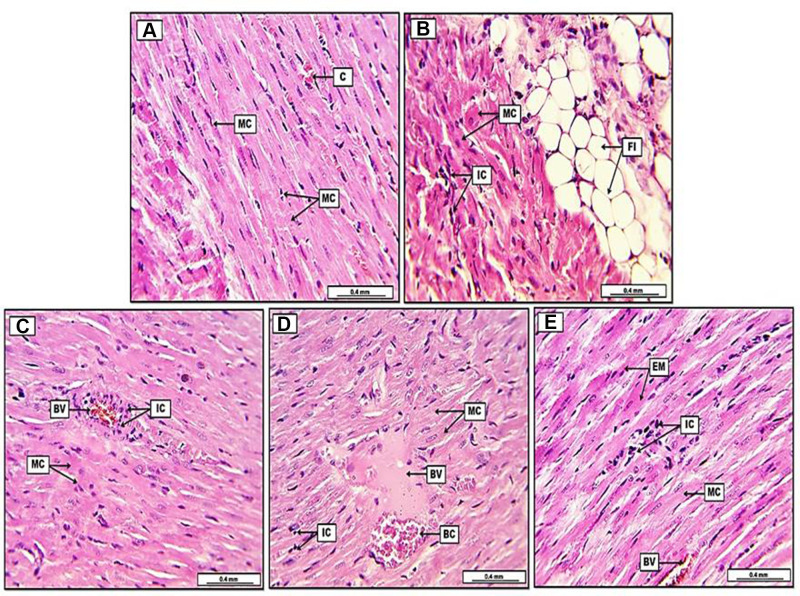
Photomicrograph of heart from groups; (A) control group, display typically arranged myocardial cells (MC), with their oval nuclei and light pinkish cytoplasm, in addition, the section shows some congested blood capillaries (C). (B) Doxorubicin group (DOX), reveal remarkable fatty infiltration (FI) within the cardiac muscle, together with significant fatty degeneration (FD), the section shows severe degenerative changes in myocardial muscle (MC), together with the infiltration of inflammatory cells (IC). (C) Doxorubicin, quercetin and sitagliptin group (DOX+QC+STN), display slight pre-vascular cuffing of inflammatory cells (IC), together with vascular congestion in some blood vessels (BV), moreover, some myocardial cells (MC) show acidophilic cytoplasm with condensate nuclei. (D) Doxorubicin and quercetin group (DOX+GC), demonstrate slight to moderate infiltration of inflammatory cells (IC), the section reveals some blood vessels (BV) with semi-coagulated red blood cells (BC) and eosinophilic plasma-rich protein. Myocardial muscle (MC) shows oval nuclei with cross-striated appearance. (E) Doxorubicin and sitagliptin group (DOX+STN), reveal slight infiltration of inflammatory cells (IC), the section shows some eosinophilic myocardial muscle cells (EM) with condensate nuclei, however, some other myocardial cells (MC) demonstrate typical cross striation together with their oval nuclei. Some blood vessels appear congested (BV). H&E. Scale bars: 0.4 mm.

References

    1. Shaito A, Thuan DTB, Phu HT, et al. Herbal medicine for cardiovascular diseases: efficacy, mechanisms, and safety. Front Pharmacol. 2020;11(April):1–32. doi: 10.3389/fphar.2020.00422 - DOI - PMC - PubMed
    1. Ferdinandy P, Baczkó I, Bencsik P, et al. Definition of hidden drug cardiotoxicity: paradigm change in cardiac safety testing and its clinical implications. Eur Heart J. 2019;40(22):1771–1777C. doi: 10.1093/eurheartj/ehy365 - DOI - PMC - PubMed
    1. McGowan JV, Chung R, Maulik A, Piotrowska I, Walker JM, Yellon DM. Anthracycline chemotherapy and cardiotoxicity. Cardiovasc Drugs Ther. 2017;31(1):63–75. doi: 10.1007/s10557-016-6711-0 - DOI - PMC - PubMed
    1. Nayebi M. Ultrastructural and echocardiographic assessment of chronic doxorubicin-induced cardiotoxicity in rats. Arch Razi Inst. 2020;75(1):56. doi: 10.22092/ARI.2019.116862.1177 - DOI - PMC - PubMed
    1. Thorn CF, Oshiro C, Marsh S, et al. Doxorubicin pathways. Pharmacogenet Genomics. 2011;21(7):440–446. doi: 10.1097/fpc.0b013e32833ffb56 - DOI - PMC - PubMed