


Recent trend of androgen deprivation therapy in newly diagnosed prostate cancer patients: Comparing between high- and middle-income Asian countries
- PMID: 33738901
- PMCID: PMC8177804
- DOI: 10.1111/cas.14889
Recent trend of androgen deprivation therapy in newly diagnosed prostate cancer patients: Comparing between high- and middle-income Asian countries
Abstract
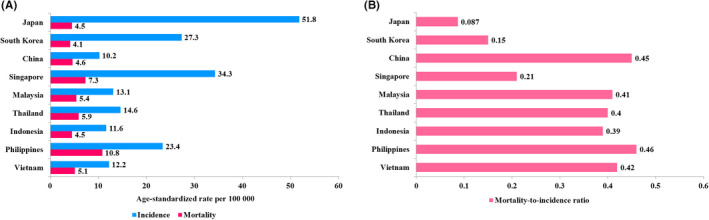
The number of newly diagnosed prostate cancer cases varies across Asia, with higher mortality-to-incidence ratio reported in developing nations. Androgen deprivation therapy (ADT), alone or in combination, remains the mainstay of first-line treatment for advanced prostate cancer. Key findings of extensive research and randomized controlled trials have shaped current clinical practice and influenced clinical guideline recommendations. We describe here the recent trend of ADT in newly diagnosed prostate cancer for Asia focusing on Japan (high-income country) and Malaysia (middle-income country) based on the Asian Prostate Cancer (A-CaP) Study. The combination of radiotherapy and ADT or ADT alone was common in patients with intermediate-to-high risk localized and locally advanced disease. For metastatic prostate cancer, maximum androgen blockade (gonadotrophin-releasing hormone [GnRH] agonist/antagonist plus antiandrogen) was prevalent among the Japanese patients while primary ADT alone with GnRH agonist/antagonist was widely practiced in the Malaysian cohort. Upfront combined therapy (ADT plus docetaxel or androgen receptor pathway inhibitor) has significantly improved the outcomes of patients with metastatic castration-naïve prostate cancer. Its application, however, remains low in our cohorts due to patients' financial capacity and national health insurance coverage. Early detection remains the cornerstone in prostate cancer control to improve treatment outcome and patient survival.
Keywords: A-CaP Study; abiraterone acetate; adjuvant ADT; chemohormonal therapy; metastatic prostate cancer.
© 2021 The Authors. Cancer Science published by John Wiley & Sons Australia, Ltd on behalf of Japanese Cancer Association.
Conflict of interest statement
The authors have no conflict of interest.
Figures
References
-
- GLOBOCAN . 2020: Estimated cancer incidence, mortality and prevalence worldwide in 2020. http://GLOBOCAN.iarcfr/Defaultaspx
-
- Huggins C, Hodges CV. Studies on prostatic cancer. I. The effect of castration, of estrogen and androgen injection on serum phosphatases in metastatic carcinoma of the prostate. Cancer Res. 1941;1:293‐297. - PubMed
-
- Ahmann FR, Citrin DL, deHaan HA, et al. Zoladex: a sustained‐release, monthly luteinizing hormone‐releasing hormone analogue for the treatment of advanced prostate cancer. J Clin Oncol. 1987;5:912‐917. - PubMed
-
- Labrie F, Dupont A, Belanger A, et al. New hormonal therapy in prostatic carcinoma: combined treatment with an LHRH agonist and an antiandrogen. Clin Invest Med. 1982;5:267‐275. - PubMed
-
- Crawford ED, Eisenberger MA, McLeod DG, et al. A controlled trial of leuprolide with and without flutamide in prostatic carcinoma. N Engl J Med. 1989;321:419‐424. - PubMed
Publication types
MeSH terms
Substances
Grants and funding
LinkOut - more resources
Full Text Sources
Other Literature Sources
Medical
Miscellaneous
