. 2021 Apr 12;31(7):1508-1514.e5.
doi: 10.1016/j.cub.2021.03.008. Epub 2021 Mar 18.

Meiotic DNA break repair can utilize homolog-independent chromatid templates in C. elegans

Affiliations

Meiotic DNA break repair can utilize homolog-independent chromatid templates in C. elegans

Erik Toraason et al. Curr Biol. .

Abstract

During meiosis, the maintenance of genome integrity is critical for generating viable haploid gametes.1 In meiotic prophase I, double-strand DNA breaks (DSBs) are induced and a subset of these DSBs are repaired as interhomolog crossovers to ensure proper chromosome segregation. DSBs not resolved as crossovers with the homolog must be repaired by other pathways to ensure genome integrity.2 To determine if alternative repair templates can be engaged for meiotic DSB repair during oogenesis, we developed an assay to detect sister and/or intra-chromatid repair events at a defined DSB site during Caenorhabditis elegans meiosis. Using this assay, we directly demonstrate that the sister chromatid or the same DNA molecule can be engaged as a meiotic repair template for both crossover and noncrossover recombination, with noncrossover events being the predominant recombination outcome. We additionally find that the sister or intra-chromatid substrate is available as a recombination partner for DSBs induced throughout meiotic prophase I, including late prophase when the homolog is unavailable. Analysis of noncrossover conversion tract sequences reveals that DSBs are processed similarly throughout prophase I. We further present data indicating that the XPF-1 nuclease functions in late prophase to promote sister or intra-chromatid repair at steps of recombination following joint molecule processing. Despite its function in sister or intra-chromatid repair, we find that xpf-1 mutants do not exhibit severe defects in progeny viability following exposure to ionizing radiation. Overall, we propose that C. elegans XPF-1 may assist as an intersister or intrachromatid resolvase only in late prophase I.

Keywords: C. elegans; DNA repair; double-strand DNA break; genome integrity; germ line; meiosis; oogenesis; recombination; sister chromatid; worms.


Conflict of interest statement

Declaration of interests The authors declare that they have no competing interests.

Figures
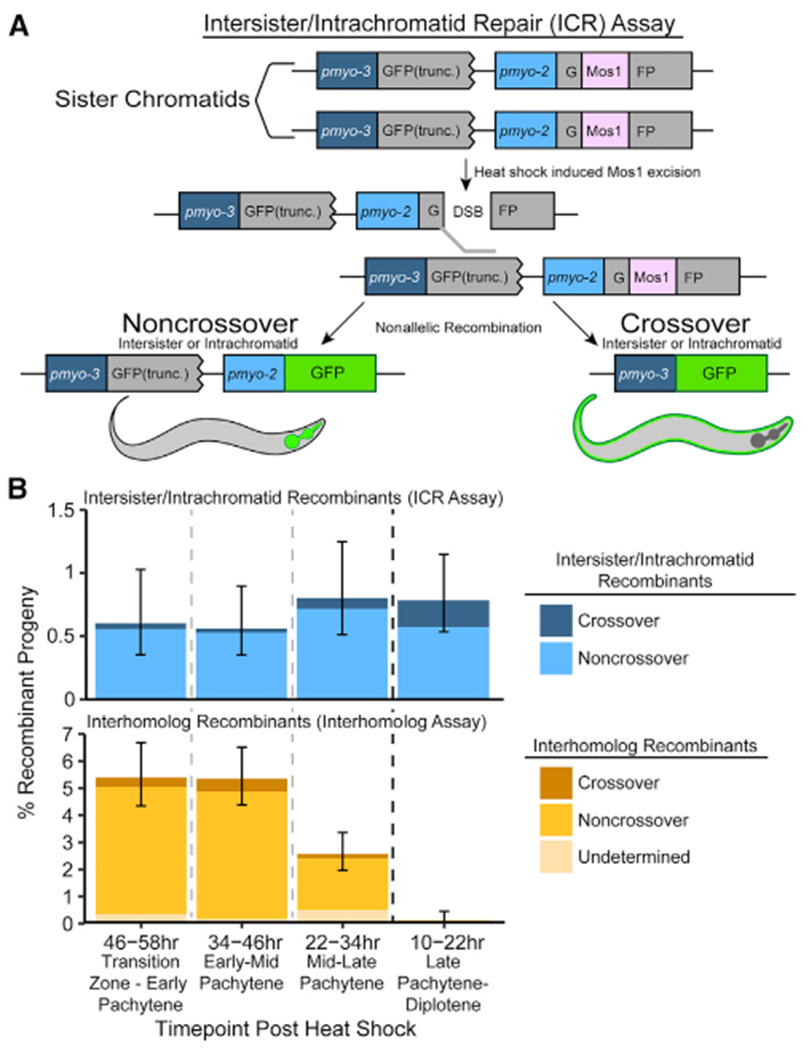
Figure 1.
Figure 1.. Intersister/intrachromatid repair can be engaged to resolve DSBs in meiotic prophase I
(A) Cartoon diagram of the intersister/intrachromatid repair (ICR) assay. The ICR assay is composed of two tandem GFP cassettes. The upstream GFP is driven by a pmyo-3 (body wall) promoter and is truncated, while the downstream GFP is driven by a pmyo-2 (pharynx) promoter and is interrupted by a Mos1 Drosophila transposon. Excision of Mos1 yields a single DSB. Repair of this DSB by intersister or intrachromatid recombination will yield GFP+ progeny. Figure S1A depicts how intrachromatid repair could be engaged within the ICR assay. See Figures S1B–S1D and S4 for confirmation of both ICR assay integration and noncrossover progeny genotypes. (B) Frequency of recombinant progeny identified in the ICR assay (top) and interhomolog assay (bottom). Total progeny scored, n = ICR assay/interhomolog assay; 10–22 h,n = 3,317/1,625; 22–34 h,n = 2,372/1,989; 34–46 h, n = 3,032/1,721; 46–58 h, n = 2,159/1,477 (Table S1). Stacked bar plots represent the overall percent of living progeny that exhibit the indicated recombinant phenotype within a specific time point following heat shock. Error bars represent 95% binomial confidence intervals. Dashed vertical lines delineate between time points scored, while the dark black dashed line delineates between the “interhomolog window” (22–58 h post-heat shock) and “non-interhomolog window” (10–22 h post-heat shock).
Figure 2.
Figure 2.. XPF-1 promotes intersister/intrachromatid repair in late meiotic prophase I
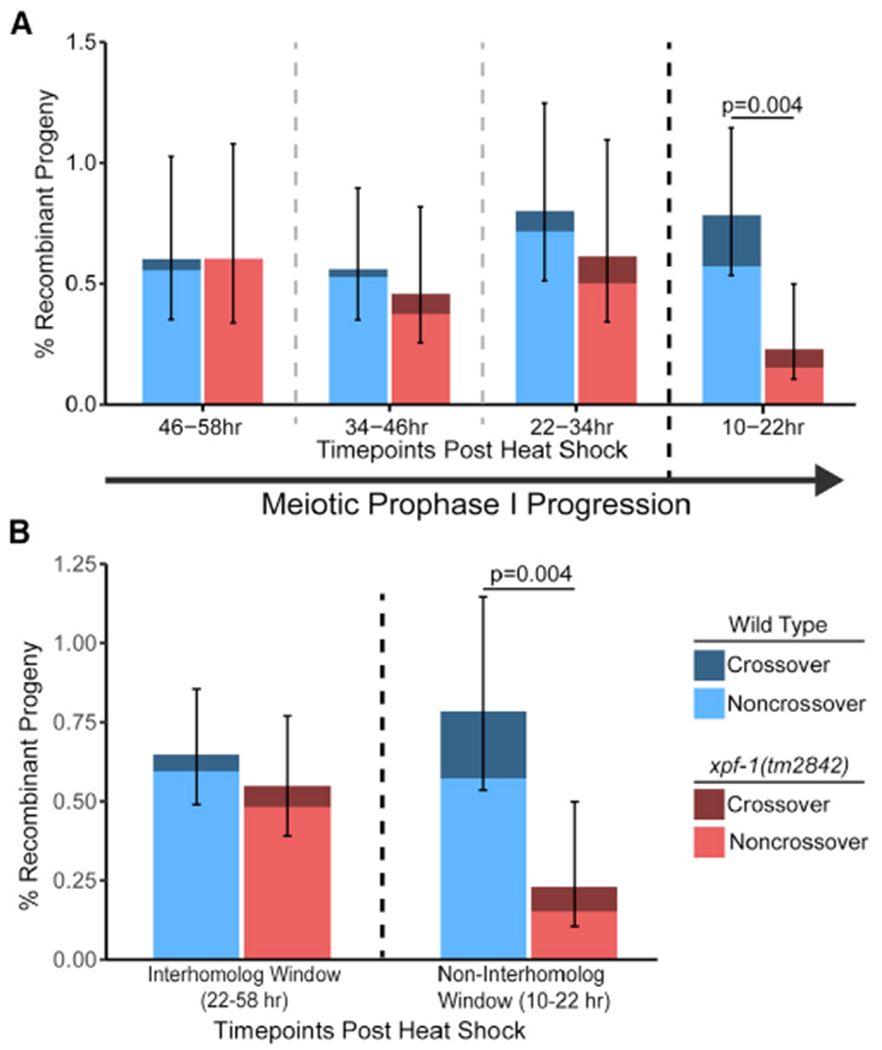
(A) Frequency of ICR assay recombinant progeny in wild-type and xpf-1(tm2842) mutants at each scored time point following heat shock. Total progeny scored, n = wild-type/xpf-1; 10–22 h, n = 3,317/2,618; 22–34 h, n = 2,372/1,793; 34–46 h,n = 3,032/2,400; 46–58 h,n = 2,159/1,819 (Tables S1 and S2). Both wild-type and xpf-1(tm2842) have similar rates of meiotic prophase progression (Figure S2A). (B) Frequency of recombinant progeny identified in the ICR assay within binned windows of prophase I defined by observation of recombinants in the interhomolog assay. n = wild-type/xpf-1; interhomolog window, n = 7,563/ 6,012; non-interhomolog window, n = 3,317/2,618 (Tables S1 and S2). Stacked bars represent the overall percent of living progeny that exhibit the indicated recombinant phenotype within the labeled time interval following heat shock. Error bars represent 95% binomial confidence intervals. p values were calculated by Fisher’s exact test. Dashed vertical lines delineate between time points scored, while the dark black dashed line delineates between the “interhomolog window” (22–58 h post-heat shock) and “non-interhomolog window” (10–22 h post-heat shock).
Figure 3.
Figure 3.. XPF-1 does not influence intersister/intrachromatid conversion tract length.
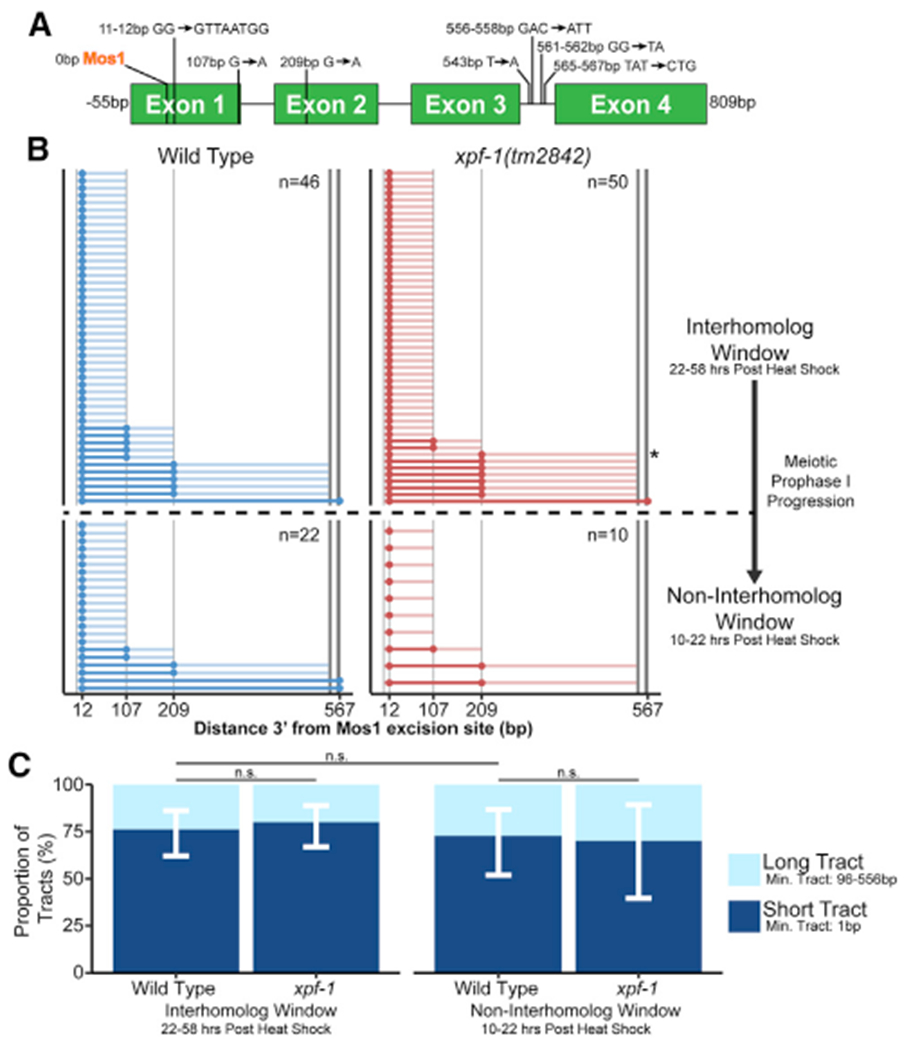
(A) Scale cartoon of ICR assay GFP cassette with annotated polymorphisms. The polymorphisms of thepmyo-2::GFP sequence are listed tothe left ofeach arrow, while the sequence of the pmyo-3::GFP polymorphism is listed to the right of each arrow. Positions of polymorphisms in bp are relative to the site of Mos1 excision. (B) Converted polymorphisms within wild-type and xpf-1(tm2842) ICR assay noncrossover recombinant loci. Each horizontal line represents the sequenced locus of a single recombinant. High-opacity lines connect contiguous converted polymorphisms within a single tract and represent minimum tract length, while the low-opacity lines represent the range between converted and the most proximal non-converted polymorphism. See Figure S3 for crossover conversion tract data. (C) Stacked bar plots showing the proportion of “short” (1 bp minimum tract length) and “long” (>96 bp minimum tract length). Error bars represent 95% binomial confidence intervals. p values calculated by Fisher’s exact test.
Figure 4.
Figure 4.
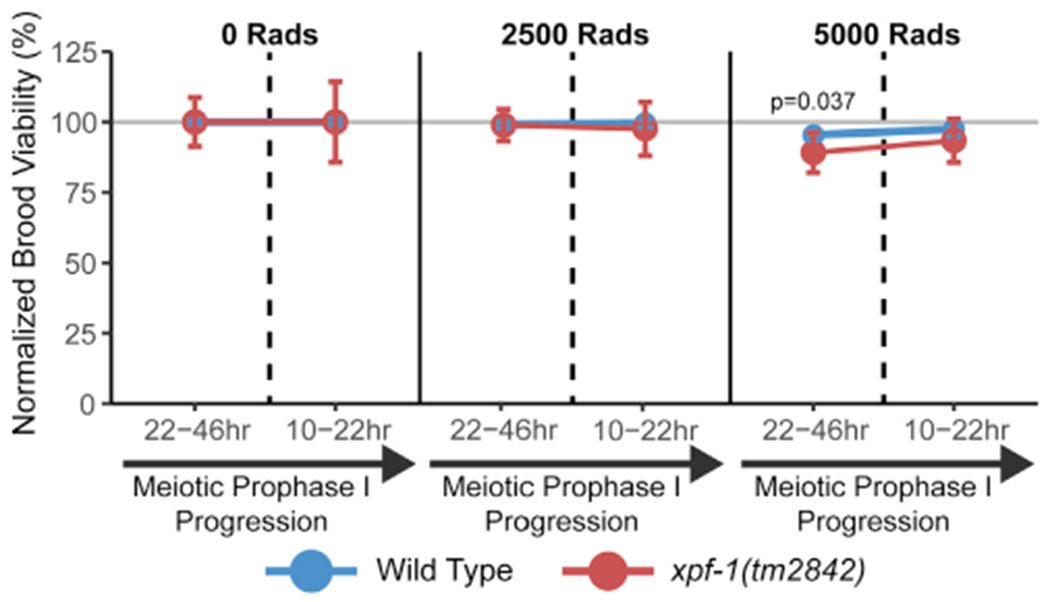
XPF-1 is not required for brood viability in response to ionizing radiation Mean brood viability of young adult hermaphrodites exposed to 0, 2,500, or 5,000 Rads of ionizing radiation, normalized to the mean brood viability for each genotype and time point scored in the absence of ionizing radiation (0 Rads treatment). Broods of n = 15 parent hermaphrodites of each respective genotype were scored for each irradiation treatment dose. Vertical dashed lines delineate between time points representing damage induced during the interhomolog window (22–46 h) and time points representing damage induced during the non-interhomolog window (10–22 h). Error bars represent SD. p values were calculated by Mann-Whitney U test. Brood viabilities of each condition without normalization are displayed in Figure S2B.

Comment in

References

    1. Handel MA, and Schimenti JC (2010). Genetics of mammalian meiosis: regulation, dynamics and impact on fertility. Nat. Rev. Genet. 11,124–136. - PubMed
    1. Gray S, and Cohen PE (2016). Control of meiotic crossovers: from double-strand break formation to designation. Annu. Rev. Genet. 50,175–210. - PMC - PubMed
    1. Lao JP, and Hunter N (2010). Trying to avoid your sister. PLoS Biol. 8, e1000519. - PMC - PubMed
    1. Rosu S, Libuda DE, and Villeneuve AM (2011). Robust crossover assurance and regulated interhomolog access maintain meiotic crossover number. Science 334, 1286–1289. - PMC - PubMed
    1. Hayashi M, Chin GM, and Villeneuve AM (2007). C. elegans germ cells switch between distinct modes of double-strand break repair during meiotic prophase progression. PLoS Genet. 3, e191. - PMC - PubMed

Publication types

Substances

LinkOut - more resources