. 2021 Mar 19;11(1):6436.
doi: 10.1038/s41598-021-85901-3.

Amorphous cellulose nanofiber supercapacitors

Affiliations

Amorphous cellulose nanofiber supercapacitors

Mikio Fukuhara et al. Sci Rep. .

Abstract

Despite the intense interest in cellulose nanofibers (CNFs) for biomedical and engineering applications, no research findings about the electrical energy storage of CNF have been reported yet. Here, we present the first electroadsorption effects of an amorphous cellulose nanofiber (ACF) supercapacitor, which can store a large amount of electricity (221 mJm-2, 13.1 Wkg-1). The electric storage can be attributed to the entirely enhanced electroadsorption owing to a quantum-size effect by convexity of 17.9 nm, an offset effect caused by positive polar C6=O6 radicles, and an electrostatic effect by appearance of the localised electrons near the Na ions. The supercapacitor also captures both positive and negative electricity from the atmosphere and in vacuum. The supercapacitor could illuminate a red LED for 1 s after charging it with 2 mA at 10 V. Further gains might be attained by integrating CNF specimens with a nano-electromechanical system (NEMS).


Conflict of interest statement

The authors declare no competing interests.

Figures
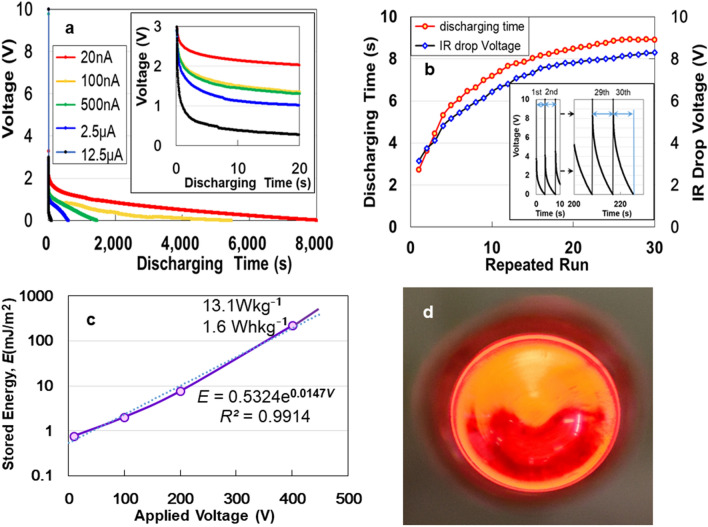
Figure 1
Figure 1
(a) Discharging behaviours of the ACF device for constant currents of 20 nA, 100 nA, 500 nA, 2.5 μA, and 12.5 μA after 2 mA–10 V charging for 50 s. (b) Discharging time and IR drop for 2 mA-rapid charging/1μA-discharging up to 30 times. (c) Applied voltage dependency of stored energy. (d) An LED powered by the ACF device.
Figure 2
Figure 2
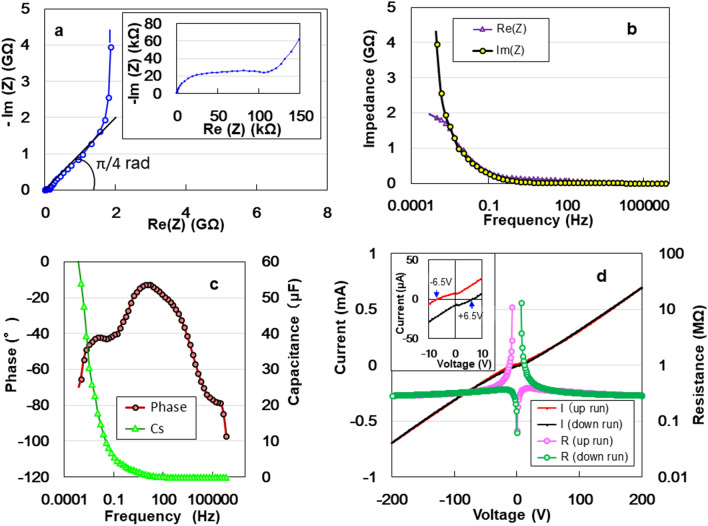
Non-destructive analysis of the electrostatic contribution of the specimen. (a) Nyquist plot as a function of frequency for the ACF device. (b) Real and imaginary impedances. (c) Frequency dependence of phase angle and series capacitance. (d) I–V and R–V characteristics between − 200 and + 200 V.
Figure 3
Figure 3
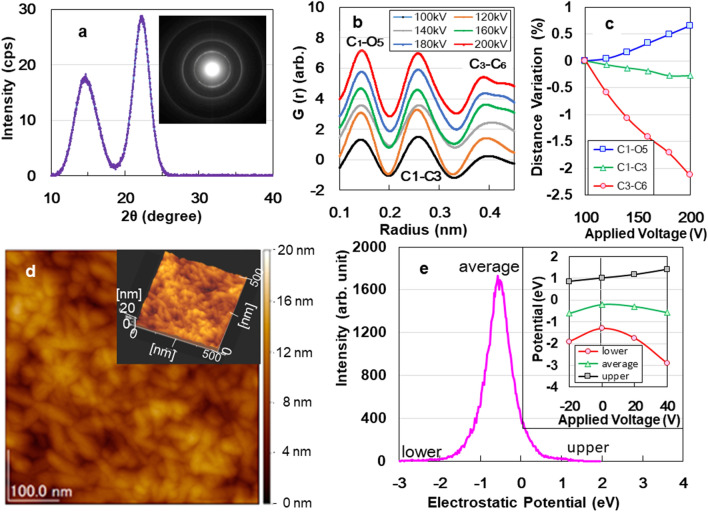
(a) XRD analysis of ACF specimen. (b) Changes in atomic pair distribution functions (PDFs) under 100–200 kV irradiation at a rate of 3 nA/m2. (c) Change rates of bonding distance as functions of applied voltage. (d) AFM image of the ACF surface. (e) Histogram of the potential distribution at + 40 V. Inset in (a) SAED pattern, (d) three-dimensional AFM image, (e) electrostatic potential distributions for ACF surface when the applied voltage changed from − 20 V to + 40 V.
Figure 4
Figure 4
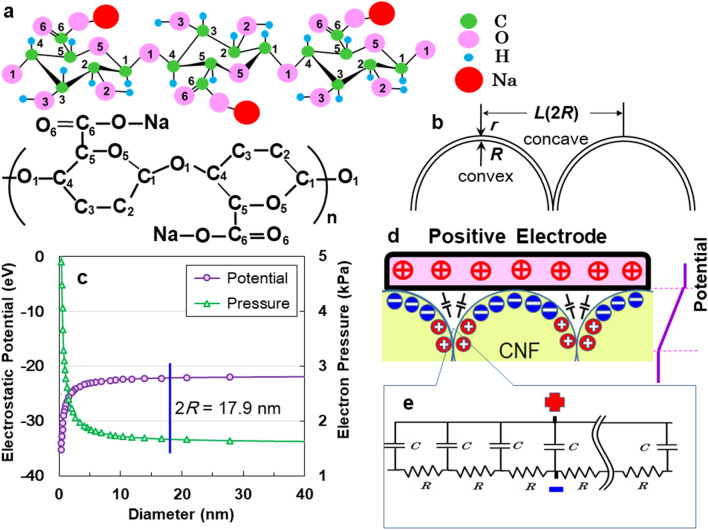
(a) Structure of sodium (1→4)-β-D-poly-glucuronate cell with green carbon, pink oxygen, light-blue hydrogen, and red sodium atoms. (b) Schematic diagram for calculations based on the Thomas–Fermi statistical method. (c) Convex dependences of the electrostatic potential and electron pressure with diameter. (d) Schematic representation of the microscopic electric energy storage used in this study. (e) The electric distributed constant circuit of the amorphous ACF surface.
Figure 5
Figure 5
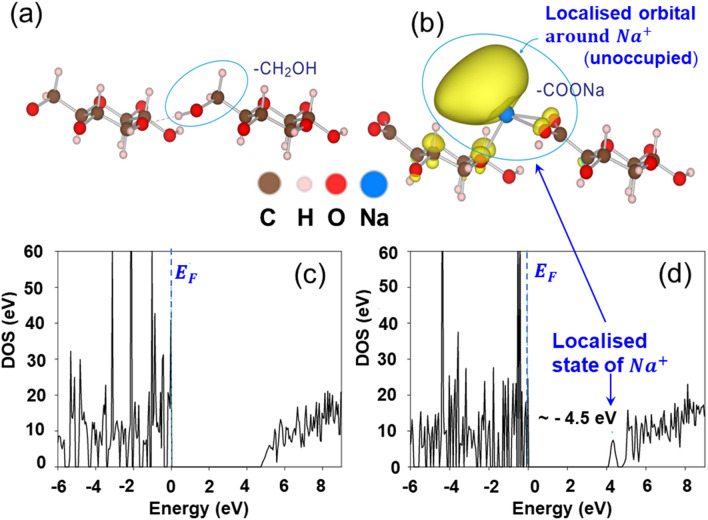
Local structures and density of states (DOS) in C12H20O10 and C12H17O11Na. Isolated electronic state (yellow) locally occurs in vicinity of Na ion.

References

    1. Kafy A, et al. Cellulose long fibers fabricated from cellulose nanofibers and its strong and tough characteristics. Sci. Rep. 2017;7:17683. doi: 10.1038/s41598-017-17713-3. - DOI - PMC - PubMed
    1. Abitbol T, et al. Nanocellulose, a tiny fiber with huge applications. COBIOT. 2016;39:76–88. doi: 10.1016/j.copbio.2016.01.002. - DOI - PubMed
    1. Abdel-karim AM, Salama AH, Hassan ML. Electrical conductivity and dielectric properties of nanofibrillated cellulose thin films from bagasse. J. Phys. Org. Chem. 2018;31:e3851. doi: 10.1002/poc.3851. - DOI
    1. Martin-Martinez FJ. Designing nanocellulose materials from the molecular scale. PNAS. 2018;115:7174–7175. doi: 10.1073/pnas.1809308115. - DOI - PMC - PubMed
    1. Saito T, Isogai A. TEMPO-mediated oxidation of native cellulose. The effect of oxidation conditions on chemical and crystal structures of the water-insoluble fractions. Biomacromol. 2004;5:1983–1989. doi: 10.1021/bm0497769. - DOI - PubMed

LinkOut - more resources