


Face-Processing Performance is an Independent Predictor of Social Affect as Measured by the Autism Diagnostic Observation Schedule Across Large-Scale Datasets
- PMID: 33743118
- PMCID: PMC9747289
- DOI: 10.1007/s10803-021-04971-4
Face-Processing Performance is an Independent Predictor of Social Affect as Measured by the Autism Diagnostic Observation Schedule Across Large-Scale Datasets
Abstract
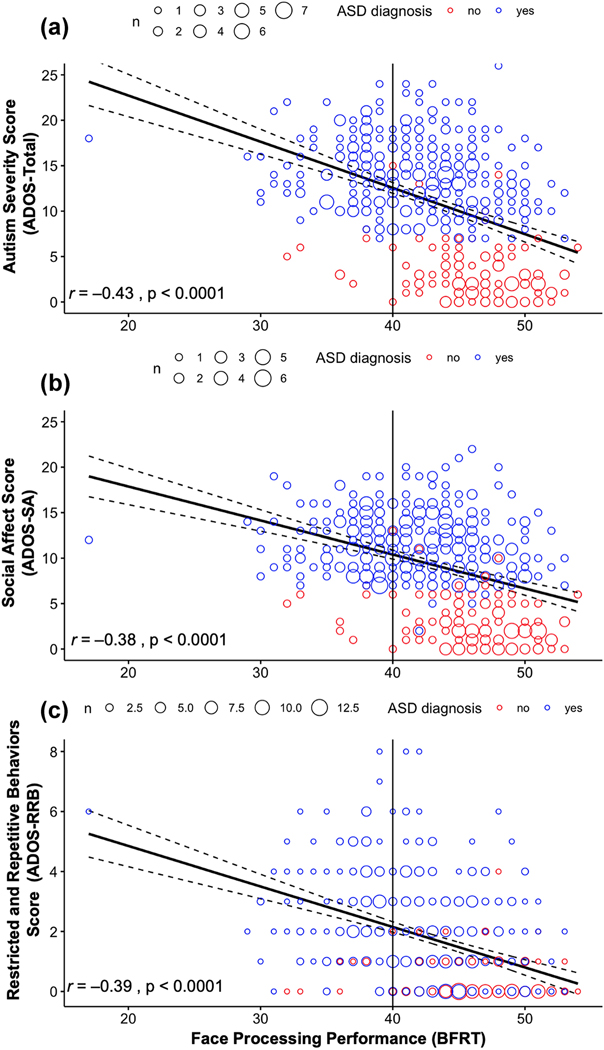
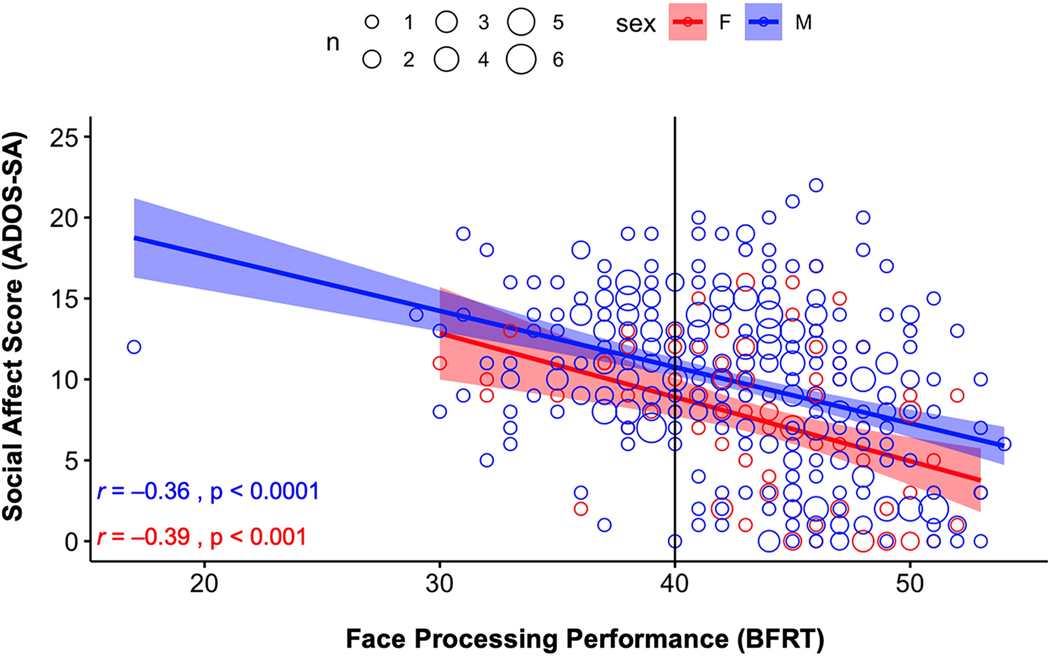
Face-processing deficits, while not required for the diagnosis of autism spectrum disorder (ASD), have been associated with impaired social skills-a core feature of ASD; however, the strength and prevalence of this relationship remains unclear. Across 445 participants from the NIMH Data Archive, we examined the relationship between Benton Face Recognition Test (BFRT) performance and Autism Diagnostic Observation Schedule-Social Affect (ADOS-SA) scores. Lower BFRT scores (worse face-processing performance) were associated with higher ADOS-SA scores (higher ASD severity)-a relationship that held after controlling for other factors associated with face processing, i.e., age, sex, and IQ. These findings underscore the utility of face discrimination, not just recognition of facial emotion, as a key covariate for the severity of symptoms that characterize ASD.
Keywords: Autism spectrum disorder; Face discrimination; Face perception; Face processing; Social cognition; Social interaction.
© 2021. The Author(s), under exclusive licence to Springer Science+Business Media, LLC, part of Springer Nature.
Figures

References
-
- American Psychiatric Association. (2013). Diagnostic and Statistical Manual of Mental Disorders, 5th Edition: DSM-5. Washington, DC: American Psychiatric Association.
MeSH terms
Grants and funding
LinkOut - more resources
Full Text Sources
Other Literature Sources
Medical
