. 2021 Apr 1;108(4):749-756.
doi: 10.1016/j.ajhg.2021.03.007. Epub 2021 Mar 19.

A DNA repair disorder caused by de novo monoallelic DDB1 variants is associated with a neurodevelopmental syndrome

Affiliations

A DNA repair disorder caused by de novo monoallelic DDB1 variants is associated with a neurodevelopmental syndrome

Susan M White et al. Am J Hum Genet. .

Abstract

The DNA damage-binding protein 1 (DDB1) is part of the CUL4-DDB1 ubiquitin E3 ligase complex (CRL4), which is essential for DNA repair, chromatin remodeling, DNA replication, and signal transduction. Loss-of-function variants in genes encoding the complex components CUL4 and PHIP have been reported to cause syndromic intellectual disability with hypotonia and obesity, but no phenotype has been reported in association with DDB1 variants. Here, we report eight unrelated individuals, identified through Matchmaker Exchange, with de novo monoallelic variants in DDB1, including one recurrent variant in four individuals. The affected individuals have a consistent phenotype of hypotonia, mild to moderate intellectual disability, and similar facies, including horizontal or slightly bowed eyebrows, deep-set eyes, full cheeks, a short nose, and large, fleshy and forward-facing earlobes, demonstrated in the composite face generated from the cohort. Digital anomalies, including brachydactyly and syndactyly, were common. Three older individuals have obesity. We show that cells derived from affected individuals have altered DDB1 function resulting in abnormal DNA damage signatures and histone methylation following UV-induced DNA damage. Overall, our study adds to the growing family of neurodevelopmental phenotypes mediated by disruption of the CRL4 ubiquitin ligase pathway and begins to delineate the phenotypic and molecular effects of DDB1 misregulation.

Keywords: CRL4; DDB1; intellectual disability; mutation.


Conflict of interest statement

The authors declare no competing interests.

Figures
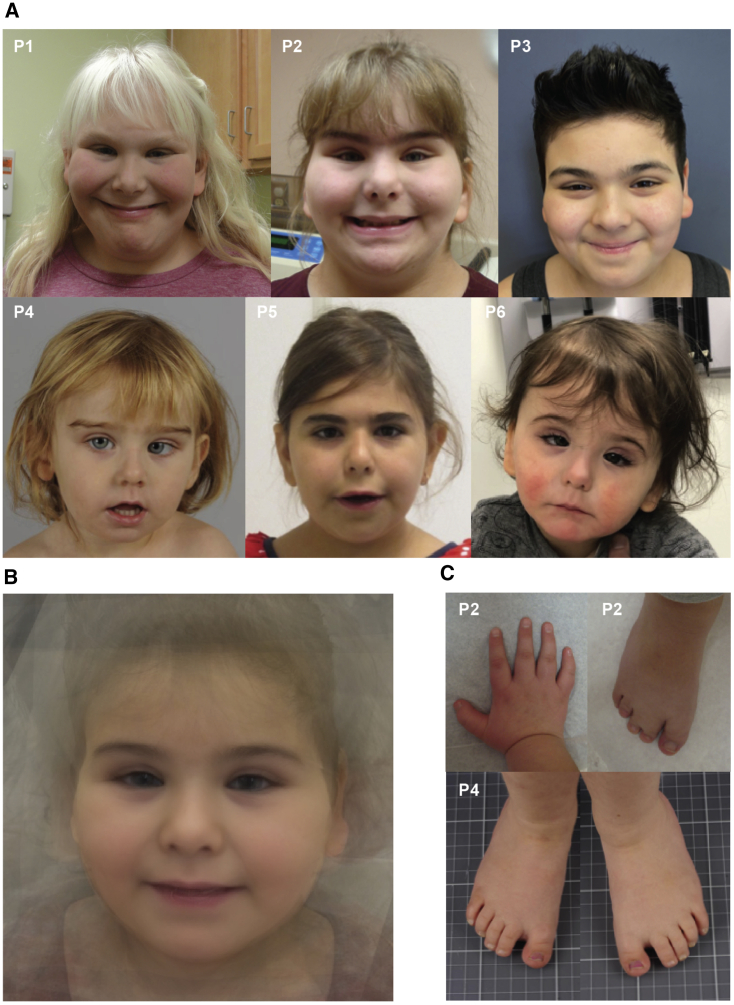
Figure 1
Figure 1
Face, hand, and feet and composite photographs (A) Facial photographs of individuals 1, 2, 3, 4, and 5 showing horizontal eyebrows, short nose, and full cheeks. (B) Composite image of individuals with DDB1 variants showing key distinctive features of horizontal eyebrows, short nose, full cheeks, and large ear lobes. (C) Photograph of hand in individual 2 showing brachydactyly and proximally placed thumb. Photograph of feet in individuals 2 and 4 showing syndactyly and brachydactyly.
Figure 2
Figure 2
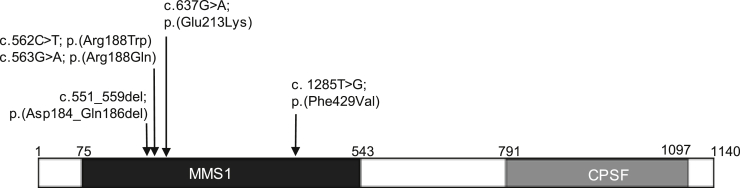
Protein domains of DDB1 and de novo variants found in affected individuals DDB1 contains the MMS1 and CPSF protein domains. The MMS1 domain is homologous to the N-terminal region of MMS1; the protein itself protects against replication-dependent DNA damage in Saccharomyces cerevisiae and belongs to the DDB1 family of CUL4 adaptors. The function of the CPSF domain, homologous to the C terminus of the CPSF A subunit, is unknown but may be involved in RNA/DNA binding. All eight individuals had one de novo DDB1 missense variant, all of which were located within the coding region of the MMS1 domain and are listed above the schematic. Numbers above the schematic denote amino acid positions.
Figure 3
Figure 3
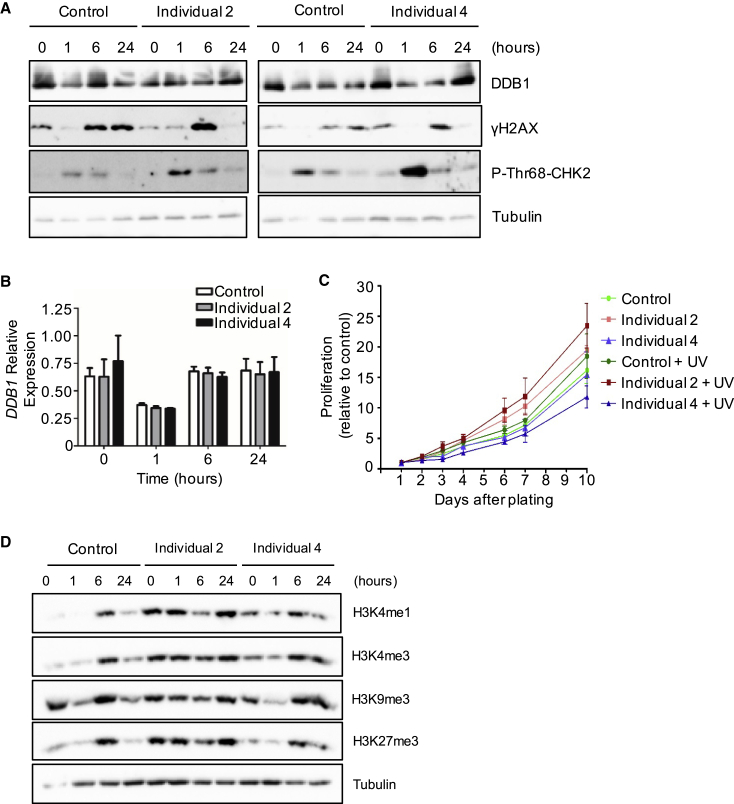
DDB1 missense variants in lymphoblast cells result in altered DNA damage signatures and histone methylation following UV damage (A) Immunoblot analysis on total extracts from control and affected lymphoblast cells. Untreated cells are shown at the 0 h time point, whereas the other time intervals indicate the number of h following UV exposure. Total DDB1 and the levels of γH2AX and p-Thr68-CHK2 phosphorylation were assessed: DDB1 was found to be unchanged and γH2AX and p-Thr68-CHK2 levels were induced as expected, p-Thr68-CHK2 to a higher level than controls and γH2AX to a similar level as controls but was not sustained. (B) Real-time PCR analysis on extracts from lymphoblast cells showing transcript levels of DDB1 before and after UV exposure are similar between cells from affected individuals and control individuals. (C) Cell proliferation of control and affected lymphoblast cells was measured by harvesting and counting cells on each of the specified days after initial plating, either with or without UV exposure. (D) Immunoblot analysis of total extracts from control and affected lymphoblast cells. Untreated cells are shown at the 0 h time point, whereas the other time intervals indicate the number of h following UV exposure. Levels of various histone H3 methylations were assessed and found to be abnormal in cells from affected individuals. Immunoblots in this figure are representative images of at least three biological replicates, and graphed data represent the mean of three biological replicates; error bars depict standard error of the mean.

References

    1. Tiwari V., Wilson D.M., 3rd DNA Damage and Associated DNA Repair Defects in Disease and Premature Aging. Am. J. Hum. Genet. 2019;105:237–257. - PMC - PubMed
    1. Maréchal A., Zou L. DNA damage sensing by the ATM and ATR kinases. Cold Spring Harb. Perspect. Biol. 2013;5:a012716. - PMC - PubMed
    1. Scrima A., Konícková R., Czyzewski B.K., Kawasaki Y., Jeffrey P.D., Groisman R., Nakatani Y., Iwai S., Pavletich N.P., Thomä N.H. Structural basis of UV DNA-damage recognition by the DDB1-DDB2 complex. Cell. 2008;135:1213–1223. - PMC - PubMed
    1. Higa L.A., Wu M., Ye T., Kobayashi R., Sun H., Zhang H. CUL4-DDB1 ubiquitin ligase interacts with multiple WD40-repeat proteins and regulates histone methylation. Nat. Cell Biol. 2006;8:1277–1283. - PubMed
    1. Nishitani H., Sugimoto N., Roukos V., Nakanishi Y., Saijo M., Obuse C., Tsurimoto T., Nakayama K.I., Nakayama K., Fujita M. Two E3 ubiquitin ligases, SCF-Skp2 and DDB1-Cul4, target human Cdt1 for proteolysis. EMBO J. 2006;25:1126–1136. - PMC - PubMed

Publication types