


Severity of metabolic syndrome is greater among nonalcoholic adults with elevated ALT and advanced fibrosis
- PMID: 33743323
- PMCID: PMC8048170
- DOI: 10.1016/j.nutres.2020.12.023
Severity of metabolic syndrome is greater among nonalcoholic adults with elevated ALT and advanced fibrosis
Abstract
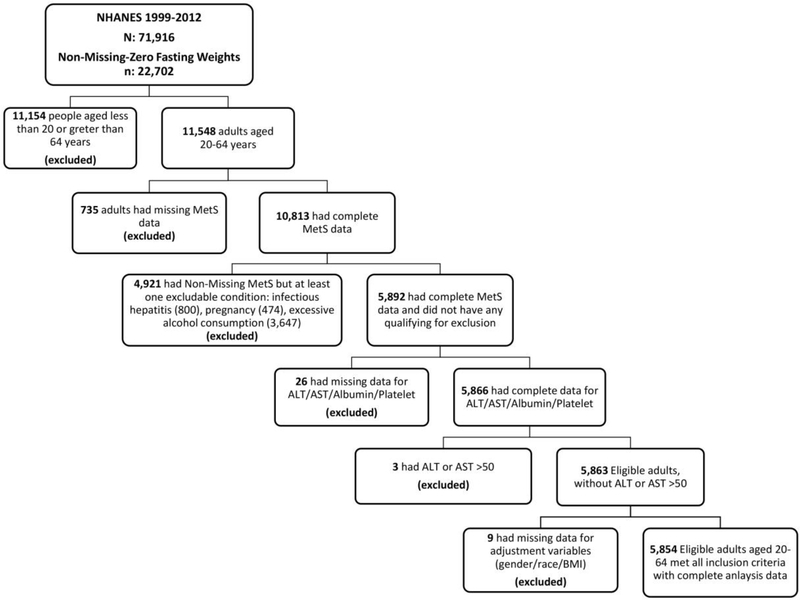
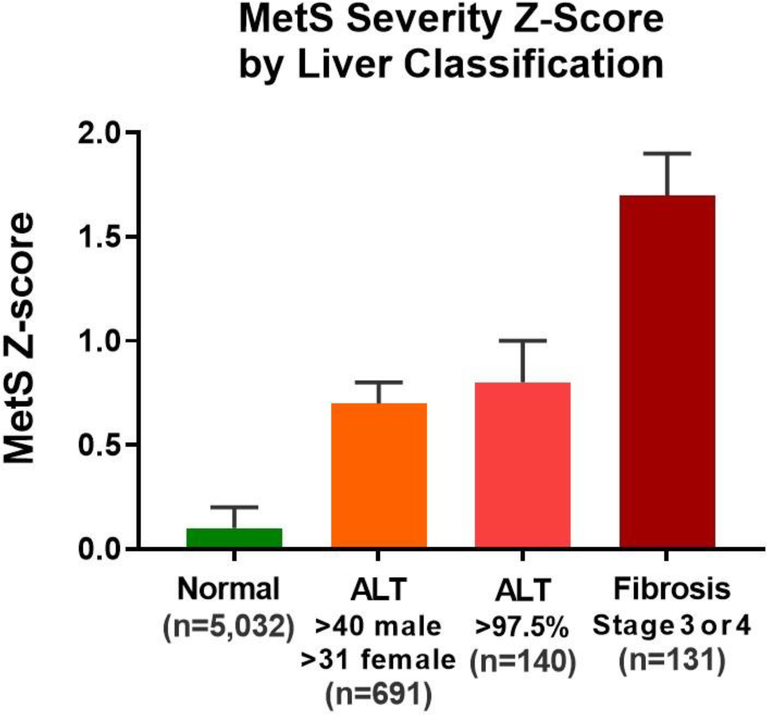
The obesity epidemic has increased risk for nonalcoholic fatty-liver disease (NAFLD), nonalcoholic steatohepatitis (NASH), advanced fibrosis and cirrhosis. We hypothesized that metabolic syndrome (MetS) severity would correlate with markers of NAFLD and NASH fibrosis. We evaluated cross-sectional data from 5463 participants of the National Health and Nutrition Examination Survey 1999-2012, age 20 to 64 years with and without diabetes, excluding those with heavy drinking and infectious liver serologies. We used linear and logistic regression to evaluate links between MetS-severity (using a race/ethnicity-specific MetS-severity-Z-score, MetS-Z) and apparent NALFD sequelae, using elevated alanine aminotransferase (ALT) to determine presence of NAFLD and elevated NAFLD Fibrosis Score to identify advanced fibrosis (NASH Clinical Research Network scoring stage 3-4). The prevalence of unexplained ALT elevations and advanced fibrosis were 11.4% and 1.37%, respectively. MetS-Z-scores were higher among those with elevated ALT (0.7, 95% confidence interval [CI]: 0.6, 0.8) and advanced fibrosis (1.7, CI: 1.5,1.9), compared to those without liver abnormalities (0.2, CI:0.2, 0.3). For every 1-standard-deviation unit increase in MetS-Z, there were higher odds of elevated ALT (OR = 1.58, CI: 1.44, 1.72) and advanced fibrosis (OR = 1.96, CI: 1.77, 2.18), with some attenuation after adjustment for age, sex, race/ethnicity, and diabetes status. Significant differences were noted by race/ethnicity, with stronger links among whites versus blacks. The degree of MetS-severity was associated with progressive increase in apparent NAFLD and advanced fibrosis; as MetS-severity has also been linked to future cardiovascular disease, diabetes, and chronic kidney disease, this provides support for use of a MetS-severity score to screen for general health, with high levels triggering further assessment for liver abnormalities.
Keywords: Fibrosis; Metabolic syndrome; Nonalcoholic fatty liver disease; Nonalcoholic steatohepatitis; Risk.
Copyright © 2021 Elsevier Inc. All rights reserved.
Figures
References
-
- McPherson S, Hardy T, Henderson E, Burt AD, Day CP, Anstee QM. Evidence of NAFLD progression from s[teatosis to fibrosing-steatohepatitis using paired biopsies: implications for prognosis and clinical management. J Hepatol 2015;62:1148–55. - PubMed
-
- Ekstedt M, Hagström H, Nasr P, Fredrikson M, Stål P, Kechagias S, Hultcrantz R. Fibrosis stage is the strongest predictor for disease-specific mortality in NAFLD after up to 33 years of follow-up. Hepatology 2015;61:1547–54. - PubMed
-
- Adams LA, Anstee QM, Tilg H, Targher G. Non-alcoholic fatty liver disease and its relationship with cardiovascular disease and other extrahepatic diseases. Gut 2017;66:1138–53. - PubMed
-
- Musso G, Gambino R, Cassader M, Pagano G. Meta-analysis: natural history of non-alcoholic fatty liver disease (NAFLD) and diagnostic accuracy of non-invasive tests for liver disease severity. Ann Med 2011;43:617–49. - PubMed
-
- Kleiner DE, Brunt EM, Van Natta M, Behling C, Contos MJ, Cummings OW, Ferrell LD, Liu YC, Torbenson MS, Unalp-Arida A, Yeh M, McCullough AJ, Sanyal AJ, Nonalcoholic Steatohepatitis C. Design and validation of a histological scoring system for nonalcoholic fatty liver disease. Hepatology 2005;41:1313–21. - PubMed
Publication types
MeSH terms
Substances
Grants and funding
LinkOut - more resources
Full Text Sources
Other Literature Sources
Medical
