Ovarian cysts disappear after 14-day oral regimen of Korean red ginseng extract in letrozole-induced polycystic ovarian syndrome
- PMID: 33743577
- PMCID: PMC8138080
- DOI: 10.5468/ogs.20094
Ovarian cysts disappear after 14-day oral regimen of Korean red ginseng extract in letrozole-induced polycystic ovarian syndrome
Abstract
Objective: Hormonal and inflammatory mechanisms are involved in the pathogenesis of polycystic ovarian syndrome (PCOS), which is a prevalent metabolic disorder among women of reproductive age. We aimed to evaluate the comparative efficiency of short-term oral administration of Korean red ginseng extract (KRGE) and the standard treatment on PCOS by focusing on the histopathological parameters and serum levels of luteinizing hormone (LH), folliclestimulating hormone (FSH), testosterone, and nuclear factor kappa B (NF-κB).
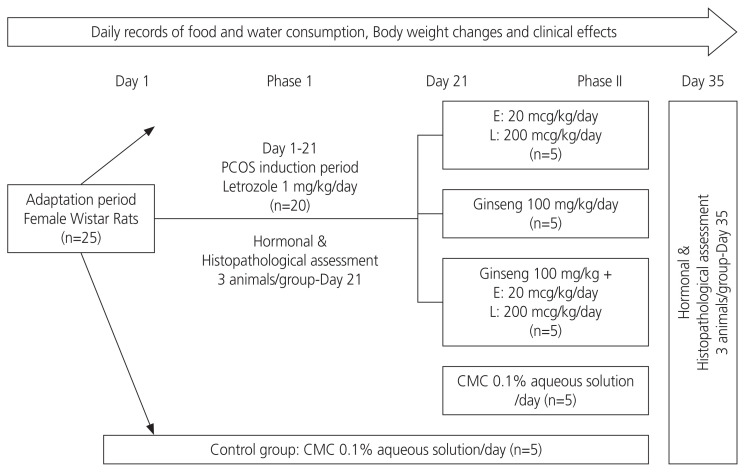
Methods: A PCOS rat model was established by oral gavage of letrozole (1 mg/kg) for 21 days. The serum levels of LH, FSH, testosterone, and NF-κB were measured, and the morphological features and differences of the ovaries were examined in each group using a light microscope before and after 14 days of treatment with oral regimens-KRGE, oral contraceptives (OCPs), KRGE+OCPs, and carboxymethyl cellulose (CMC).
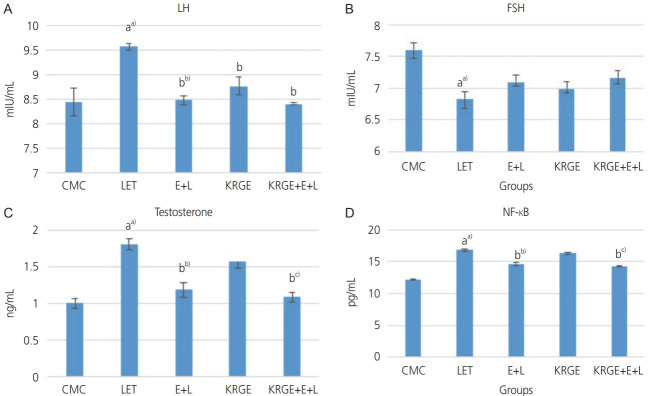
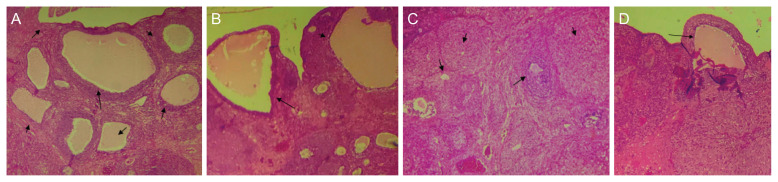
Results: OCPs alone could not normalize the mean ovarian weights of PCOS rats despite the 14-day oral regimen, but they were more effective in reducing the number and size of cysts compared to others. KRGE alone and in combination with OCPs was effective in normalizing abnormal ovarian weights, decreasing LH serum levels, and dissipating the ovarian cysts in PCOS rats. However, when combined with the standard regimen, KRGE showed additional therapeutic effects by efficiently reducing serum testosterone and NF-κB levels.
Conclusion: Our necropsy and histopathological evidence suggests the efficacy of KRGE as a novel integrative medicine against abnormal multiple follicular cysts. However, antiandrogenic and anti-inflammatory effects were only seen in animals that were administered a combination of KRGE and the standard regimen.
Keywords: Luteinizing hormone; NF-kappa B; Ovarian cysts; Panax; Polycystic ovary syndrome.
Conflict of interest statement
No potential conflict of interest relevant to this article was reported.
Figures
References
-
- Walters KA, Gilchrist RB, Ledger WL, Teede HJ, Handelsman DJ, Campbell RE. New perspectives on the pathogenesis of PCOS: neuroendocrine origins. Trends Endocrinol Metab. 2018;29:841–52. - PubMed
-
- Yildiz BO. Oral contraceptives in polycystic ovary syndrome: risk-benefit assessment. Semin Reprod Med. 2008;2:111–20. - PubMed
-
- Victor VM, Rocha M, Bañuls C, Sanchez-Serrano M, Sola E, Gomez M, et al. Mitochondrial complex I impairment in leukocytes from polycystic ovary syndrome patients with insulin resistance. J Clin Endocrinol Metab. 2009;94:3505–12. - PubMed
-
- Teede HJ, Misso ML, Deeks AA, Moran LJ, Stuckey BG, Wong JL, et al. Assessment and management of polycystic ovary syndrome: summary of an evidence-based guideline. Med J Aust. 2011;195:S65–112. - PubMed
-
- Damone AL, Joham AE, Loxton D, Earnest A, Teede HJ, Moran LJ. Depression, anxiety and perceived stress in women with and without PCOS: a community-based study. Psychol Med. 2019;49:1510–20. - PubMed
Grants and funding
LinkOut - more resources
Full Text Sources
Other Literature Sources