


Prior context influences motor brain areas in an auditory oddball task and prefrontal cortex multitasking modelling
- PMID: 33745089
- PMCID: PMC7982371
- DOI: 10.1186/s40708-021-00124-6
Prior context influences motor brain areas in an auditory oddball task and prefrontal cortex multitasking modelling
Abstract
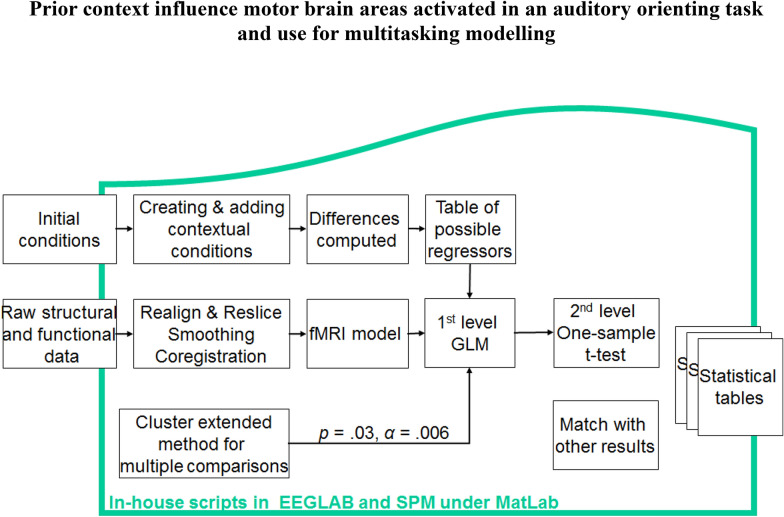
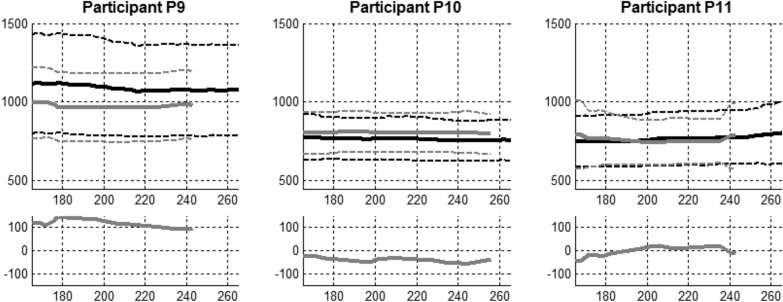
In this study, the relationship of orienting of attention, motor control and the Stimulus- (SDN) and Goal-Driven Networks (GDN) was explored through an innovative method for fMRI analysis considering all voxels in four experimental conditions: standard target (Goal; G), novel (N), neutral (Z) and noisy target (NG). First, average reaction times (RTs) for each condition were calculated. In the second-level analysis, 'distracted' participants, as indicated by slower RTs, evoked brain activations and differences in both hemispheres' neural networks for selective attention, while the participants, as a whole, demonstrated mainly left cortical and subcortical activations. A context analysis was run in the behaviourally distracted participant group contrasting the trials immediately prior to the G trials, namely one of the Z, N or NG conditions, i.e. Z.G, N.G, NG.G. Results showed different prefrontal activations dependent on prior context in the auditory modality, recruiting between 1 to 10 prefrontal areas. The higher the motor response and influence of the previous novel stimulus, the more prefrontal areas were engaged, which extends the findings of hierarchical studies of prefrontal control of attention and better explains how auditory processing interferes with movement. Also, the current study addressed how subcortical loops and models of previous motor response affected the signal processing of the novel stimulus, when this was presented laterally or simultaneously with the target. This multitasking model could enhance our understanding on how an auditory stimulus is affecting motor responses in a way that is self-induced, by taking into account prior context, as demonstrated in the standard condition and as supported by Pulvinar activations complementing visual findings. Moreover, current BCI works address some multimodal stimulus-driven systems.
Keywords: Attention; Cognitive modelling; Cue–target onset asynchrony (CTOA); Electroencephalography (EEG); Event-related potential (ERP); Executive function; Functional magnetic resonance imaging (fMRI); Motor networks; Multitask applications; Orienting of attention; Prefrontal cortex (PFC); Running average reaction times.
Conflict of interest statement
The authors declare that the research was conducted in the absence of any commercial or financial relationships that could be construed as a potential conflict of interest.
Figures


References
-
- Wu L, Wang Y, Gao J, Wang M, Zha ZJ, Tao D. Deep co-attention based comparator for relative representation learning in person re-identification. IEEE Trans Neural Netw Learn Syst. 2020. - PubMed
Grants and funding
LinkOut - more resources
Full Text Sources
Other Literature Sources
Miscellaneous
