


The Effects of Resisted Post-Activation Sprint Performance Enhancement in Elite Female Sprinters
- PMID: 33746784
- PMCID: PMC7973236
- DOI: 10.3389/fphys.2021.651659
The Effects of Resisted Post-Activation Sprint Performance Enhancement in Elite Female Sprinters
Abstract
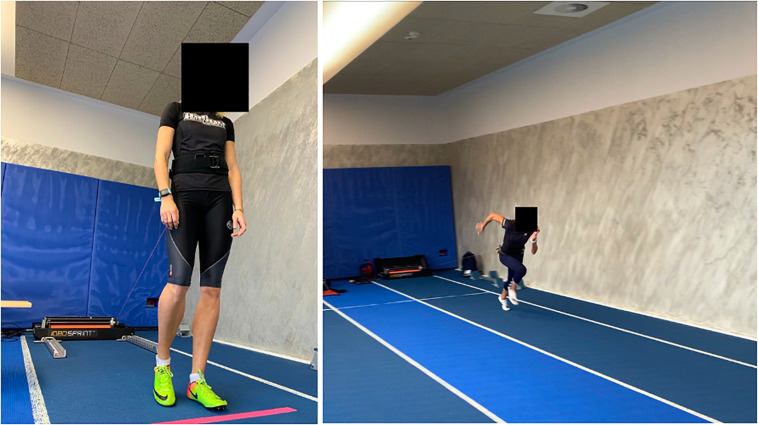
Considering the effectiveness of resisted sprint training, and the acute enhancement of sprinting performance through locomotor post-activation performance enhancement, the main objective of the research was to determine the acute effects of resisted activation with loads of 5, 10, and 15% body mass on sprint and flying start sprint performance in elite female sprinters using resisted drag technology system. Ten elite female sprinters (age: 23.2 ± 5.4 years, body mass: 54.2 ± 6.1 kg, height: 167.4 ± 7.3 cm, personal best for 100 m: 12.05 ± 0.56 s, and for 400 m: 53.17 ± 2.76 s) performed two unresisted 20-m sprints (from a crouched and flying start) before and after a single resisted sprint loaded with 5, 10, or 15% body mass to verify the effectiveness of the activation stimulus. Compared with pre-activation, Friedman tests showed that peak velocity increased by 1.6 ± 2.2% [effect size (ES) = 0.66], 2.3 ± 1.5% (ES = 1.33), and 0.2 ± 1% (ES = 0.09), as well as peak force by 2.8 ± 2.1% (ES = 0.49), 3.5 ± 2.3% (ES = 1), and 0.5 ± 2.4% (ES = 0.14), concomitant with a significant decreased in sprint time by -0.5 ± 1.2% (ES = -0.07), -2.5 ± 1.3% (ES = -0.64), and -1 ± 1.4% (ES = -0.36) for the 5, 10, and 15% body mass post-activation, respectively (p < 0.001; for all). Furthermore, the ANOVA showed that peak power increased by 2.9 ± 2.3% (ES = 0.61), 3.8 ± 2.2% (ES = 1.05), and 2 ± 7.1% (ES = 0.22) for the 5, 10, and 15% body mass resisted-conditioning activity, respectively, with no difference between the three conditions (p = 0.003 main effect time, no interaction). Moreover, compared with the 5 and 15% body mass trials [-1.5 ± 2% (ES = -0.44), -0.8 ± 0.8% (ES = -0.44), respectively], the ANOVA showed that flying start sprint time significantly decreased by -4.3 ± 1.1% (ES = -1.25) (p < 0.001, interaction effect) after a 10% body mass resisted-conditioning activity. The results of this study indicated that resisted sprints acutely enhance sprint performance; however, their effectiveness depends on the applied load. A single resisted sprint using 10% body mass is effective at inducing a potentiating effect on subsequent 20-m flying start sprint performance in elite female sprinters. Therefore, keeping in mind the optimal load, it is recommended to perform resisted sprints as a conditioning activation when seeking to acutely enhance 20-m flying start sprint performance in these athletes.
Keywords: post-activation performance enhancement; post-activation potentiation (PAP); resisted sprint; resisted sprint training; sprint training; sprinting; training and development.
Copyright © 2021 Matusiński, Pietraszewski, Krzysztofik and Gołaś.
Conflict of interest statement
The authors declare that the research was conducted in the absence of any commercial or financial relationships that could be construed as a potential conflict of interest.
Figures

References
-
- Behrens M. J., Simonson S. R. (2011). A comparison of the various methods used to enhance sprint speed. Strength Cond. J. 33 64–71. 10.1519/SSC.0b013e318210174d - DOI
LinkOut - more resources
Full Text Sources
Other Literature Sources
Research Materials
