. 2021 Mar 5:12:639226.
doi: 10.3389/fimmu.2021.639226. eCollection 2021.

Second Report of Chronic Granulomatous Disease in Jordan: Clinical and Genetic Description of 31 Patients From 21 Different Families, Including Families From Lybia and Iraq

Affiliations

Second Report of Chronic Granulomatous Disease in Jordan: Clinical and Genetic Description of 31 Patients From 21 Different Families, Including Families From Lybia and Iraq

Faris Ghalib Bakri et al. Front Immunol. .

Abstract

Chronic granulomatous Disease (CGD) is a rare innate immunodeficiency disorder caused by mutations in one of the six genes (CYBA, CYBB, NCF1, NCF2, NCF4, and CYBC1/EROS) encoding the superoxide-producing nicotinamide adenine dinucleotide phosphate (NADPH)-oxidase complex in phagocytes. In the Western population, the most prevalent form of CGD (about two-thirds of all cases) is the X-linked form (X-CGD) caused by mutations in CYBB. The autosomal recessive forms (AR-CGD), due to mutations in the other genes, collectively account for the remaining one-third of CGD cases. We investigated the clinical and molecular features of 22 Jordanian, 7 Libyan, and 2 Iraqi CGD patients from 21 different families. In addition, 11 sibling patients from these families were suspected to have been died from CGD as suggested by their familial and clinical history. All patients except 9 were children of consanguineous parents. Most of the patients suffered from AR-CGD, with mutations in CYBA, NCF1, and NCF2, encoding p22 phox , p47 phox , and p67 phox proteins, respectively. AR-CGD was the most frequent form, in Jordan probably because consanguineous marriages are common in this country. Only one patient from non-consanguineous parents suffered from an X910 CGD subtype (0 indicates no protein expression). AR670 CGD and AR220 CGD appeared to be the most frequently found sub-types but also the most severe clinical forms compared to AR470 CGD. As a geographical clustering of 11 patients from eight Jordanian families exhibited the c.1171_1175delAAGCT mutation in NCF2, segregation analysis with nine polymorphic markers overlapping NCF2 indicates that a common ancestor has arisen ~1,075 years ago.

Keywords: Jordan; NADPH oxidase; autosomal recessive; chronic granulomatous disease; founder mutation; innate immunodeficiency.


Conflict of interest statement

The authors declare that the research was conducted in the absence of any commercial or financial relationships that could be construed as a potential conflict of interest.

Figures
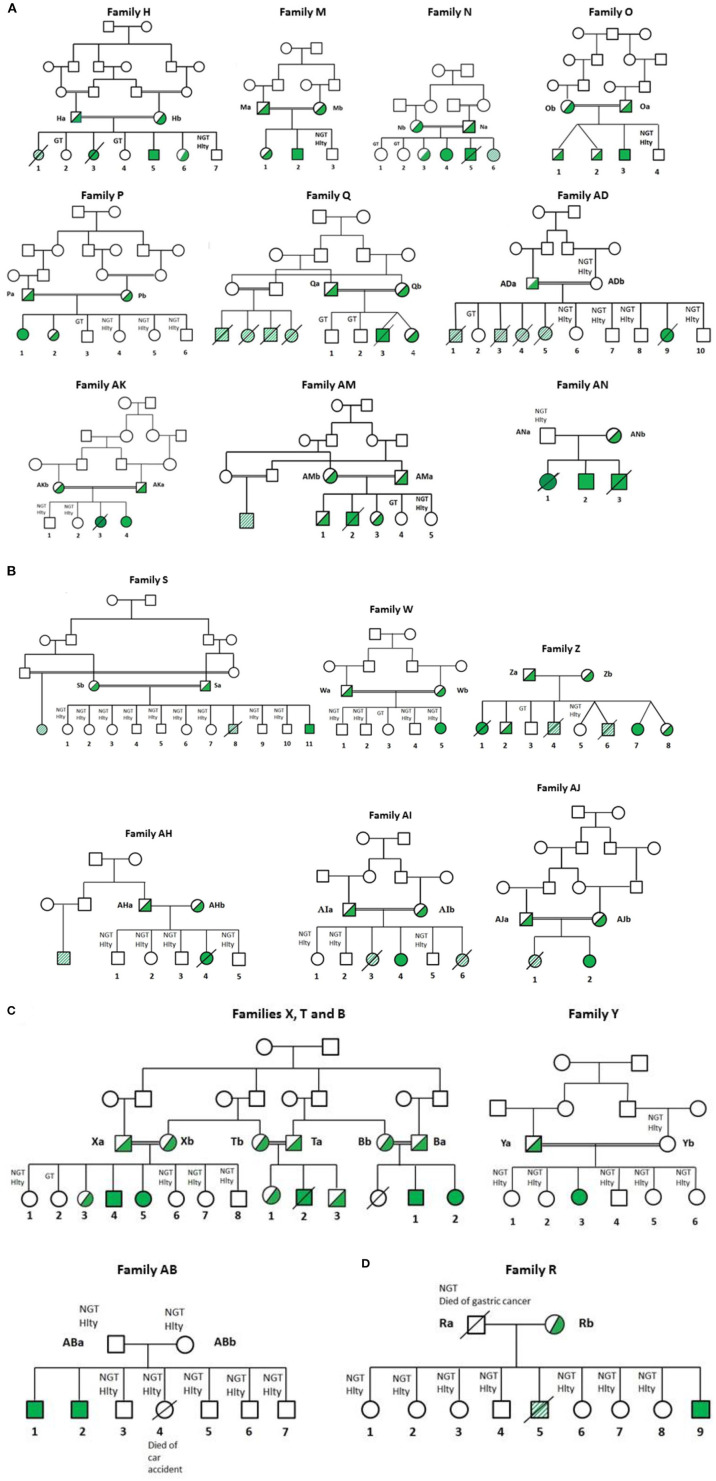
Figure 1
Figure 1
Pedigree of Jordanian, Lybian, and Iraqi families. CGD was diagnosed by measurement of NADPH oxidase activity in neutrophils as described in Patients and Methods. All families contained consanguineous marriages, except families R, Z, AB, AH, and AN. Diagonal shaded box: highly suspicious but functionally and genetically not tested (H1, R5, S8, Z6, Z4, AD1, AD3, AD4 and AD5, AI3 and AJ1). Hlty, healthy; NGT, not genetically tested; GT, genetically tested; Open symbols: no mutation in CGD genes among the tested members; filled symbols: homozygous for the CGD mutations; half-filled symbols: heterozygous for the mutation; cross-out symbols: deceased patients. (A) CGD patients from families H, M, N, O, P, Q, AK, AM, AN, and AD suffering from AR670 CGD. (B) CGD patients from families S, W, Z, AH, AI, and AJ suffering from AR220 CGD. (C) CGD patients from families T, Y, X, and AB suffering from AR470 CGD. T and X are related families. These families were also related to family B (21). (D) CGD patients from family R suffering from X0 CGD.
Figure 2
Figure 2
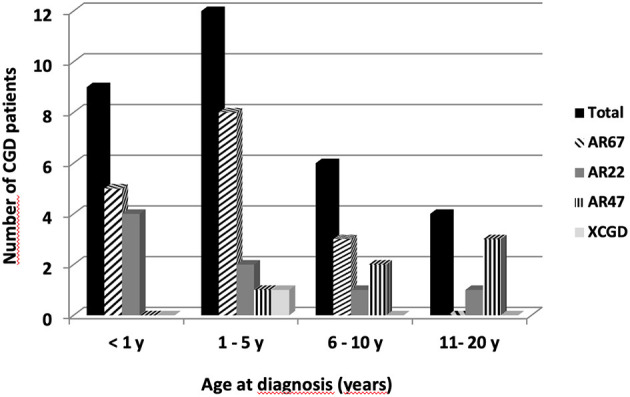
Age at diagnosis of the 31 CGD patients from Jordan, Iraq, and Lybian according to the CGD types. Twenty-two Jordanian, seven Lybian, and two Iraqi CGD patients from 21 different families were investigated. Sixteen patients suffered from AR670 CGD, eight patients from AR220 CGD, six from AR470CGD, and only one patient had X-CGD.
Figure 3
Figure 3
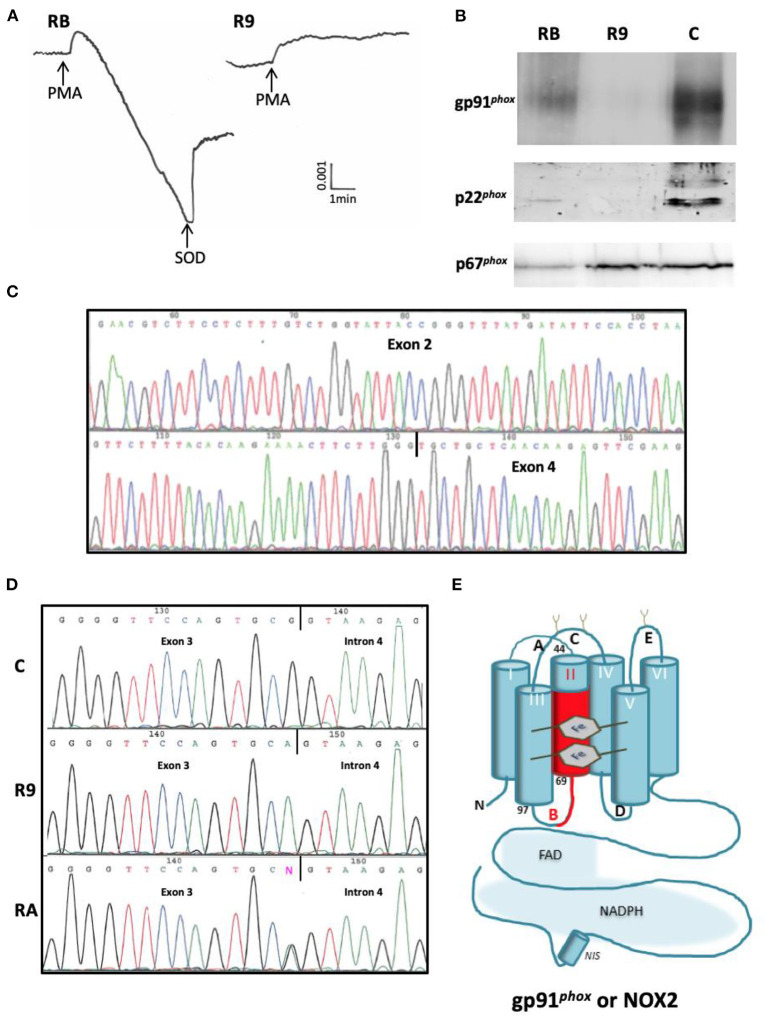
Phenotypic and genotypic characterization of the missense mutation c.252 G>T at the 3' end of exon 3 of CYBB in the X910 CGD patient from family R. (A) NADPH oxidase activity measured by SOD sensitive-cytochrome c reduction with 5 × 10⁵ purified neutrophils stimulated by PMA (80 ng/mL). RB = mother, R9 = CGD patient. (B) Western-blot of p22phox and gp91phox analysis of soluble extracts (50 μg of protein in each lane) from purified neutrophils of Family R's members (RB mother, R9 CGD patient). The p67phox expression was used to control the protein load. (C) Analysis of mutated p67phox mRNA. (D) Analysis of mutated NCF2 gene. (E) Consequence on the sequence of gp91phox protein. The absence of exon 3 corresponds to the amino acid deletion p.Ser48_Ala84del in the second transmembrane domain of gp91phox with a probable structural disorganization of the protein.
Figure 4
Figure 4
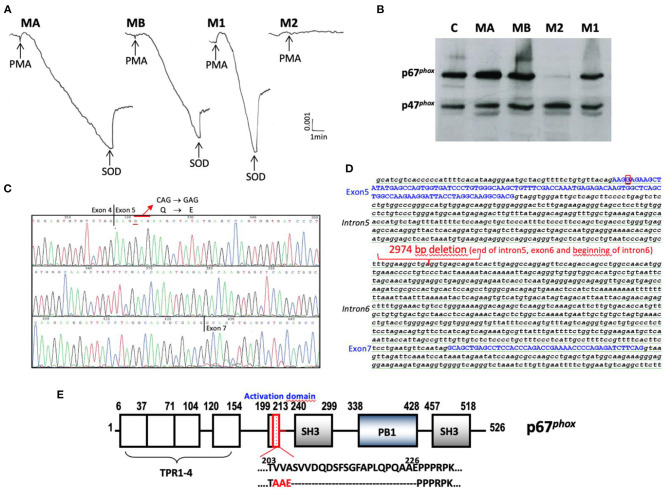
Phenotypic and genotypic characterization of the new mutation of the AR670CGD patient from family M. (A) NADPH oxidase activity measured by SOD sensitive-cytochrome c reduction with 5 × 10⁵ purified neutrophils stimulated by PMA (80 ng/mL). (B) Western blot of cytosolic factors p47phox and p67phox analysis of soluble extracts (50 μg of protein in each lane) from purified neutrophils of family M (MA father, MB mother, M2 CGD patient, M1 sister). The p47phox expression was used to control the protein load. (C) Analysis of mutated p67phox mRNA. (D) Analysis of mutated NCF2 gene. (E) Consequence on the sequence of p67phox protein. The molecular consequence is an amino acid change p.ValValAla204-206AlaAlaGlu and p.Ser207-Glu226del in the activation domain of p67phox protein that could be a potential interacting domain with NOX2.
Figure 5
Figure 5
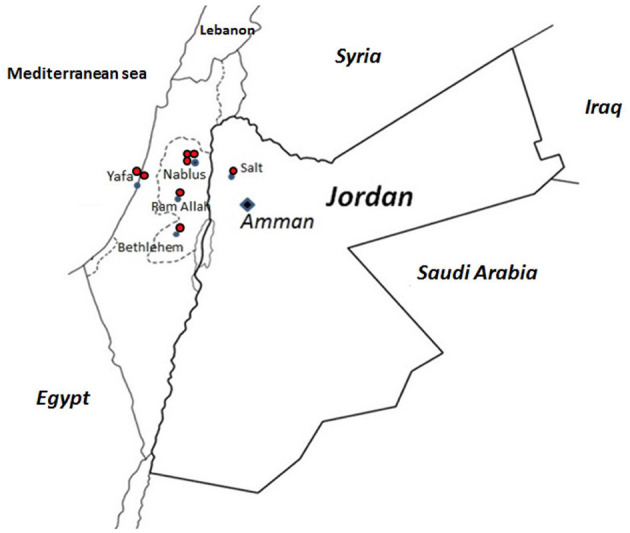
Geographical clustering of the Jordanian AR67 families sharing the c.1171_1175delAAGCT mutation in NCF2. The ancestor origin of each family is marked on the Jordan and Palestine map by a red dot.

References

    1. Roos D. Chronic granulomatous disease. Br Med Bull. (2016) 118:50–63. 10.1093/bmb/ldw009 - DOI - PMC - PubMed
    1. Thomas DC, Charbonnier LM, Schejtman A, Aldhekri H, Coomber EL, Dufficy ER, et al. . EROS/CYBC1 mutations: decreased NADPH oxidase function and chronic granulomatous disease. J Allergy Clin Immunol. (2019) 143:782–5 e1. 10.1016/j.jaci.2018.09.019 - DOI - PMC - PubMed
    1. Brandes RP, Weissmann N, Schroder K. Nox family NADPH oxidases: molecular mechanisms of activation. Free Radic Biol Med. (2014) 76:208–26. 10.1016/j.freeradbiomed.2014.07.046 - DOI - PubMed
    1. van den Berg JM, van Koppen E, Ahlin A, Belohradsky BH, Bernatowska E, Corbeel L, et al. . Chronic granulomatous disease: the European experience. PLoS ONE. (2009) 4:e5234. 10.1371/journal.pone.0005234 - DOI - PMC - PubMed
    1. Winkelstein JA, Marino MC, Johnston RB, Jr, Boyle J, Curnutte J, Gallin JI, et al. . Chronic granulomatous disease. Report on a national registry of 368 patients. Medicine. (2000) 79:155–69. 10.1097/00005792-200005000-00003 - DOI - PubMed

Publication types