


Morphological and Physiological Traits Related to the Response and Adaption of Bolboschoenus planiculmis Seedlings Grown Under Salt-Alkaline Stress Conditions
- PMID: 33746992
- PMCID: PMC7973282
- DOI: 10.3389/fpls.2021.567782
Morphological and Physiological Traits Related to the Response and Adaption of Bolboschoenus planiculmis Seedlings Grown Under Salt-Alkaline Stress Conditions
Abstract
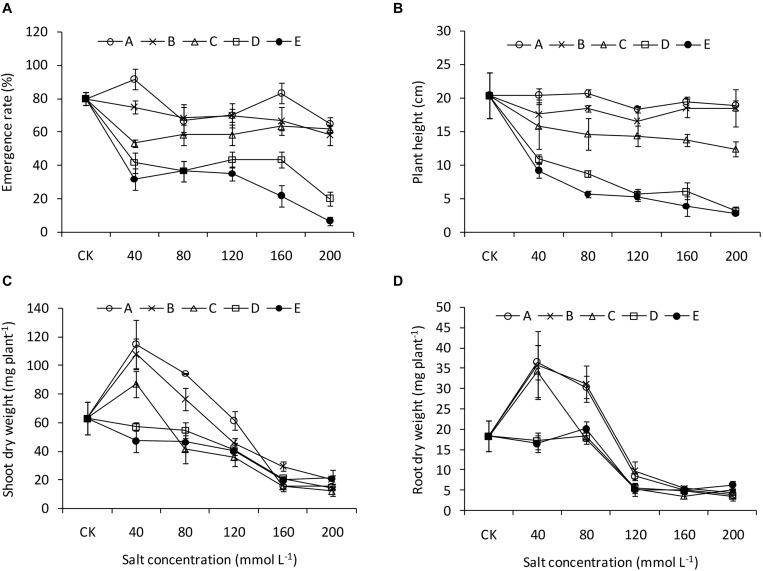
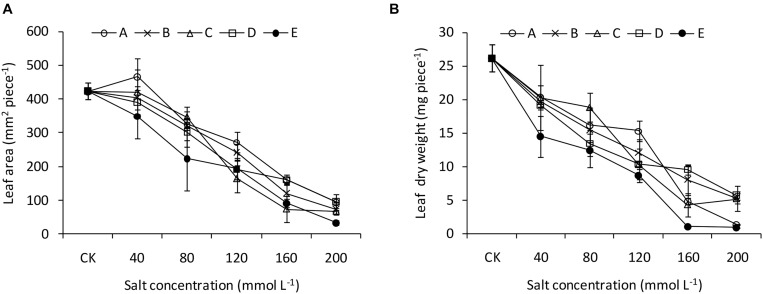
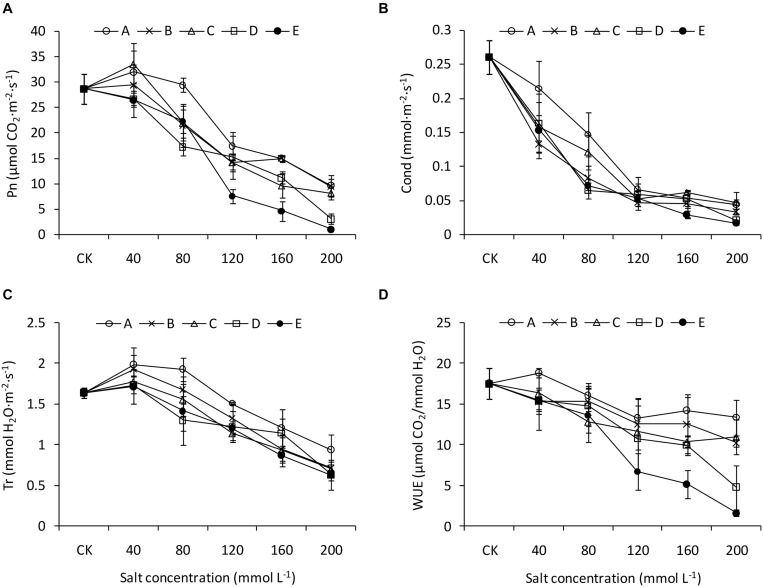
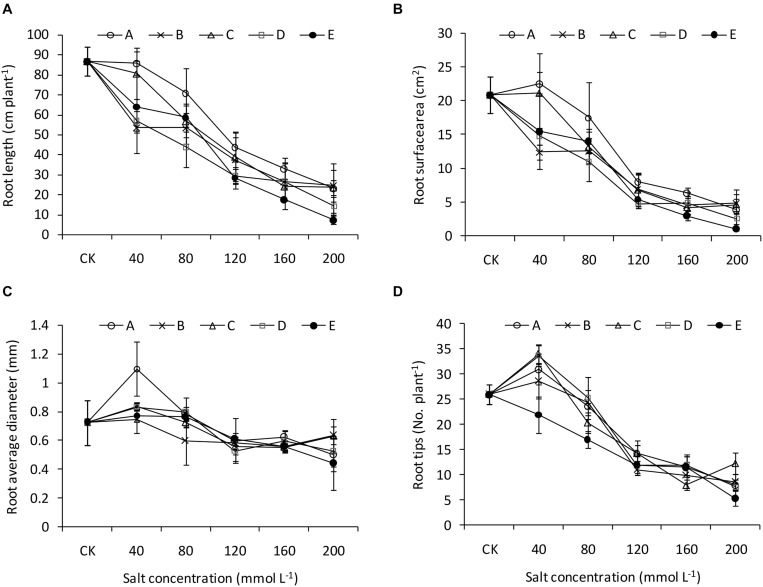
Soil saline-alkalization is expanding and becoming a serious threat to the initial establishment of plants in inland salt marshes on the Songnen Plain in Northeast China. Bolboschoenus planiculmis is a key wetland plant in this area, and its root tubers provide food for an endangered migratory Siberian crane (Grus leucogeranus). However, the survival of this plant in many wetlands is threatened by increased soil saline-alkalization. The early establishment of B. planiculmis populations under salt and alkaline stress conditions has not been well understood. The aim of this study was to investigate the response and adaption of the seedling emergence and growth of B. planiculmis to salt-alkaline mixed stress. In this study, B. planiculmis root tubers were planted into saline-sodic soils with five pH levels (7.31-7.49, 8.48-8.59, 9.10-9.28, 10.07-10.19, and 10.66-10.73) and five salinity levels (40, 80, 120, 160, and 200 mmol⋅L-1). The emergence and growth metrics, as well as the underlying morphological and physiological traits in response to salt-alkaline stress were explored for 2-week-old seedlings. The seedling emergence, growth, and leaf and root traits showed distinct responses to the pH and salt gradients. Under the lower saline-alkaline condition (pH ≤ 9.10-9.28 and salinity ≤ 80 mmol⋅L-1), the seedling growth was substantially facilitated or not significantly altered. Salinity affected the seedlings more significantly than alkalinity did. In particular, among the salt ions, the Na+ concentration had predominantly negative effects on all the morphological and physiological traits of the seedlings. Seedling emergence was more tolerant to salinity and, based on its observed close relationships with pH and the alkaline ion CO3 2-, was highly alkalinity-dependent. Moreover, the leaf area and photosynthetic rate, as well as the root surface area and tip number mainly accounted for the response of the seedling biomass to salt-alkaline stress. This is evidence of the adaption of B. planiculmis to saline-alkaline conditions largely due to the responses of its morphological and physiological traits. This study provides a mechanistic process-based understanding of the early seedling establishment of B. planiculmis populations in response to increased soil saline-alkalization in natural wetlands.
Keywords: Bolboschoenus planiculmis; early establishment; growth performance; salt-alkaline stress; wetland plant.
Copyright © 2021 An, Gao, Tong and Liu.
Conflict of interest statement
The authors declare that the research was conducted in the absence of any commercial or financial relationships that could be construed as a potential conflict of interest.
Figures
References
-
- An Y., Gao Y., Tong S. (2018). Emergence and growth performance of Bolboschoenus planiculmis varied in response to water level and soil planting depth: implications for wetland restoration using tuber transplantation. Aquat. Bot. 148 10–14. 10.1016/j.aquabot.2018.04.005 - DOI
-
- An Y., Gao Y., Zhang Y., Tong S., Liu X. (2019). Early establishment of Suaeda salsa population as affected by soil moisture and salinity: implications for pioneer species introduction in saline-sodic wetlands in Songnen Plain. China. Ecol. Ind. 107:105654. 10.1016/j.ecolind.2019.105654 - DOI
-
- Bernstein N., Kravchik M., Dudai N. (2010). Salinity-induced changes in essential oil, pigments and salts accumulation in sweet basil (Ocimum basilicum) in relation to alterations of morphological development. Ann. Appl. Biol. 156 167–177. 10.1111/j.1744-7348.2009.00376.x - DOI
-
- Brugnoli E., Lauteri M. (1991). Effects of salinity on stomatal conductance, photosynthetic capacity, and carbon isotope discrimination of salt-tolerant (Gossypium hirsutum L.) and salt-sensitive (Phaseolus vulgaris L.) C(3) non-halophytes. Plant Physiol. 95 628–635. 10.1104/pp.95.2.628 - DOI - PMC - PubMed
LinkOut - more resources
Full Text Sources
Other Literature Sources
