Review
. 2021;8(2):141-147.
doi: 10.1007/s40475-021-00235-4. Epub 2021 Mar 16.

Crimean-Congo Hemorrhagic Fever Virus (CCHFV): A Silent but Widespread Threat

Affiliations
Review

Crimean-Congo Hemorrhagic Fever Virus (CCHFV): A Silent but Widespread Threat

Paul A Kuehnert et al. Curr Trop Med Rep. 2021.

Abstract

Purpose of review: This review is aimed at highlighting recent research and articles on the complicated relationship between virus, vector, and host and how biosurveillance at each level informs disease spread and risk.

Recent findings: While human cases of CCHFV and tick identification in non-endemic areas in 2019-2020 were reported to sites such as ProMed, there is a gap in recent published literature on these and broader CCHFV surveillance efforts from the late 2010s.

Summary: A review of the complex aspects of CCHFV maintenance in the environment coupled with high fatality rate and lack of vaccines and therapeutics warrants the need for a One-Health approach toward detection and increased biosurveillance programs for CCHFV.

Keywords: Biosurveillance; Crimean-congo hemorrhagic fever; Hyalomma; Sentinel animals; Vector spread.


Conflict of interest statement

Conflict of InterestPaul A. Kuehnert, Christopher P. Stefan, Catherine V. Badger, and Keersten M. Ricks declare that they have no conflict of interest.

Figures
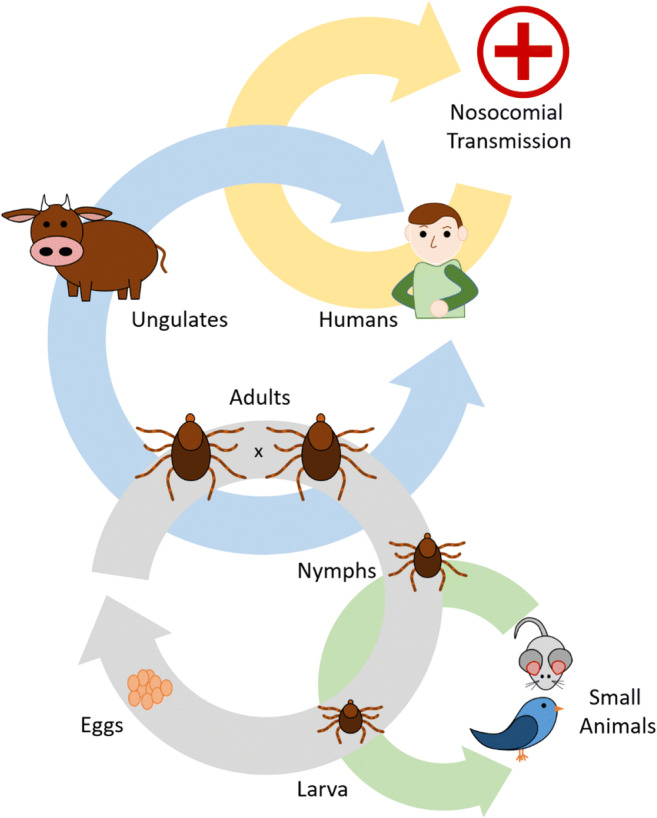
Fig. 1
Fig. 1
Life cycle and transmission of Hyalomma spp ticks. Hyalomma spp. maintain a two-host life-cycle, initially molting from larva to nymphs on small animals, such as birds and rodents, then transitioning to larger vertebrate, including humans. Direct contact with CCHFV infected ticks, infected non-human vertebrates, and nosocomial transmission represent significant sources of human infection. The effects of increasing human movement, vertebrate host migration, and climate change which affects migratory habits of small animals threatens to increase CCHFV infections within the population

References

    1. Hawman DW, Feldmann H. Recent advances in understanding Crimean-Congo hemorrhagic fever virus. F1000Res. 2018;7:F1000. doi: 10.12688/f1000research.16189.1. - DOI - PMC - PubMed
    1. Hoogstraal H. Review article1: the epidemiology of tick-borne Crimean-Congo hemorrhagic fever in Asia, Europe, and Africa23. J Med Entomol. 1979;15(4):307–417. doi: 10.1093/jmedent/15.4.307. - DOI - PubMed
    1. Casals J. Antigenic similarity between the virus causing Crimean hemorrhagic fever and Congo virus. Proc Soc Exp Biol Med. 1969;131(1):233–236. doi: 10.3181/00379727-131-33847. - DOI - PubMed
    1. Bente DA, Forrester NL, Watts DM, McAuley AJ, Whitehouse CA, Bray M. Crimean-Congo hemorrhagic fever: history, epidemiology, pathogenesis, clinical syndrome and genetic diversity. Antivir Res. 2013;100(1):159–189. doi: 10.1016/j.antiviral.2013.07.006. - DOI - PubMed
    1. Raju R, Kolakofsky D. The ends of La Crosse virus genome and antigenome RNAs within nucleocapsids are base paired. J Virol. 1989;63(1):122–128. doi: 10.1128/jvi.63.1.122-128.1989. - DOI - PMC - PubMed

LinkOut - more resources