. 2021 Feb 25;24(3):102231.
doi: 10.1016/j.isci.2021.102231. eCollection 2021 Mar 19.

Rad52 SUMOylation functions as a molecular switch that determines a balance between the Rad51- and Rad59-dependent survivors

Affiliations

Rad52 SUMOylation functions as a molecular switch that determines a balance between the Rad51- and Rad59-dependent survivors

Ferose Charifi et al. iScience. .

Abstract

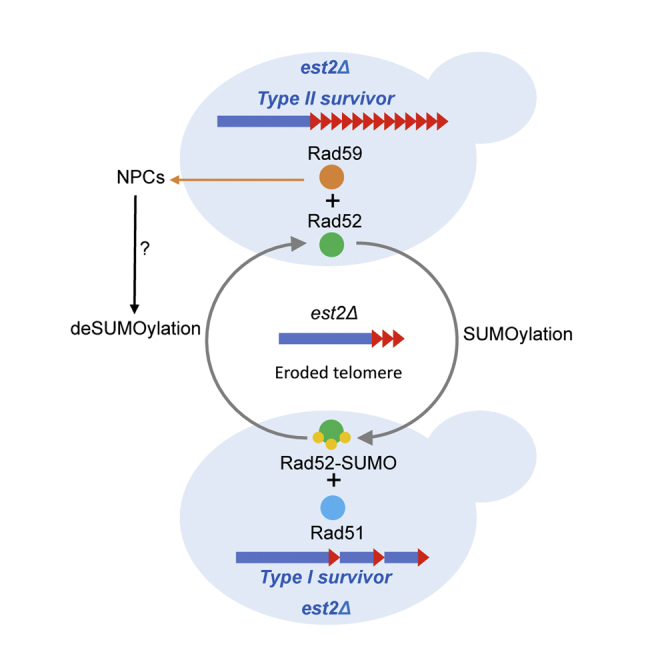
Functional telomeres in yeast lacking telomerase can be restored by rare Rad51- or Rad59-dependent recombination events that lead to type I and type II survivors, respectively. We previously proposed that polySUMOylation of proteins and the SUMO-targeted ubiquitin ligase Slx5-Slx8 are key factors in type II recombination. Here, we show that SUMOylation of Rad52 favors the formation of type I survivors. Conversely, preventing Rad52 SUMOylation partially bypasses the requirement of Slx5-Slx8 for type II recombination. We further report that SUMO-dependent proteasomal degradation favors type II recombination. Finally, inactivation of Rad59, but not Rad51, impairs the relocation of eroded telomeres to the Nuclear Pore complexes (NPCs). We propose that Rad59 cooperates with non-SUMOylated Rad52 to promote type II recombination at NPCs, resulting in the emergence of more robust survivors akin to ALT cancer cells. Finally, neither Rad59 nor Rad51 is required by itself for the survival of established type II survivors.

Keywords: Biological Sciences; Cell Biology; Molecular Biology.


Conflict of interest statement

The authors declare no competing interests.

Figures
None
Graphical abstract
Figure 1
Figure 1
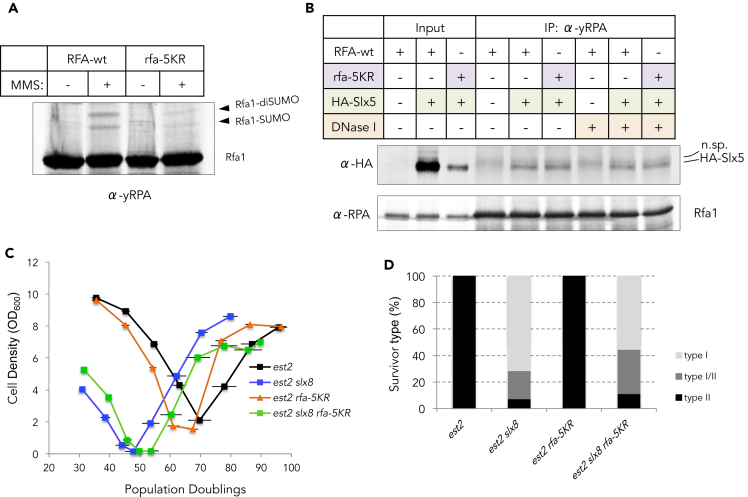
SUMOylation-deficient RPA mutant retains basal interaction with Slx5 and does not affect type II survivor formation (A) The effect of rfa-5KR mutation on MMS-induced Rfa1 SUMOylation was analyzed by immunoblotting with anti-RFA serum. The cells were treated with 0.25% MMS for 2 h where indicated. (B) Co-immunoprecipitation of the HA-Slx5 with either Rfa1 wild-type or Rfa-5KR proteins. The presence of HA-Slx5 in the anti-RPA immunoprecipitates was determined by anti-HA (12CA5) immunoblotting. The fuzzy band detected in all anti-RPA immunoprecipitates is due to cross-reactivity of the anti-HA antibody with unknown protein precipitating with anti-RPA serum. To verify DNA-independent interaction between HA-Slx5 and Rfa1, the extracts were treated with DNase I (100 μg/mL) for 30 min on ice prior to immunoprecipitation. (C) Mean senescence profiles of est2Δ (n = 12), est2Δ slx8Δ (n = 8), est2Δ rfa-5KR (n = 17), and est2Δ rfa-5KR slxΔ8 (n = 9) clones. Each clone issued from a spore colony was propagated in liquid culture through daily serial dilution. OD600 was measured every day to estimate the cell density reached in 24 h. PD numbers were estimated from the initial spores. Bars are SD. (D) Relative frequencies of the telomerase-independent survivor types formed by the clones analyzed in (C). Note that the profile of est2Δ slx8Δ is from a total of 28 clones that have been analyzed throughout this study (see also Figure 4).
Figure 2
Figure 2
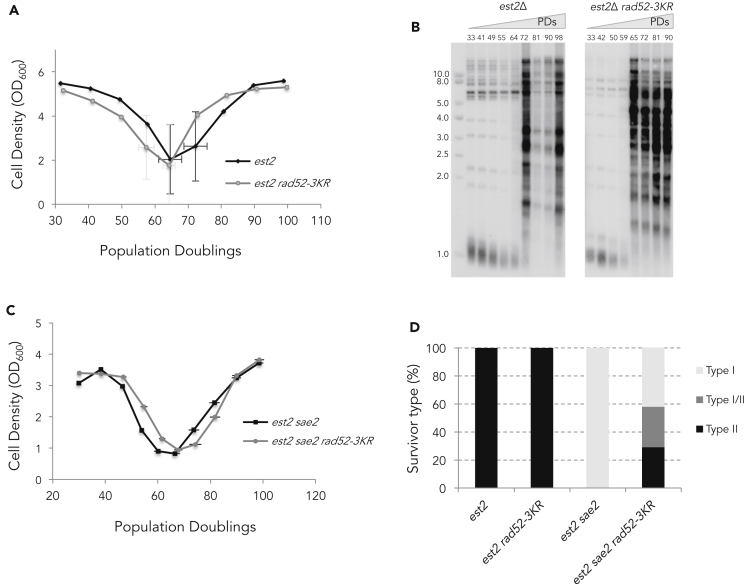
The absence of Rad52 SUMOylation accelerates replicative senescence and facilitates type II survivor formation (A) Mean replicative senescence curves of est2Δ and est2Δ rad52-3KR (n = 26). Error bars are SDs. (B) Telomere length and recombination were analyzed by TG1-3 probed Southern blot of XhoI-digested DNA prepared from samples of the replicative senescence. The result for two representative clones is shown. The number of PDs from spore germination is indicated. (C) Mean senescence profiles of est2Δ saeΔ (n = 4), est2Δ and est2Δ rad52-3KR (n = 7) clones. (D) Relative frequencies of the telomerase-independent survivor types for est2Δ (n = 44), est2Δ rad52-3KR (n = 26), est2Δ sae2Δ (n = 4), and est2Δ sae2Δ rad52-3KR (n = 7) clones.
Figure 3
Figure 3
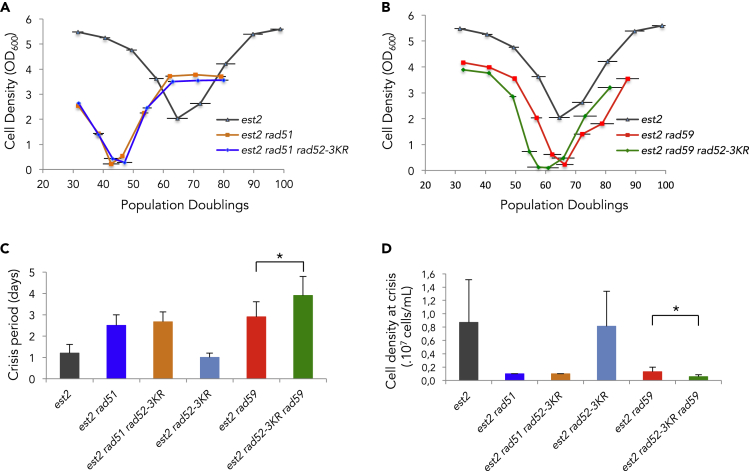
The rad52-3KR mutation impairs Rad51-dependent type I survivor formation (A) Mean replicative senescence curves of est2Δ, est2Δ rad51Δ (n = 4), and est2Δ rad51Δ rad52-3KR (n = 3) cells. Bars are SD. (B) Replicative senescence est2Δ, est2Δ rad59Δ (n = 10), and est2Δ rad59Δ rad52-3KR (n = 8) clones. Bars are SD. (C) The crisis period is determined as the number of days the cell population stays arrested for each individual clones analyzed. Crisis period average calculated for each mutant is represented. T test analysis between crisis period of est2Δ rad59Δ and est2Δ rad59Δ rad52-3KR spores scores 0.029 (∗). (D) Cell density at crisis corresponds to the optical density (OD) at 600nm measured at the nadir of crisis. Average of the lowest OD600 during replicative senescence is represented for each mutant. T test analysis between est2Δ rad59Δ and est2Δ rad59Δ rad52-3KR spores scores 0.016 (∗).
Figure 4
Figure 4
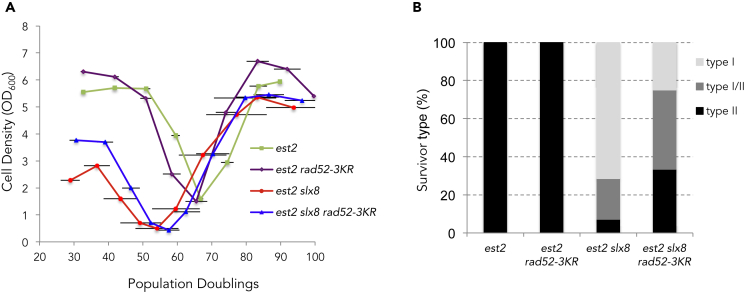
The rad52-3KR mutation partially bypasses the need for Slx8 for type II survivor formation (A) Mean senescence profiles of est2Δ (n = 7), est2Δ slx8Δ (n = 11), est2Δ rad52-3KR (n = 6), and est2Δ rad52-3KR slxΔ8 (n = 14) clones. The est2Δ slx8Δ profile is as in Figure 1D and is shown for comparison. Bars are SD. (B) Relative frequencies of the telomerase-independent survivor types formed by the clones analyzed in (A).
Figure 5
Figure 5
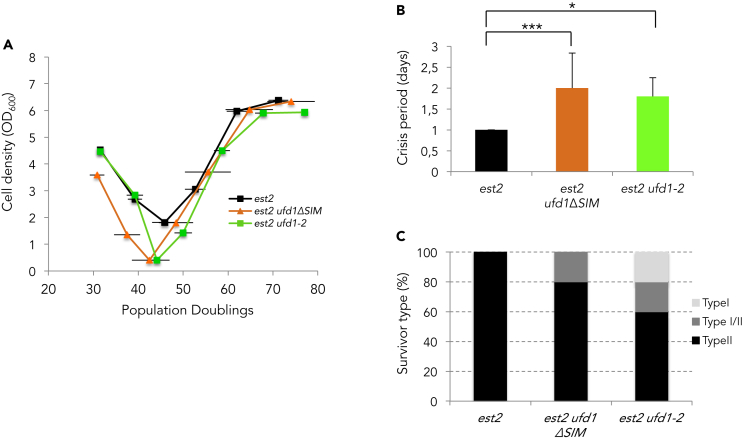
Ufd1 mutants impact type II recombination (A) Mean replicative senescence curves of est2Δ (n = 6), est2Δ ufd1ΔSIM (n = 6), and est2Δ ufd1-2 (n = 6) cells. Bars are SD. (B) Average of the length of the crisis period for each mutant is represented (see Figure 3C). Statistical differences were determined by a Fisher's exact test (∗p = 0.022, ∗∗∗p = 0.008). (C) Relative frequencies of the telomerase-independent survivor types formed.
Figure 6
Figure 6
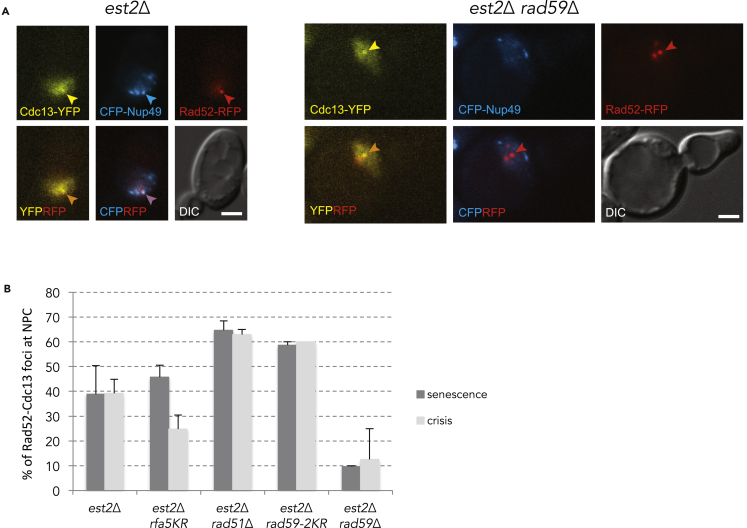
Rad59, but not Rad51, is required to tether eroded telomeres at the NPC (A) Co-localization of Cdc13-YFP/Rad52-RFP foci with CFP-Nup49 during replicative senescence in est2Δ cells. Eroded telomeres in est2Δ cells are detected as foci containing both Rad52-RFP and Cdc13-YFP in the nup133ΔN background, which causes Nup49-CFP (NPCs) to cluster at one side of the nucleus. Representative images illustrating the colocalization of Cdc13, Rad51, and Nup49 are shown. (B) Quantification of the triple colocalization of Cdc13-YFP, Rad52-RFP, and Nup49-CFP during senescence and at the time of crisis. The data are represented as the means ± SEM for 4, 2, 4, 2, and 2 biological replicates for the est2Δ, est2 rfa1-5KR, est2Δ rad51Δ, est2Δ rad59-2KR, and est2Δ rad59Δ mutants, respectively. Control est2Δ are from Churikov et al., (2016).
Figure 7
Figure 7
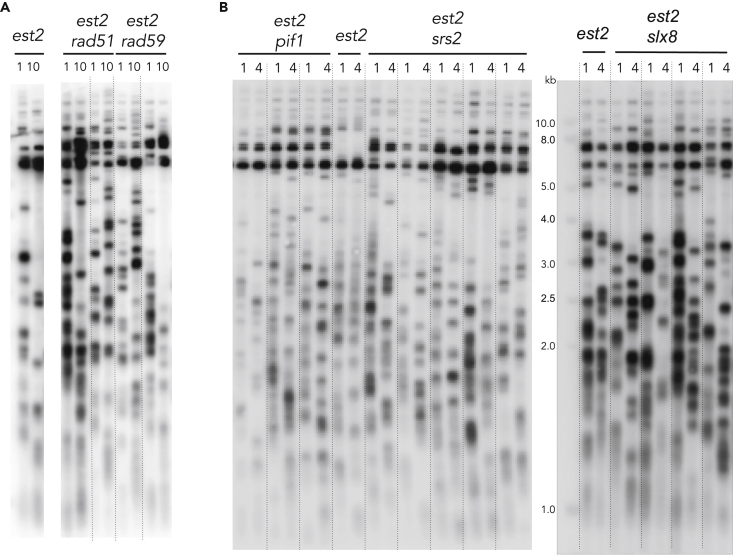
Rad59 is not required for the maintenance of type II survivors (A) RAD59 and RAD51 genes were deleted in an est2Δ diploid strain obtained by mating two type II survivors. Haploid type II survivors with the indicated genotypes were obtained after dissection and the spore colonies serially restreaked every two days on YPD plates. The telomere length distribution was analyzed by TG1-3 probed southern blot analysis of DNA isolated at the first and the 10th streak. (B) A similar approach was used to delete SRS2, SLX8, and PIF1 in already formed type II survivors. Telomere length were analyzed as in (A) after 1 and 4 restreaks on plates from independent spore colonies.

References

    1. Aguilera P., Whalen J., Minguet C., Churikov D., Freudenreich C., Simon M.-N., Géli V. The nuclear pore complex prevents sister chromatid recombination during replicative senescence. Nat. Commun. 2020;11:160. - PMC - PubMed
    1. Altmannova V., Eckert-Boulet N., Arneric M., Kolesar P., Chaloupkova R., Damborsky J., Sung P., Zhao X., Lisby M., Krejci L. Rad52 SUMOylation affects the efficiency of the DNA repair. Nucleic Acids Res. 2010;38:4708–4721. - PMC - PubMed
    1. Andrulis E.D., Zappulla D.C., Ansari A., Perrod S., Laiosa C.V., Gartenberg M.R., Sternglanz R. Esc1, a nuclear periphery protein required for sir4-based plasmid anchoring and partitioning. Mol. Cell. Biol. 2002;22:8292–8301. - PMC - PubMed
    1. Audry J., Maestroni L., Delagoutte E., Gauthier T., Nakamura T.M., Gachet Y., Saintomé C., Géli V., Coulon S. RPA prevents G-rich structure formation at lagging-strand telomeres to allow maintenance of chromosome ends. EMBO J. 2015;34:1942–1958. - PMC - PubMed
    1. Bergink S., Ammon T., Kern M., Schermelleh L., Leonhardt H., Jentsch S. Role of Cdc48/p97 as a SUMO-targeted segregase curbing Rad51-Rad52 interaction. Nat. Cell Biol. 2013;15:526–532. - PubMed

LinkOut - more resources