


Preterm care during the COVID-19 pandemic: A comparative risk analysis of neonatal deaths averted by kangaroo mother care versus mortality due to SARS-CoV-2 infection
- PMID: 33748724
- PMCID: PMC7955179
- DOI: 10.1016/j.eclinm.2021.100733
Preterm care during the COVID-19 pandemic: A comparative risk analysis of neonatal deaths averted by kangaroo mother care versus mortality due to SARS-CoV-2 infection
Abstract
Background: COVID-19 is disrupting health services for mothers and newborns, particularly in low- and middle-income countries (LMIC). Preterm newborns are particularly vulnerable. We undertook analyses of the benefits of kangaroo mother care (KMC) on survival among neonates weighing ≤2000 g compared with the risk of SARS-CoV-2 acquired from infected mothers/caregivers.
Methods: We modelled two scenarios over 12 months. Scenario 1 compared the survival benefits of KMC with universal coverage (99%) and mortality risk due to COVID-19. Scenario 2 estimated incremental deaths from reduced coverage and complete disruption of KMC. Projections were based on the most recent data for 127 LMICs (~90% of global births), with results aggregated into five regions.
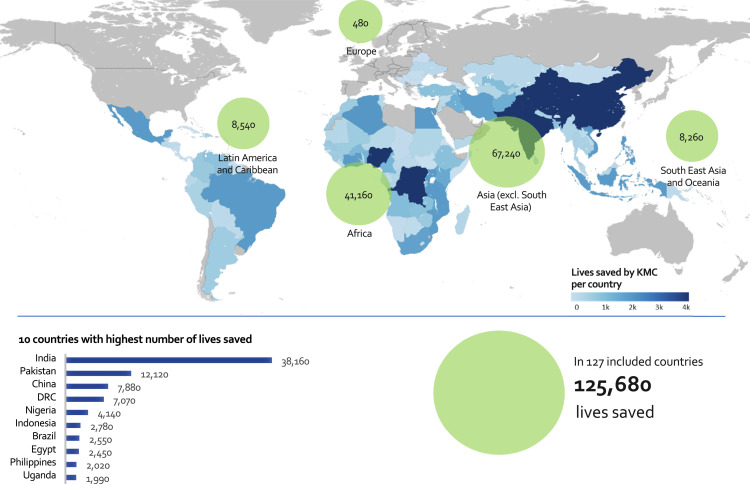
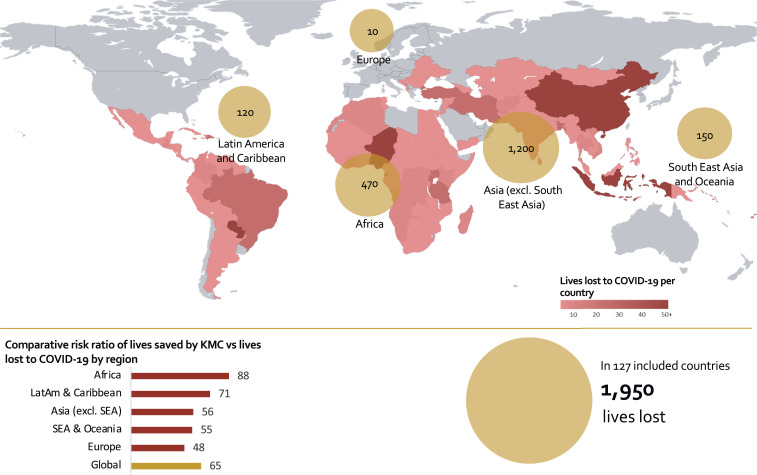
Findings: Our worst-case scenario (100% transmission) could result in 1,950 neonatal deaths from COVID-19. Conversely, 125,680 neonatal lives could be saved with universal KMC coverage. Hence, the benefit of KMC is 65-fold higher than the mortality risk of COVID-19. If recent evidence of 10% transmission was applied, the ratio would be 630-fold. We estimated a 50% reduction in KMC coverage could result in 12,570 incremental deaths and full disruption could result in 25,140 incremental deaths, representing a 2·3-4·6% increase in neonatal mortality across the 127 countries.
Interpretation: The survival benefit of KMC far outweighs the small risk of death due to COVID-19. Preterm newborns are at risk, especially in LMICs where the consequences of disruptions are substantial. Policymakers and healthcare professionals need to protect services and ensure clearer messaging to keep mothers and newborns together, even if the mother is SARS-CoV-2-positive.
Funding: Eunice Kennedy Shriver National Institute of Child Health & Human Development; Bill & Melinda Gates Foundation; Elma Philanthropies; Wellcome Trust; and Joint Global Health Trials scheme of Department of Health and Social Care, Department for International Development, Medical Research Council, and Wellcome Trust.
Keywords: Breastfeeding; Covid-19; Kangaroo mother care; Low birthweight; Neonatal mortality; Newborn; Preterm; SARS-CoV-2.
© 2021 The Authors.
Conflict of interest statement
We declare no competing interests.
Figures
References
-
- UN Inter-agency Group for Child Mortality Estimation. Levels & Trends in Child Mortality: Report 2020. New York; 2020. [cited 2020 Oct 9]. Available from: https://data.unicef.org/resources/levels-and-trends-in-child-mortality/.
-
- Lawn J., Blencowe H., Oza S. Every Newborn: progress, priorities, and potential beyond survival. Lancet. 2014;384:189–205. - PubMed
-
- WHO. Causes of child death, 2017. Geneva; 2018 [cited 2020 Aug 14]. Available from: https://www.who.int/data/gho/data/themes/topics/indicator-groups/indicat....
-
- WHO. Survive and thrive: transforming care for every small and sick newborn. Geneva; 2019. [cited 2020 Jul 18]. Available from: https://www.unicef.org/media/58076/file.
Grants and funding
LinkOut - more resources
Full Text Sources
Other Literature Sources
Miscellaneous
