


Outcomes reported in evaluations of programs designed to improve health in Indigenous people
- PMID: 33748978
- PMCID: PMC8586489
- DOI: 10.1111/1475-6773.13653
Outcomes reported in evaluations of programs designed to improve health in Indigenous people
Abstract
Objective: To assess the outcomes reported and measured in evaluations of complex health interventions in Indigenous communities.
Data sources: We searched all publications indexed in MEDLINE, PreMEDLINE, EMBASE, PsycINFO, EconLit, and CINAHL until January 2020 and reference lists from included papers were hand-searched for additional articles.
Study design: Systematic review.
Data collection/extraction methods: We included all primary studies, published in peer-reviewed journals, where the main objective was to evaluate a complex health intervention developed specifically for an Indigenous community residing in a high-income country. Only studies published in English were included. Quantitative and qualitative data were extracted and summarized.
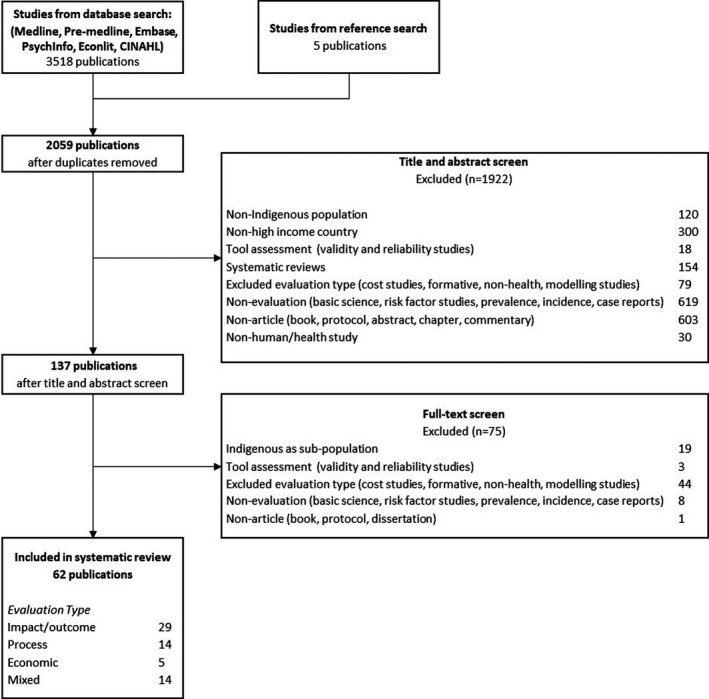
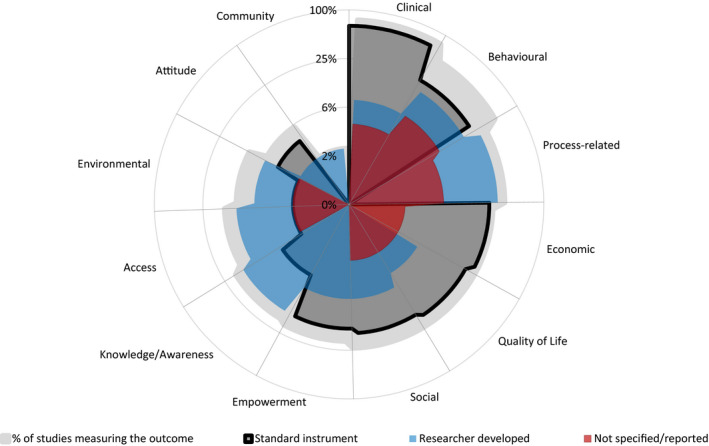
Principal findings: Of the 3523 publications retrieved, 62 evaluation studies were included from Australia, the United States, Canada, and New Zealand. Most studies involved less than 100 participants and were mainly adults. We identified outcomes across 13 domains: clinical, behavioral, process-related, economic, quality of life, knowledge/awareness, social, empowerment, access, environmental, attitude, trust, and community. Evaluations using quantitative methods primarily measured outcomes from the clinical and behavioral domains, while the outcomes reported in the qualitative studies were mostly from the process-related and empowerment domains.
Conclusion: The outcomes from qualitative evaluations, which better reflect the impact of the intervention on participant health, remain different from the outcomes routinely measured in quantitative evaluations. Measuring the outcomes from qualitative evaluations alongside outcomes from quantitative evaluations could result in more relevant evaluations to inform decision making in Indigenous health.
Keywords: Indigenous health; complex health interventions; evaluation; outcomes; policy.
© 2021 Health Research and Educational Trust.
Conflict of interest statement
None to declare.
Figures
References
-
- Brewster DR, Morris PS. Indigenous child health: are we making progress? J Paediatr Child Health. 2015;51(1):40‐47. - PubMed
-
- Anderson I, Robson B, Connolly M, et al. Indigenous and tribal peoples' health (The Lancet‐Lowitja Institute Global Collaboration): a population study. The Lancet. 2016;388(10040):131‐157. - PubMed
-
- Scott PJ. Mixed methods: a paradigm for holistic evaluation of health IT. Ammenwerth E, Rigby M, eds. Evidence‐Based Health Informatics. 2016;102–113. - PubMed
-
- Springett J. Appropriate approaches to the evaluation of health promotion. Critical Public Health. 2001;11(2):139‐151.
-
- Jan S. A holistic approach to the economic evaluation of health programs using institutionalist methodology. Soc Sci Med. 1998;47(10):1565‐1572. - PubMed
Publication types
MeSH terms
LinkOut - more resources
Full Text Sources
Other Literature Sources
