


Unmet Need for Equipment to Help With Bathing and Toileting Among Older US Adults
- PMID: 33749707
- PMCID: PMC7985819
- DOI: 10.1001/jamainternmed.2021.0204
Unmet Need for Equipment to Help With Bathing and Toileting Among Older US Adults
Abstract
Importance: Home modification through seemingly mundane equipment, such as grab bars and shower seats, mitigates injury, dependence, and reduced quality of life in older adults coping with increasing disability. However, whether these interventions are underused in the US is unclear.
Objective: To estimate how many older adults who need equipment to help with bathing and toileting do not have it, describe factors associated with not having equipment, and describe how many who did not initially have equipment acquired equipment over time.
Design: This observational cohort study of participants 65 years or older used secondary data from the 2015 to 2019 waves of the US National Health and Aging Trends Study. Participants included community-dwelling older adults who would unequivocally benefit from equipment, defined as those with poor physical performance or substantial difficulty bathing, toileting, transferring, or walking. Respondents were representative of the US population 65 years and older. Data were collected from May 2015 to October 2019 and analyzed from August 1, 2019, to February 24, 2021.
Exposures: Population characteristics (eg, age, sex, income, health conditions, and physical performance), environmental factors (eg, home ownership and living arrangement), and health behaviors (eg, prior knee and/or hip surgery).
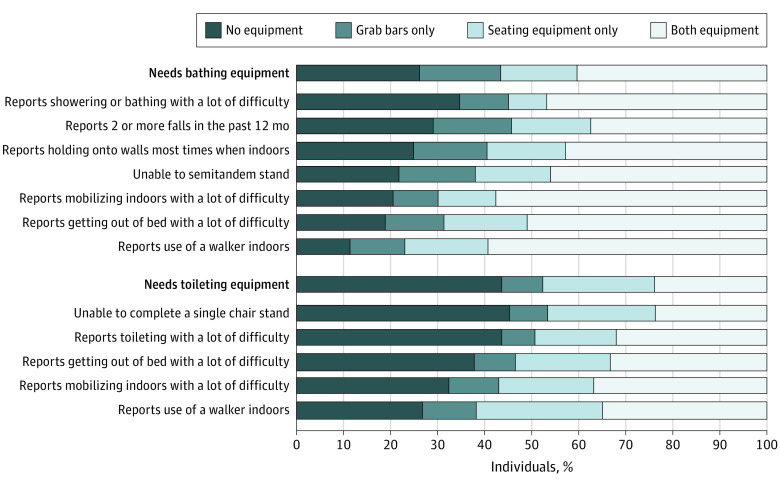
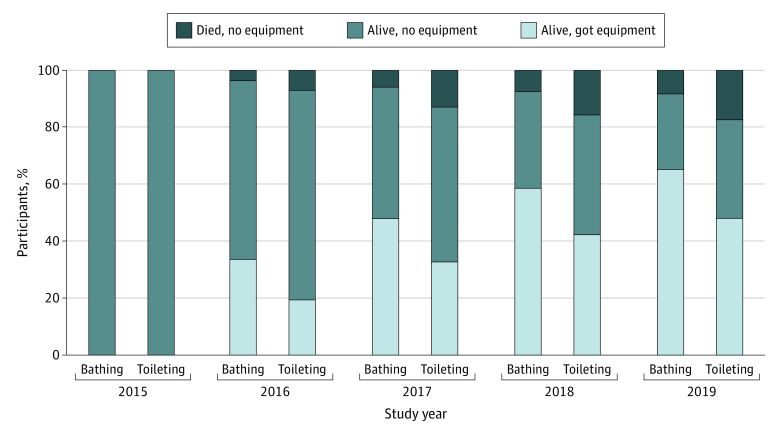
Main outcomes and measures: Prevalence of any unmet need for equipment, defined as either needing bathing equipment (bath grab bars and shower seat) but having none or needing toileting equipment (toilet grab bars and raised toilet seat) but having none and the cumulative incidence of equipment acquisition during 4 years of follow-up.
Results: A total of 2614 participants representing 12 million US individuals would benefit from equipment. The mean (SD) age was 80.5 (8.2) years, and 1619 individuals (62%) were women. Of these, an estimated 5 million individuals (42%; 95% CI, 39%-44%) had an unmet need. After adjustment for age, sex, and race/ethnicity, unmet need was associated with younger age (49% if aged 65-74 years, 37% if aged 75-84 years, and 29% if aged ≥85 years; P < .001), having fewer health conditions (55% if none vs 39% if ≥3; P = .002), non-White race/ethnicity (40% if White vs 51% if Black, 54% if Hispanic, and 55% if other; P < .001), no recent hospitalization (46% vs 37% if hospitalized; P = .001), and no prior knee and/or hip fracture or surgery (46% vs 35% if prior fracture or surgery; P < .001). After 4 years of follow-up, 35% of those with bathing equipment needs and 52% of those with toileting equipment needs never received equipment.
Conclusions and relevance: This cohort study suggests that in the US, 42% of older adults with impairments that would make bathing or toileting difficult lack equipment to assist. This situation is a missed opportunity to help 5 million individuals live independently and safely.
Conflict of interest statement
Figures
Comment in
-
Addressing Unmet Adaptive Equipment Needs Through Primary Care.JAMA Intern Med. 2021 May 1;181(5):670-671. doi: 10.1001/jamainternmed.2021.0398. JAMA Intern Med. 2021. PMID: 33749738 No abstract available.
References
-
- Rinaldo F, Altman M, Cannon K, et al. . Slowing Medicare spending by optimizing late-life needs. NEJM Catal. 2020;1(4):1-22. doi:10.1056/CAT.20.0290 - DOI
Publication types
MeSH terms
Grants and funding
LinkOut - more resources
Full Text Sources
Other Literature Sources
Medical
