. 2021 Jun;89(6):1129-1144.
doi: 10.1002/ana.26070. Epub 2021 Apr 22.

Meningeal CGRP-Prolactin Interaction Evokes Female-Specific Migraine Behavior

Affiliations

Meningeal CGRP-Prolactin Interaction Evokes Female-Specific Migraine Behavior

Amanda Avona et al. Ann Neurol. 2021 Jun.

Abstract

Objective: Migraine is three times more common in women. CGRP plays a critical role in migraine pathology and causes female-specific behavioral responses upon meningeal application. These effects are likely mediated through interactions of CGRP with signaling systems specific to females. Prolactin (PRL) levels have been correlated with migraine attacks. Here, we explore a potential interaction between CGRP and PRL in the meninges.

Methods: Prolactin, CGRP, and receptor antagonists CGRP8-37 or Δ1-9-G129R-hPRL were administered onto the dura of rodents followed by behavioral testing. Immunohistochemistry was used to examine PRL, CGRP and Prolactin receptor (Prlr) expression within the dura. Electrophysiology on cultured and back-labeled trigeminal ganglia (TG) neurons was used to assess PRL-induced excitability. Finally, the effects of PRL on evoked CGRP release from ex vivo dura were measured.

Results: We found that dural PRL produced sustained and long-lasting migraine-like behavior in cycling and ovariectomized female, but not male rodents. Prlr was expressed on dural afferent nerves in females with little-to-no presence in males. Consistent with this, PRL increased excitability only in female TG neurons innervating the dura and selectively sensitized CGRP release from female ex vivo dura. We demonstrate crosstalk between PRL and CGRP systems as CGRP8-37 decreases migraine-like responses to dural PRL. Reciprocally, Δ1-9-G129R-hPRL attenuates dural CGRP-induced migraine behaviors. Similarly, Prlr deletion from sensory neurons significantly reduced migraine-like responses to dural CGRP.

Interpretation: This CGRP-PRL interaction in the meninges is a mechanism by which these peptides could produce female-selective responses and increase the prevalence of migraine in women. ANN NEUROL 2021;89:1129-1144.


Conflict of interest statement

Potential Conflicts of Interest

Nothing to report.

Figures
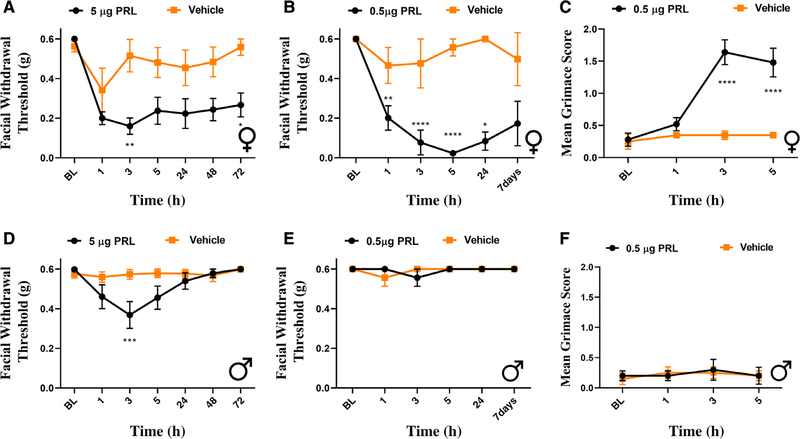
FIGURE 1:
FIGURE 1:
Dural prolactin induces greater behavioral responses in female mice. Male and female mice had mechanical withdrawal thresholds assessed prior to dural injection of either 5 μg or 0.5 μg PRL. Following 5 μg PRL, both female (A) (n = 7 PRL, 6 vehicle) and male (D) (n = 7 PRL, 7 vehicle) mice exhibited facial hypersensitivity. Only females exhibited a significant hypersensitivity at low dose PRL (B) (n = 5 PRL, 4 vehicle). Animals that received 0.5 μg of PRL were additionally assessed for grimace prior to facial testing at each time point (C). Female mice that received this dose of PRL experienced significant grimace in comparison with respective controls, while male mice (n = 4 PRL, 4 vehicle) exhibited no significant grimace. Two-way ANOVA followed by Bonferroni multiple comparison analysis indicated significant differences between females that received PRL when compared with those that received vehicle. Data are represented as means ± SEM. *p < 0.05, **p < 0.01, ***p < 0.001, ****p < 0.0001. See Table S1 for additional results of analysis.
FIGURE 2:
FIGURE 2:
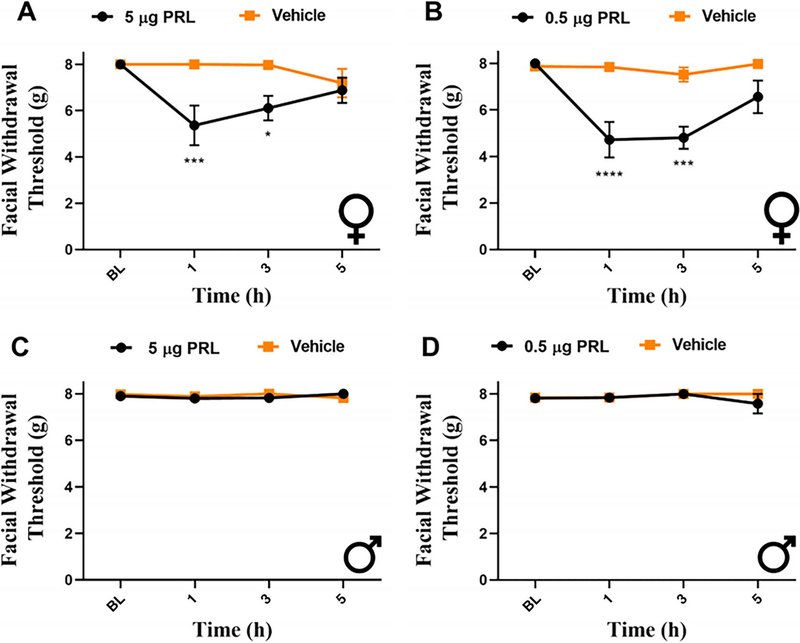
Dural prolactin causes female-specific behavioral responses in rats. Facial withdrawal thresholds were measured in female and male rats prior to and following dural injection of either 5 μg (A, C) or 0.5 μg dural PRL (B, D). Two-way ANOVA followed by Bonferroni multiple comparison analysis indicated significant differences between females that received 5 μg PRL (n = 8 PRL) when compared with those that received vehicle (n = 9). No significant responses were seen in males at this dose (n = 8 PRL, 7 vehicle). At the 0.5 μg PRL dose, female mice that received PRL (n = 8) demonstrated significant hypersensitivity when compared with controls (n = 7). No significant effect was found in males (n = 5 PRL, 5 vehicle). Data are represented as means ± SEM. *p < 0.05,***p < 0.001, ****p < 0.0001. See Table S1 for additional results of analysis.
FIGURE 3:
FIGURE 3:
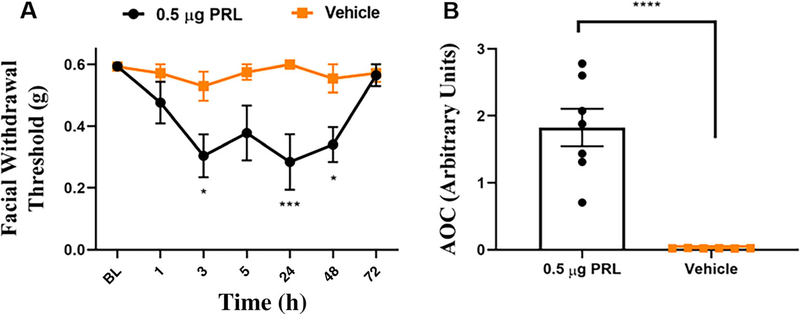
Dural PRL induces behavioral responses in ovariectomized female mice. Ovariectomized female mice received dural injection of either 0.5 μg PRL (n = 8) or vehicle (n = 8), 3 weeks after surgery. Data are additionally represented as area over the curve (B). Two-way ANOVA followed by Bonferroni multiple comparison analysis indicated significant differences between OVX females that received PRL and those that received vehicle. Data are represented as means ± SEM. *p < 0.05, **p < 0.01„***p < 0.001, ****p < 0.0001. See Table S1 for additional results of analysis.
FIGURE 4:
FIGURE 4:
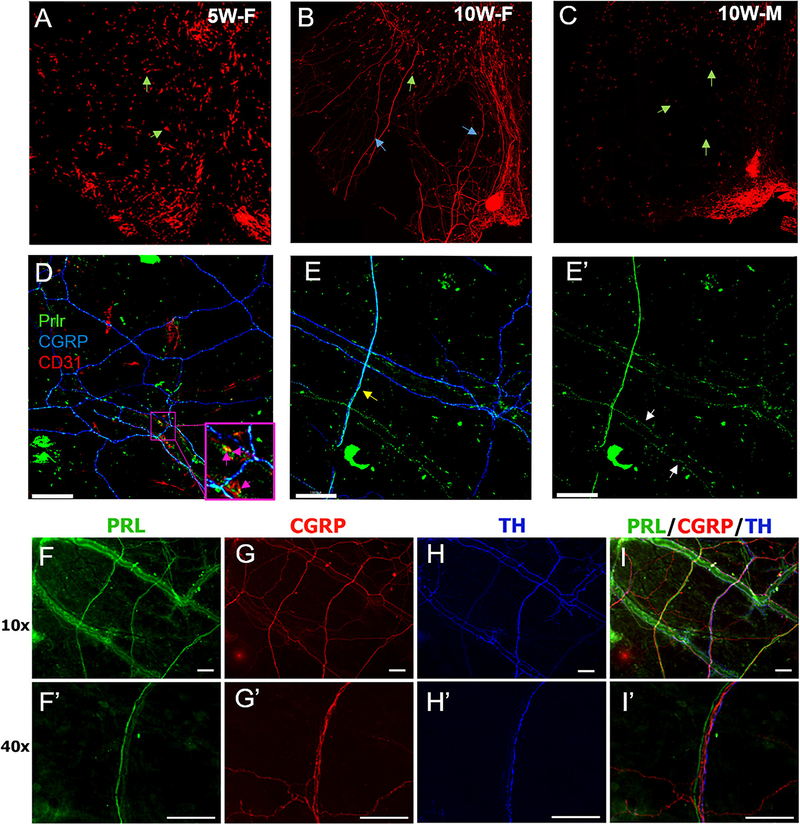
Expression of Prolactin and prolactin receptor in mouse dura. A 3 x 3 mm square area of dura mater from 5-week-old female (A), 10-week-old female (B) and 10-week-old male (C) Prlrcre/-/TdT mice. Green arrows mark Prlr-cre+non-neuronal cells. Blue arrows mark Prlr-cre+dural afferent fibers. Objective (10x, scale bars represent 120 μm). Dura mater from 10-week-old female Prlrcre/-/TdT mice labeled with anti-CGRP and anti-CD31 antibodies (D). Pink arrows show dural blood vessel co-expressing Prlr-cre+(Green) and CD31 + (Red) cells. Objective (20x, scale bars = 120 μm). Prlr-cre+dural afferent fibers express CGRP (Blue) and are indicated with yellow arrows (E). White arrows mark Prlr-cre+ expression on non CGRP expressing dural fibers (E'). Objective (20x). PRL (F, F'), CGRP (G, G'), and TH (H, H') expression in female mouse dura. Overlap of (F-H) shown in (I). For 40x images scale bars represent 100 μm.
FIGURE 5:
FIGURE 5:
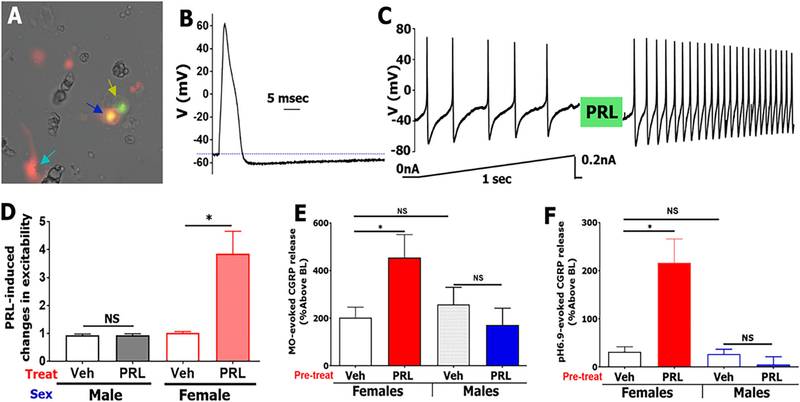
PRL selectively sensitizes Prlr-positive TG neurons innervating the dura of female mice. Prlr-cre+/WGA-488+ back-traced neurons from dura TG neuron (blue arrow) were selected for recording. Yellow arrow shows Prlr-cre-/WGA-488+ TG neuron. Sapphire arrow shows Prlr-cre+ non-neuronal cell. (A) Action potential (AP) from small-sized (25 pF) selected Prlr-cre +/WGA-488+ TG neuron. Stimulus waveform is 1,000 pA, 0.5 ms. (B) Train of APs in a selected Prlr-cre+/WGA-488+ TG neuron (same neurons as panels A and B) was stimulated with current ramp protocol shown below trace. The neuron was treated with exogenous PRL (200 ng/ml) for 5 min, and the same current ramp protocol was applied. Ratio of post-PRL AP frequency to before-PRL AP frequency reflects changes in excitability. (C) PRL-induced changes in excitability of Prlr-cre+/WGA-488+ TG neuron from females and males. Control is vehicle treatment between two current ramps, n = 7–14 (D) PRL (1 μg/ml)-induced sensitization of MO (0.01%)-evoked CGRP release from female and male dura biopsies, n = 4–6. (E) PRL (1 μg/ml)-induced sensitization of pH 6.9-evoked CGRP release from female and male dura biopsies, n = 4 (F) Statistics are 2-way ANOVA with variables as sex and treatment (NS, non-significant; *p < 0.05).
FIGURE 6:
FIGURE 6:
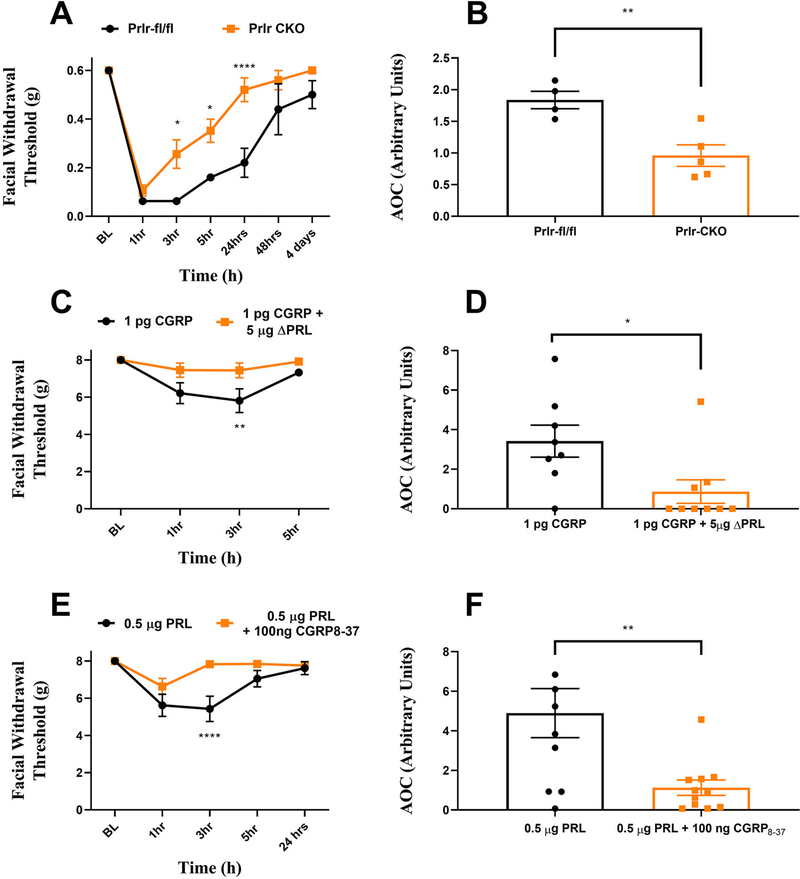
Crosstalk between the CGRP and PRL signaling systems within the dura. Female prolactin receptor CKO mice (n = 5) and their control littermates (n = 4) had mechanical withdrawal thresholds tested prior to and following injection with CGRP (A, B). Female rats had baseline thresholds assessed and received dural injection of 1 pg CGRP (C, D) (n = 9) or 1 pg of CGRP co-injected with 5 μg of delta PRL (n = 9). Co-injection with delta prolactin significantly attenuated CGRP induced responses, as indicated via two-way ANOVA followed by Bonferroni post-hoc analysis. A separate cohort of female rats received injection of either 0.5 μg dural PRL (n = 10) or co-injection of 0.5 μg PRL with 100 ng CGRP8–37 (E, F) (n = 11). Co-injection with CGRP8–37 significantly reduced behavioral responses to dural PRL. Data are represented as means ± SEM. **p < 0.01,****p < 0.0001. See Table S1 for additional results of analysis.
FIGURE 7:
FIGURE 7:
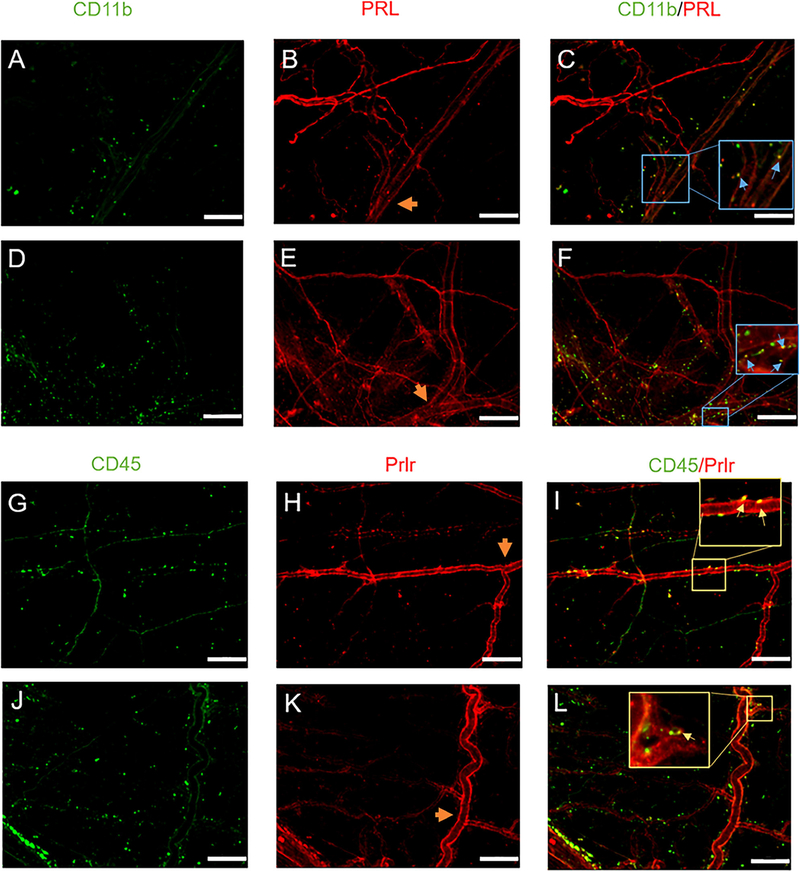
Expression of prolactin and prolactin receptor in non-neuronal cells in the dura. Dura mater was removed from 3–5-month-old female (A-C) and male (D-F) mice. These dura were processed and stained for PRL expression and co-stained with CD11b. Images were taken at 20x. Scale bars represent 100 μm. Blood vessels are included as a potential source of prolactin release. Orange arrow heads indicate the middle meningeal artery (MMA) which served as a biological marker to ensure images were taken from the same region of animals. CD11b expression (A, D), PRL expression (B, E) and the overlay is shown in (C, F). Inserts in (C, F) highlight overlap of PRL and CD11b. Expression of Prlr in intact females. Prolactin receptor expression (H) was assessed in 3–5-month-*old female mice, dura was co-stained for CD45 (G) and overlap shown in (I). Dura of littermate Prlr conditional knockout animals, that have Prlr deleted from Nav1.8 sensory neurons, were also stained to assess the presence of Prlr (J-L). Inserts in (I, L) highlight overlap of Prlr and CD45.
FIGURE 8:
FIGURE 8:
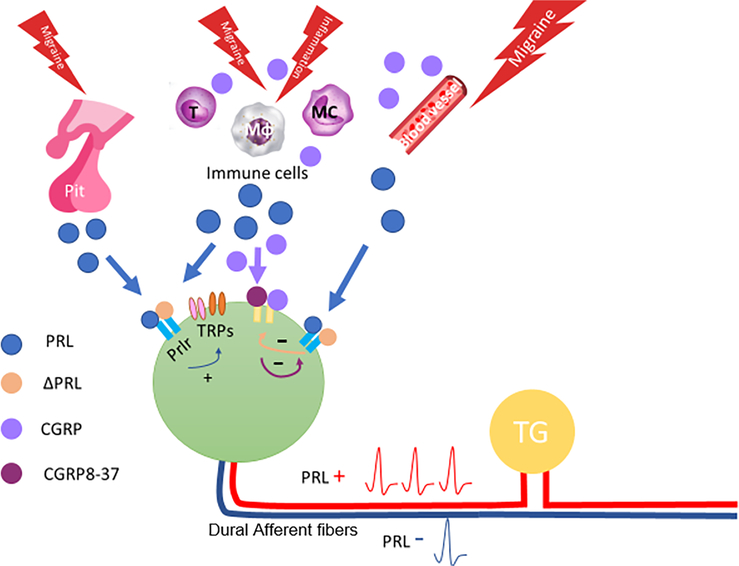
Hypothesized intercellular interactions within the dura. The pituitary (Pit), endothelial cells on blood vessels, immune cells (macrophages (Mφ), mast cells (MC), T cells (T)), and sensory neurons can all serve as potential PRL release sites during migraine. PRL can sensitize dural afferents in a paracrine manner via TRP and other channels. CGRP released from dural afferents may interact with immune cells and blood vessels leading to further PRL release. CGRP and PRL receptor antagonists mitigate intercellular signaling, where CGRP8–37 may block release of PRL from dural cells and nerve fibers (indicated via purple arrow), and ΔPRL may block additional sensitization of dural afferents (yellow arrow). These combined actions lead to sensitized afferent signaling from the dura (represented by PRL+).

Comment in

References

    1. Steiner TJ, Stovner LJ, Vos T, et al. Migraine is first cause of disability in under 50s: will health politicians now take notice? J Headache Pain 2018;19:17. - PMC - PubMed
    1. Reuwer AQ, Nowak-Sliwinska P, Mans LA, et al. Functional consequences of prolactin signalling in endothelial cells: a potential link with angiogenesis in pathophysiology? J Cell Mol Med 2012;16: 2035–2048. - PMC - PubMed
    1. Stewart WF, Shechter A, Rasmussen BK. Migraine prevalence. A review of population-based studies. Neurology 1994;44:S17–S23. - PubMed
    1. Buse DC, Loder EW, Gorman JA, et al. Sex differences in the prevalence, symptoms, and associated features of migraine, probable migraine and other severe headache: results of the American migraine prevalence and prevention (AMPP) study. Headache 2013; 53:1278–1299. - PubMed
    1. Ben-Jonathan N, LaPensee CR, LaPensee EW. What can we learn from rodents about prolactin in humans? Endocr Rev 2008;29:1–41. - PMC - PubMed

Publication types