Review
. 2021 Mar 9;7(1):26.
doi: 10.1038/s41531-021-00170-1.

Is LRRK2 the missing link between inflammatory bowel disease and Parkinson's disease?

Affiliations
Review

Is LRRK2 the missing link between inflammatory bowel disease and Parkinson's disease?

Mary K Herrick et al. NPJ Parkinsons Dis. .

Abstract

Links that implicate the gastrointestinal system in Parkinson's disease (PD) pathogenesis and progression have become increasingly common. PD shares several similarities with Crohn's disease (CD). Intestinal inflammation is common in both PD and CD and is hypothesized to contribute to PD neuropathology. Mutations in leucine-rich repeat kinase 2 (LRRK2) are one of the greatest genetic contributors to PD. Variants in LRRK2 have also been associated with increased incidence of CD. Since its discovery, LRRK2 has been studied intensely in neurons, despite multiple lines of evidence showing that LRRK2 is highly expressed in immune cells. Based on the fact that higher levels of LRRK2 are detectable in inflamed colonic tissue from CD patients and in peripheral immune cells from sporadic PD patients relative to matched controls, we posit that LRRK2 regulates inflammatory processes. Therefore, LRRK2 may sit at a crossroads whereby gut inflammation and higher LRRK2 levels in CD may be a biomarker of increased risk for sporadic PD and/or may represent a tractable therapeutic target in inflammatory diseases that increase risk for PD. Here we will focus on reviewing how PD and CD share overlapping phenotypes, particularly in terms of LRRK2 in the context of the immune system, that could be targeted in future therapies.


Conflict of interest statement

The authors declare no competing interests.

Figures
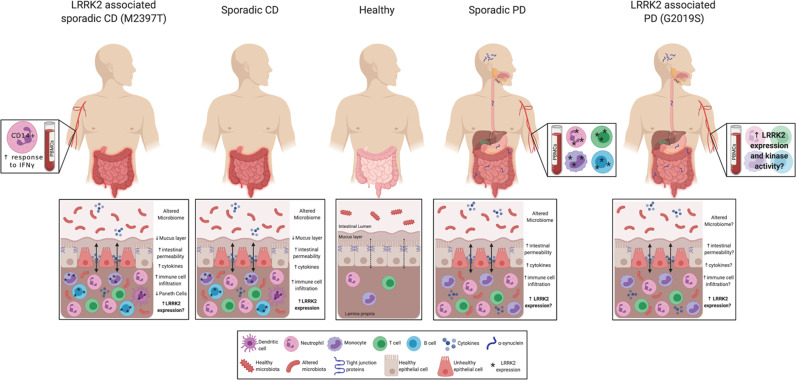
Fig. 1
Fig. 1. LRRK2 immune cell expression at the interface of PD and CD.
PD and CD exhibit very similar intestinal phenotypes with altered microbiome, increased intestinal permeability, cytokine secretion, and immune cell infiltration. While LRRK2 expression is increased in specific immune cells in the inflamed intestine in sporadic CD, LRRK2 expression in intestinal immune cells from PD patients has not been assessed. However, LRRK2 expression is increased in sporadic PD patient PBMCs, and CD14+ monocytes from LRRK2 M2397T CD patients have increased responses to IFNγ. While little is known about the LRRK2 expression and activity in the GI and peripheral immune systems of LRRK2 G2019S PD patients, we hypothesize that they will present with higher levels of LRRK2 expression and kinase activity and similar GI phenotypes as patients with non-LRRK2 PD. Given the current evidence for LRRK2’s role in sporadic and genetic PD and CD, we posit that LRRK2 regulates inflammatory responses in the periphery and this is the reason its levels are increased in chronic inflammatory conditions which may serve as a potential therapeutic. Figure created with Biorender.com.

References

    1. Christensen, K. V. et al. LRRK2 exonic variants associated with Parkinson’s disease augment phosphorylation levels for LRRK2-Ser1292 and Rab10-Thr73. bioRxiv10.1101/447946 (2018).
    1. Hui, K. Y. et al. Functional variants in the LRRK2 gene confer shared effects on risk for Crohn’s disease and Parkinson’s disease. Sci. Transl. Med.10.1126/scitranslmed.aai7795 (2018). - PMC - PubMed
    1. Michail S, Bultron G, Depaolo RW. Genetic variants associated with Crohn’s disease. Appl. Clin. Genet. 2013;6:25–32. doi: 10.2147/TACG.S33966. - DOI - PMC - PubMed
    1. Umeno J, et al. Meta-analysis of published studies identified eight additional common susceptibility loci for Crohn’s disease and ulcerative colitis. Inflamm. Bowel Dis. 2011;17:2407–2415. doi: 10.1002/ibd.21651. - DOI - PubMed
    1. Franke A, et al. Genome-wide meta-analysis increases to 71 the number of confirmed Crohn’s disease susceptibility loci. Nat. Genet. 2010;42:1118–1125. doi: 10.1038/ng.717. - DOI - PMC - PubMed

LinkOut - more resources
