. 2021 Mar 9;11(1):5522.
doi: 10.1038/s41598-021-85026-7.

Tert-butylhydroquinone attenuates doxorubicin-induced dysregulation of testicular cytoprotective and steroidogenic genes, and improves spermatogenesis in rats

Affiliations

Tert-butylhydroquinone attenuates doxorubicin-induced dysregulation of testicular cytoprotective and steroidogenic genes, and improves spermatogenesis in rats

Godwin Adakole Ujah et al. Sci Rep. .

Abstract

Doxorubicin (DOX) is a broad-spectrum chemotherapeutic drug used in the treatment of cancers. It acts by generating reactive oxygen species in target cells. The actions are, however, not limited to cancerous cells as it attacks healthy cells, killing them. This study investigated the benefits of the antioxidant, tert-butylhydroquinone (tBHQ), on testicular toxicity following DOX therapy. Twenty-four adult male albino rats were assigned randomly into four groups (n = 6), namely: normal control (NC), tBHQ, DOX and tBHQ + DOX groups. tBHQ (50 mg/kg body weight in 1% DMSO) was administered orally for 14 consecutive days, while a single DOX dose (7 mg/kg body weight) was administered intraperitoneally on Day 8. DOX decreased sperm count, motility and viability, and decreased the levels of steroidogenesis-related proteins, and reproductive hormones. Furthermore, DOX decreased the expression of antioxidant cytoprotective genes, and decreased the protein level of proliferating cell nuclear antigen in the testis. Conversely, DOX increased the expression of pro-inflammatory and pro-apoptotic genes in the testis. These negative effects were ameliorated following the intervention with tBHQ. Our results suggest that tBHQ protects the testis and preserves both steroidogenesis and spermatogenesis in DOX-treated rats through the suppression of oxidative stress, inflammation and apoptosis.


Conflict of interest statement

The authors declare no competing interests.

Figures
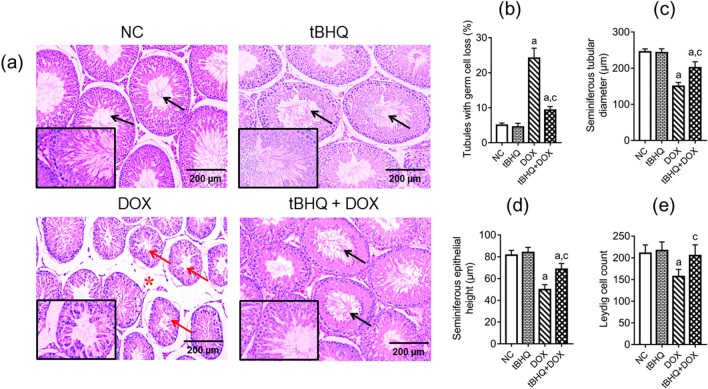
Figure 1
Figure 1
Effect of tBHQ on the testicular structure of DOX-treated rats. (a) Representative H&E staining light microscope images of testicular tissue (magnification: × 100, scale bar: 200 μm, and × 400, scale bar: 50 µm for representative images with black borders). DOX decreased seminiferous tubular diameter giving rise to large intertubular spaces (red asterisks). Numerous seminiferous tubules in DOX group had germ cell loss (red arrows) compared to the NC and tBHQ-treated groups showing several tubules with complete spermatogenesis and sperm cells in the lumen (black arrows). NC: normal control, tBHQ: tert-butylhydroquinone, DOX: doxorubicin, tBHQ + DOX: tert-butylhydroquinone + doxorubicin. Numerical data show seminiferous tubules with germ cell loss (b), seminiferous tubular diameter (c), seminiferous epithelial height (d), and Leydig cell count (e), respectively. Values are mean ± SD, n = 6/group. ap < 0.05 versus NC; cp < 0.05 versus DOX (One-way ANOVA with Tukey’s post-hoc test).
Figure 2
Figure 2
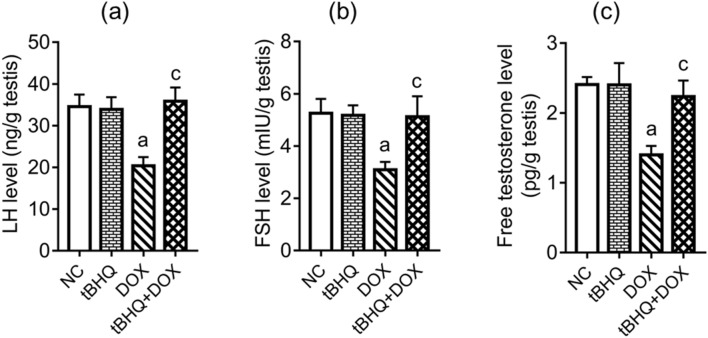
Effect of tBHQ on testicular levels of LH (a), FSH (b) and free testosterone (c) in DOX-treated rats. NC: normal control, tBHQ: tert-butylhydroquinone, DOX: doxorubicin, tBHQ + DOX: tert-butylhydroquinone + doxorubicin, FSH: follicle stimulating hormone, LH: luteinizing hormone. Values are mean ± SD, n = 6/group. ap < 0.05 versus NC; cp < 0.05 versus DOX (One-way ANOVA with Tukey’s post-hoc test).
Figure 3
Figure 3
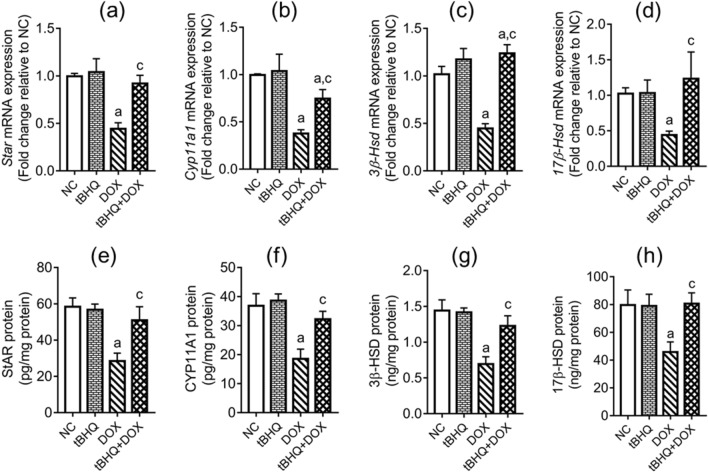
Effect of tBHQ on testicular mRNA and protein levels of StAR (a,e), CYP11A1 (b,f), 3β-HSD (c,g) and 17β-HSD (d,h) in DOX-treated rats. NC: normal control, tBHQ: tert-butylhydroquinone, DOX: Doxorubicin, tBHQ + DOX: tert-butylhydroquinone + doxorubicin, StAR: steroidogenic acute regulatory protein, CYP11A1: cholesterol side chain cleavage enzyme, HSD: hydroxysteroid dehydrogenase. Values are mean ± SD, n = 6/group. ap < 0.05 versus NC; cp < 0.05 versus DOX (One-way ANOVA with Tukey’s post-hoc test).
Figure 4
Figure 4
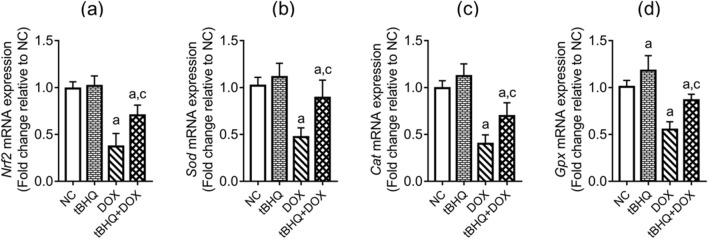
Effect of tBHQ on Nrf2 (a), Sod (b), Cat (c) and Gpx (d) mRNA levels in the testis of DOX-treated rats. NC: normal control, tBHQ: tert-butylhydroquinone, DOX: doxorubicin, tBHQ + DOX: tert-butylhydroquinone + doxorubicin, Nrf2: nuclear factor erythroid 2-related factor-2, SOD: superoxide dismutase, CAT: catalase, GPx: glutathione peroxidase. Values are mean ± SD, n = 6. ap < 0.05 versus NC; cp < 0.05 versus DOX (One-way ANOVA with Tukey’s post-hoc test).
Figure 5
Figure 5
Effect of tBHQ on Nf-κb (a), Inos (b), Tnf-α (c) and Il-10 (d) mRNA levels in the testis of DOX-treated rats. NC: normal control, tBHQ: tert-butylhydroquinone, DOX: doxorubicin, tBHQ + DOX: tert-butylhydroquinone + doxorubicin, Nf-κb: nuclear factor kappa B, Inos: inducible nitric oxide synthase, Il: interleukin, Tnf-α: tumor necrosis factor alpha. Values are mean ± SD, n = 6/group. ap < 0.05 versus NC; cp < 0.05 versus DOX (One-way ANOVA with Tukey’s post-hoc test).
Figure 6
Figure 6
Effect of tBHQ on Bax (a), Bcl2 (b), Bax/Bcl2 ratio (c) and Caspase-3 (d) mRNA levels in the testis of DOX-treated rats. NC: normal control, tBHQ: tert-butylhydroquinone, DOX: doxorubicin, tBHQ + DOX: tert-butylhydroquinone + doxorubicin, Bcl-2: Beta cell lymphoma-2, Bax: Bcl-2-associated X protein. Values are mean ± SD, n = 6. ap < 0.05 versus NC; cp < 0.05 versus DOX (One-way ANOVA with Tukey’s post-hoc test).
Figure 7
Figure 7
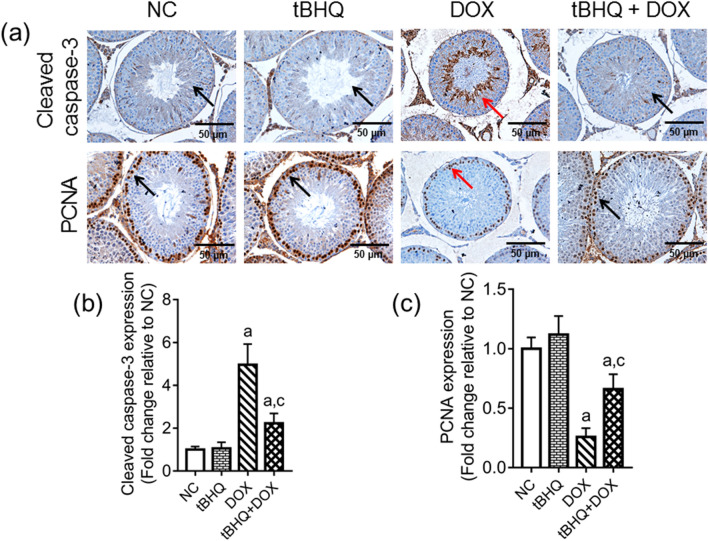
Effect of tBHQ on cleaved caspase-3 protein level (a,b) and PCNA protein level (a,c) in the testis of DOX-treated rats. NC: normal control, tBHQ: tert-butylhydroquinone, DOX: doxorubicin, PCNA: proliferating cell nuclear antigen. Cleaved caspase-3 protein level was highest in the seminiferous tubules of DOX group (red arrow) compared with the other three groups (black arrow), while PCNA protein level was lowest in the seminiferous tubules of DOX group (red arrow) relative to the other three groups (black arrow). Magnification: × 400, scale bar: 50 µm. For numerical data representing cleaved caspase-3 (b) and PCNA (c) protein levels, values are mean ± SD, n = 6/group. a p < 0.05 versus NC; c p < 0.05 versus DOX (One-way ANOVA with Tukey’s post-hoc test).
Figure 8
Figure 8
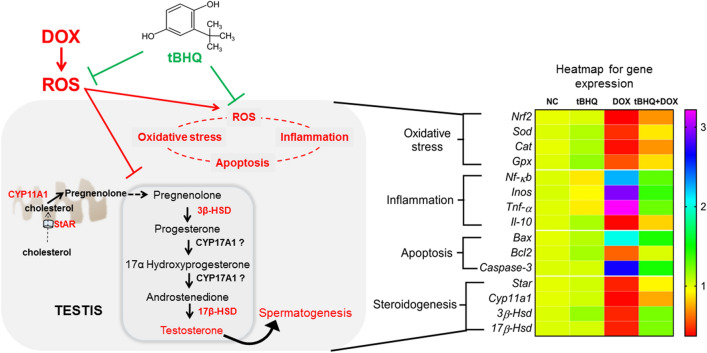
Schematic representation of the effect of tBHQ on DOX-induced testicular toxicity. DOX triggered ROS generation, causing oxidative stress, which in turn activated cytotoxic genes that control inflammation and apoptosis. Also, DOX-induced ROS generation altered genes that regulate steroidogenesis, causing testosterone decline and spermatogenesis impairment. However, pre-treatment with tBHQ offered some level of protection against DOX-induced toxicity as demonstrated by the heatmap of affected genes which have been grouped according to their targeted pathways. The heatmap key on the right side shows the expression levels of the genes; numbers greater than 1 depict upregulation while numbers below 1 depict downregulation. NC: normal control, tBHQ: tert-butylhydroquinone, DOX: doxorubicin, tBHQ + DOX: tert-butylhydroquinone + doxorubicin.

References

    1. Cortes-Funes H, Coronado C. Role of anthracyclines in the era of targeted therapy. Cardiovasc. Toxicol. 2007;7:56–60. doi: 10.1007/s12012-007-0015-3. - DOI - PubMed
    1. O'Bryan RM, et al. Phase II evaluation of adriamycin in human neoplasia. Cancer. 1973;32:1–8. doi: 10.1002/1097-0142(197307)32:1<1::AID-CNCR2820320101>3.0.CO;2-X. - DOI - PubMed
    1. Speth P, Van Hoesel Q, Haanen C. Clinical pharmacokinetics of doxorubicin. Clin. Pharmacokinet. 1988;15:15–31. doi: 10.2165/00003088-198815010-00002. - DOI - PubMed
    1. Wallace KB. Doxorubicin-induced cardiac mitochondrionopathy. Pharmacol. Toxicol. 2003;93:105–115. doi: 10.1034/j.1600-0773.2003.930301.x. - DOI - PubMed
    1. Marinello J, Delcuratolo M, Capranico G. Anthracyclines as topoisomerase II poisons: From early studies to new perspectives. Int. J. Mol. Sci. 2018;19:3480. doi: 10.3390/ijms19113480. - DOI - PMC - PubMed

LinkOut - more resources