Review
. 2021 May;78(10):4615-4637.
doi: 10.1007/s00018-021-03802-0. Epub 2021 Mar 10.

Oxidative stress and impaired oligodendrocyte precursor cell differentiation in neurological disorders

Affiliations
Review

Oxidative stress and impaired oligodendrocyte precursor cell differentiation in neurological disorders

Jan Spaas et al. Cell Mol Life Sci. 2021 May.

Abstract

Oligodendrocyte precursor cells (OPCs) account for 5% of the resident parenchymal central nervous system glial cells. OPCs are not only a back-up for the loss of oligodendrocytes that occurs due to brain injury or inflammation-induced demyelination (remyelination) but are also pivotal in plastic processes such as learning and memory (adaptive myelination). OPC differentiation into mature myelinating oligodendrocytes is controlled by a complex transcriptional network and depends on high metabolic and mitochondrial demand. Mounting evidence shows that OPC dysfunction, culminating in the lack of OPC differentiation, mediates the progression of neurodegenerative disorders such as multiple sclerosis, Alzheimer's disease and Parkinson's disease. Importantly, neurodegeneration is characterised by oxidative and carbonyl stress, which may primarily affect OPC plasticity due to the high metabolic demand and a limited antioxidant capacity associated with this cell type. The underlying mechanisms of how oxidative/carbonyl stress disrupt OPC differentiation remain enigmatic and a focus of current research efforts. This review proposes a role for oxidative/carbonyl stress in interfering with the transcriptional and metabolic changes required for OPC differentiation. In particular, oligodendrocyte (epi)genetics, cellular defence and repair responses, mitochondrial signalling and respiration, and lipid metabolism represent key mechanisms how oxidative/carbonyl stress may hamper OPC differentiation in neurodegenerative disorders. Understanding how oxidative/carbonyl stress impacts OPC function may pave the way for future OPC-targeted treatment strategies in neurodegenerative disorders.

Keywords: Carbonyl stress; Myelination; Neurodegeneration; Oligodendrocyte precursor cell; Oxidative stress.


Conflict of interest statement

The authors declare that they have no conflict of interest.

Figures
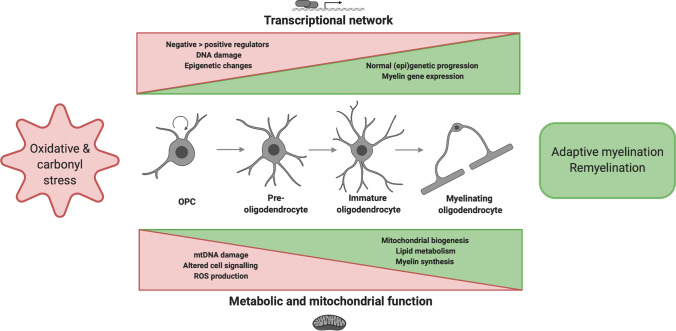
Fig. 1
Fig. 1
Outline of the review describing oxidative and carbonyl stress during transcriptional and metabolic changes associated with OPC differentiation. OPC differentiation occurs in at least four different stages characterised by increasing morphological complexity. By altering normal transcriptional and metabolic adaptations required for differentiation, oxidative/carbonyl stress may hamper oligodendrocyte development and consequently (re)myelination. OPC oligodendrocyte precursor cell; ROS reactive oxygen species. Figure created in BioRender
Fig. 2
Fig. 2
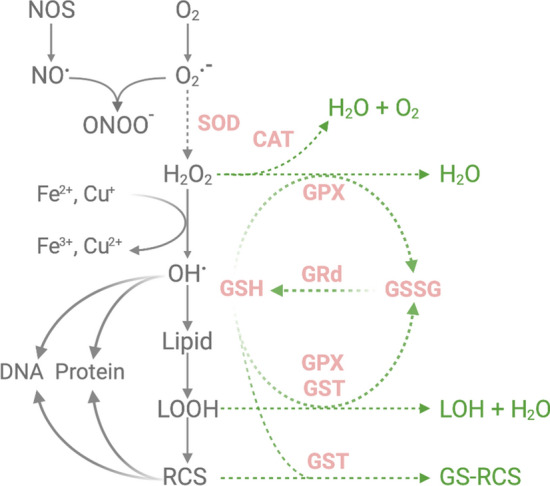
ROS generation and antioxidant defence in OPCs. The primary production and conversion pathways of ROS/RCS are shown on the left. The green arrows illustrate major antioxidant and detoxifying pathways. Enzymes and molecules with a known reduction in activity and/or expression in OPCs compared to mature oligodendrocytes and/or other CNS cell types are depicted in pink and with dotted lines. CAT catalase, Cu Copper, Fe Iron, GPX glutathione peroxidase, GRd glutathione reductase, GSH glutathione, GSSG glutathione disulphide, GST glutathione S-transferase, H2O2 hydrogen peroxide, LOH: lipid alcohol, LOOH lipid hydroperoxides, NOS nitric oxide synthase, NO· nitric oxide, O2 oxygen, O2•− superoxide, ONOO peroxynitrite, OH· hydroxyl radical, RCS reactive carbonyl species, SOD superoxide dismutase. Figure created in BioRender
Fig. 3
Fig. 3
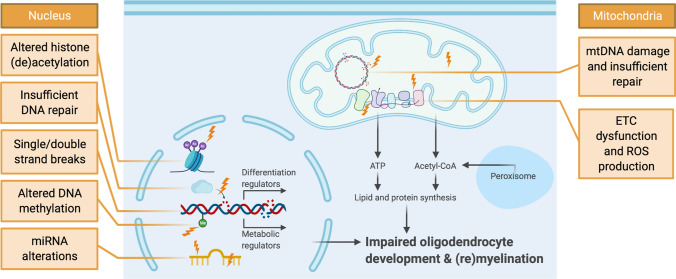
Putative effect of ROS/RCS on OPC (epi)genetics, mitochondria, cell signalling and cell differentiation. Oxidative stress (lightning bolts) affects many cellular compartments. In OPCs, this can lead to inadequate differentiation and impaired (re)myelination capacity. At the nuclear DNA (nDNA) level, oxidative stress may trigger multiple (epi)genetic alterations in OPCs (shown on the left). In addition, oxidative stress-induced changes in metabolism, mitochondrial function and mitochondrial DNA (mtDNA) may also contribute to the observed differentiation block in neurodegeneration. ETC electron transport chain. Figure created in BioRender

References

    1. Rowitch DH, Kriegstein AR. Developmental genetics of vertebrate glial-cell specification. Nature. 2010;468:214–222. doi: 10.1038/nature09611. - DOI - PubMed
    1. Emery B. Regulation of oligodendrocyte differentiation and myelination. Science. 2010;330:779–782. doi: 10.1126/science.1190927. - DOI - PubMed
    1. Bradl M, Lassmann H. Oligodendrocytes: biology and pathology. Acta Neuropathol. 2010;119:37–53. doi: 10.1007/s00401-009-0601-5. - DOI - PMC - PubMed
    1. Elbaz B, Popko B. Molecular control of oligodendrocyte development. Trends Neurosci. 2019;42:263–277. doi: 10.1016/j.tins.2019.01.002. - DOI - PMC - PubMed
    1. Fernandez-Castaneda A, Gaultier A. Adult oligodendrocyte progenitor cells—multifaceted regulators of the CNS in health and disease. Brain Behav Immun. 2016;57:1–7. doi: 10.1016/j.physbeh.2017.03.040. - DOI - PMC - PubMed

LinkOut - more resources