


Incidence rates and contemporary trends in primary urethral cancer
- PMID: 33751293
- PMCID: PMC8089076
- DOI: 10.1007/s10552-021-01416-2
Incidence rates and contemporary trends in primary urethral cancer
Abstract
Purpose: We assessed contemporary incidence rates and trends of primary urethral cancer.
Methods: We identified urethral cancer patients within Surveillance, Epidemiology and End Results registry (SEER, 2004-2016). Age-standardized incidence rates per 1,000,000 (ASR) were calculated. Log linear regression analyses were used to compute average annual percent change (AAPC).
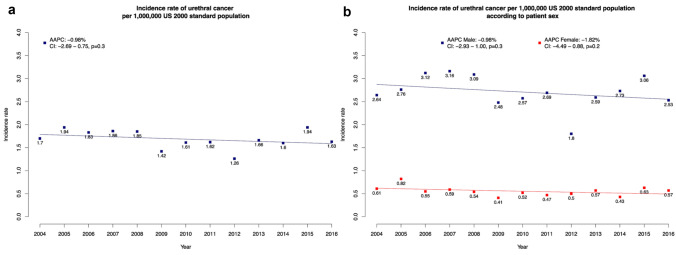
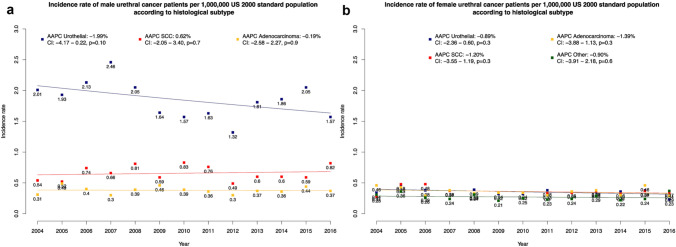
Results: From 2004 to 2016, 1907 patients with urethral cancer were diagnosed (ASR 1.69; AAPC: -0.98%, p = 0.3). ASR rates were higher in males than in females (2.70 vs. 0.55), respectively and did not change over the time (both p = 0.3). Highest incidence rates were recorded in respectively ≥75 (0.77), 55-74 (0.71) and ≤54 (0.19) years of age categories, in that order. African Americans exhibited highest incidence rate (3.33) followed by Caucasians (1.72), other race groups (1.57) and Hispanics (1.57), in that order. A significant decrease occurred over time in Hispanics, but not in other race groups. In African Americans, male and female sex-stratified incidence rates were higher than in any other race group. Urothelial histological subtype exhibited highest incidence rate (0.92), followed by squamous cell carcinoma (0.41), adenocarcinoma (0.29) and other histologies (0.20). In stage stratified analyses, T1N0M0 stage exhibited highest incidence rate. However, it decreased over time (-3.00%, p = 0.02) in favor of T1-4N1-2M0 stage (+ 2.11%, p = 0.02).
Conclusion: Urethral cancer is rare. Its incidence rates are highest in males, elderly patients, African Americans and in urothelial histological subtype. Most urethral cancer cases are T1N0M0, but over time, the incidence of T1N0M0 decreased in favor of T1-4N1-2M0.
Keywords: Histology; Incidence rate; Race; Region; Time trend; Urethral cancer.
Conflict of interest statement
Not applicable.
Figures


References
-
- Swartz MA, Porter MP, Lin DW, Weiss NS. Incidence of primary urethral carcinoma in the United States. Urology. 2006;68(6):1164–1168. - PubMed
-
- Gakis G, Witjes JA, Compérat E, et al. EAU guidelines on primary urethral carcinoma. Eur Urol. 2013;64(5):823–830. - PubMed
-
- National Comprehensive Cancer Network. Bladder Cancer (Version 5.2020).
-
- Sui W, RoyChoudhury A, Wenske S, Decastro GJ, McKiernan JM, Anderson CB. Outcomes and prognostic factors of primary urethral cancer. Urology. 2017;100:180–186. - PubMed
MeSH terms
LinkOut - more resources
Full Text Sources
Other Literature Sources
