Meta-Analysis
. 2021 May;51(5):991-1010.
doi: 10.1007/s40279-021-01426-9. Epub 2021 Mar 22.

Development of Maximal Dynamic Strength During Concurrent Resistance and Endurance Training in Untrained, Moderately Trained, and Trained Individuals: A Systematic Review and Meta-analysis

Affiliations
Meta-Analysis

Development of Maximal Dynamic Strength During Concurrent Resistance and Endurance Training in Untrained, Moderately Trained, and Trained Individuals: A Systematic Review and Meta-analysis

Henrik Petré et al. Sports Med. 2021 May.

Abstract

Background: The effect of concurrent training on the development of maximal strength is unclear, especially in individuals with different training statuses.

Objective: The aim of this systematic review and meta-analysis study was to compare the effect of concurrent resistance and endurance training with that of resistance training only on the development of maximal dynamic strength in untrained, moderately trained, and trained individuals.

Methods: On the basis of the predetermined criteria, 27 studies that compared effects between concurrent and resistance training only on lower-body 1-repetition maximum (1RM) strength were included. The effect size (ES), calculated as the standardised difference in mean, was extracted from each study, pooled, and analysed with a random-effects model.

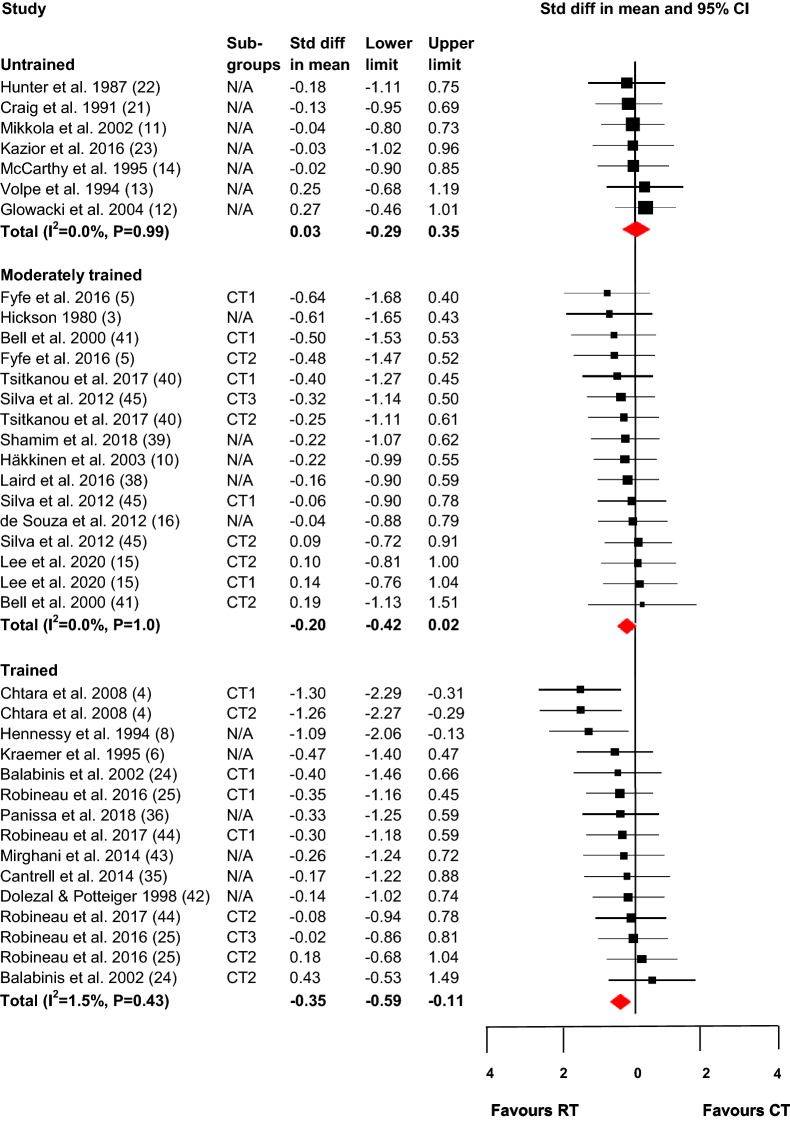
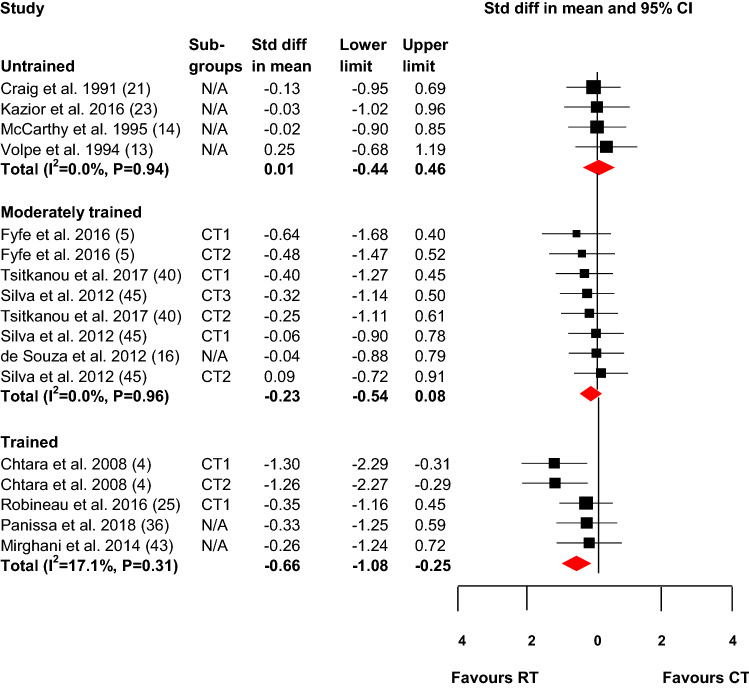
Results: The 1RM for leg press and squat exercises was negatively affected by concurrent training in trained individuals (ES = - 0.35, p < 0.01), but not in moderately trained ( - 0.20, p = 0.08) or untrained individuals (ES = 0.03, p = 0.87) as compared to resistance training only. A subgroup analysis revealed that the negative effect observed in trained individuals occurred only when resistance and endurance training were conducted within the same training session (ES same session = - 0.66, p < 0.01 vs. ES different sessions = - 0.10, p = 0.55).

Conclusion: This study demonstrated the novel and quantifiable effects of training status on lower-body strength development and shows that the addition of endurance training to a resistance training programme may have a negative impact on lower-body strength development in trained, but not in moderately trained or untrained individuals. This impairment seems to be more pronounced when training is performed within the same session than in different sessions. Trained individuals should therefore consider separating endurance from resistance training during periods where the development of dynamic maximal strength is prioritised.


Conflict of interest statement

Henrik Petré, Erik Hemmingsson, Hans Rosdahl and Niklas Psilander declare that they have no conflict of interest.

Figures

Fig.1
Fig.1
Flowchart diagram of the study screening process. RT resistance training, CT concurrent training, n number of studies
Fig. 2
Fig. 2
Effect on maximal strength of concurrent resistance and endurance training compared with resistance training only. CT concurrent training, CT1 concurrent training group 1, CT2 concurrent training group 2, CT3 concurrent training group 3, RT resistance training, N/A not applicable (only one concurrent training group). The shaded square represents the estimated intervention effect for each study, and the horizontal line represents the 95% CI. The size of the shaded square represents the relative weight of the study in the meta-analysis. The shaded diamond represents the pooled standard difference in mean. P values for the effect difference in each category: untrained, P = 0.87; moderately trained, P = 0.08; trained, P < 0.01
Fig. 3
Fig. 3
Effect on maximal strength of same session concurrent resistance and endurance training compared with resistance training only. CT concurrent training, CT1 concurrent training group 1, CT2 concurrent training group 2, CT3 concurrent training group 3, RT resistance training, N/A not applicable (only one concurrent training group). The shaded square represents the estimated intervention effect for each study, and the horizontal line represents the 95% CI. The size of the shaded square represents the relative weight of the study in the meta-analysis. The shaded diamond represents the pooled standard difference in mean. P values for the effect difference in each category: untrained, P = 0.98; moderately trained, P = 0.14; trained, P < 0.01
Fig. 4
Fig. 4
Effect on maximal strength of different session concurrent resistance and endurance training compared with resistance training only. CT concurrent training, CT1 concurrent training group 1, CT2 concurrent training group 2, CT3 concurrent training group 3, RT resistance training, N/A not applicable (only one concurrent training group). The shaded square represents the estimated intervention effect for each study, and the horizontal line represents the 95% CI. The size of the shaded square represents the relative weight of the study in the meta-analysis. The shaded diamond represents the pooled standard difference in mean. P values for the effect difference in each category: untrained, P = 0.65; moderately trained, P = 0.32; trained, P = 0.55

References

    1. WHO. Global recommendations on physical activity for health. 2011. - PubMed
    1. Leveritt M, Abernethy PJ, Barry BK, Logan PA. Concurrent strength and endurance training. A review Sports Med. 1999;28(6):413–427. doi: 10.2165/00007256-199928060-00004. - DOI - PubMed
    1. Hickson RC. Interference of strength development by simultaneously training for strength and endurance. Eur J Appl Physiol. 1980;45(2–3):255–263. doi: 10.1007/bf00421333. - DOI - PubMed
    1. Chtara M, Chaouachi A, Levin GT, Chaouachi M, Chamari K, Amri M, et al. Effect of concurrent endurance and circuit resistance training sequence on muscular strength and power development. J Strength Cond Res. 2008;22(4):1037–1045. doi: 10.1519/JSC.0b013e31816a4419. - DOI - PubMed
    1. Fyfe JJ, Bartlett JD, Hanson ED, Stepto NK, Bishop DJ. Endurance training intensity does not mediate interference to maximal lower-body strength gain during short-term concurrent training. Front Physiol. 2016;7:487. doi: 10.3389/fphys.2016.00487. - DOI - PMC - PubMed

LinkOut - more resources