. 2021 May;53(9):3199-3211.
doi: 10.1111/ejn.15179. Epub 2021 Mar 24.

Deconstructing the contribution of sensory cues in social approach

Affiliations

Deconstructing the contribution of sensory cues in social approach

Alessandro Contestabile et al. Eur J Neurosci. 2021 May.

Abstract

Social interaction is a complex and highly conserved behavior that safeguards survival and reproductive success. Although considerable progress has been made regarding our understanding of same-sex conspecific and non-aggressive interactions, questions regarding the precise contribution of sensory cues in social approach and their specific neurobiological correlates remain open. Here, by designing a series of experiments with diverse social and object stimuli manipulations in custom-made enclosures, we first sought to deconstruct key elements of social preference as assessed by the three-chamber task. Our results highlight the importance of social olfactory cues in approach behavior. Subsequently, we interrogated whether a social odor would activate dopaminergic neurons of the Ventral Tegmental Area in the same way as a juvenile conspecific would. Employing in vivo recordings in freely behaving mice, we observed an increase of the firing only during the transition toward the juvenile mouse and not during the transition toward the object impregnated with social odor, suggesting that these two experiences are distinct and can be differentiated at the neuronal level. Moreover, using a four-choice task, we further showed that mice prefer to explore complex social stimuli compared to isolated sensory cues. Our findings offer insights toward understanding how different sensory modalities contribute to the neurobiological basis of social behavior which can be essential when studying social deficits observed in autism-, depression-, anxiety-, or schizophrenia-related mouse models.

Keywords: VTA; dopamine; sensory cues; sociability; three-chamber test.


Conflict of interest statement

The authors declare no conflict of interest.

Figures
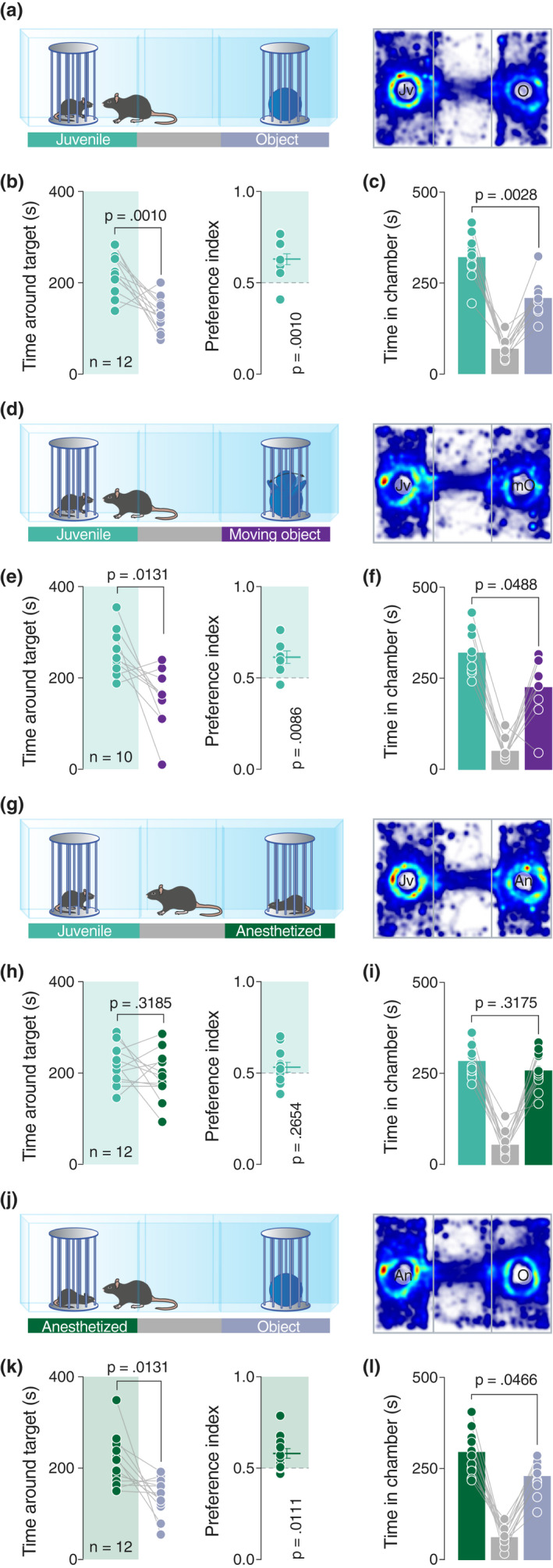
FIGURE 1
FIGURE 1
The movements are not essentials to drive sociability in mice. (a, d, g and j) Left: schematic representation of the three‐chamber test. Right: heatmap reporting the mean occupancy of the batch of mice during the test. (b, e, h and k) Left: time around the enclosures containing the stimuli (paired t‐test. b: t 11 = 4.444, p = .0010. e: t 9 = 3.081, p = .0131. h: t 11 = 1.112, p = .3185. k: t 11 = 2.956, p = .0131). Right: calculated preference index (one‐sample t‐test against theoretical mean = 0.5. b: t 11 = 4.41, p = .0010. e: t 9 = 3.346, p = .0086. h: t 11 = 1.173, p = .2654. k: t 11 = 3.048, p = .0111). (c, f, i, and l) Time spent in each chamber (paired t‐test. c: t 11 = 3.823, p = .0028. f: p = .0488, = −39 (Wilcoxon matched‐pairs signed rank test). i: t 11 = 1.047, p = .3175. l: t 11 = 2.241, p = .0466). Jv, juvenile conspecific; O, object; mO, moving object; An, anesthetized juvenile; n, number of mice that performed the experiment
FIGURE 2
FIGURE 2
Social odors are sufficient to develop the preference. (a) Schematic representation of the type of enclosures used in this study. (b, e, h, k and n) Left: schematic representation of the three‐chamber test. Right: heatmap reporting the mean occupancy of the batch of mice during the test. (c, f, i, l and o) Left: time around the enclosures containing the stimuli (paired t‐test. c: t 11 = 1.795, p = .1001. f: p = .0342 (Wilcoxon matched‐pairs signed rank test). i: t 11 = 0.9252, p = .3747. l: t 11 = 5.736, p = .0001. o: t 11 = 10.82, p < .0001). Right: calculated preference index (one‐sample t‐test against theoretical mean = 0.5. c: t 11 = 1.692, p = .1187. f: t 11 = 3.255, p = .0077. i: t 11 = 1.05, p = .3160. l: t 11 = 5.786, p = .0001. o: t 11 = 13.09, p < .0001). (d, g, j, m and p) Time spent in each chamber (paired t‐test. d: t 11 = 1.074, p = .3059. g: t 11 = 2.473, p = .0309. j: t 11 = 0.4751, p = .6440. M: t 11 = 3.482, p = .0051. P: t 11 = 9.921, p < .0001). Jv, juvenile conspecific; O, object; Os = object impregnated with social odors and n = number of mice that performed the experiment
FIGURE 3
FIGURE 3
VTA dopaminergic neurons behave differently according to the perception of sensory cues. (a and g) Schematic representation of the three‐chamber test. (b and h) Heatmap reporting the mean occupancy of the batch of mice during the test. (c and i) Left: heatmap reporting the normalized VTA pDA activity regarding the occupancy of the batch of mice during the test. Right: same heatmap overlaid by the occupancy with a significant difference of VTA‐pDA activity compared to overall activity (p < .05). (d, j, m, and p) Top: schematic representation of the behavior analyzed (enter of experimental mice in the proximity of the enclosure (target zone) for d and j; initiation of the transition from one chamber to the opposite one for m and p). Middle: PETH of normalized VTA pDA activity centered on the behavior described above. Down: a heatmap of the corresponding PETH of normalized VTA pDA activity for each neuron recorded. (e, k, n and q) Table of activity response of individual VTA pDA neurons for each event and stimuli (red, positive response; blue, negative response; green, no response for given stimuli; grey, no response for any stimuli). (f and l) Comparison of normalized VTA DA activity for positive responding neurons between baseline and the enter in the target zone (f top: paired t‐test (t 16 = 4.311); f down: paired t‐test (t 16 = 0.3882); l top: Wilcoxon test (W = 50); l down: Wilcoxon test (W = −6)). (o and r) Comparison of normalized VTA DA activity for positive responding neurons between baseline and direct transition (o top: paired t‐test (t 12 = 2.656); o down: paired t‐test (t 12 = 0.2552); r top: Wilcoxon test (W = 18); r down: Wilcoxon test (W = 11). Jv = juvenile conspecific, O = object, n = number of mice that performed the experiment, and N = number of neurons recorded during the experiment
FIGURE 4
FIGURE 4
Mice prefer to explore complex stimuli which influence multi‐sensory modalities. (a) Left: schematic representation of the three‐chamber test. Right: heatmap reporting the mean occupancy of the batch of mice during the test. (b) Left: time around the enclosures containing the stimuli (paired t‐test. t 8 = 2.762, p = .0246). Right: calculated preference index (one‐sample t‐test against theoretical mean = 0.5. t 8 = 2.579, p = .0327). (c) Time spent in each chamber (paired t‐test. t 8 = 1.753, p = .1177). (d) Left: schematic representation of the Four‐choices test. Right: heatmap reporting the mean occupancy of the batch of mice during the test. (e) Time around the enclosures containing the stimuli (RM one‐way ANOVA: F 1.436,15.8 = 6.906, p = .0116, followed by Bonferroni's multiple comparison post hoc test). (f) A diagram representing a two‐state Markov process. The heatmaps report the probability of the Markov process changing from one state to another state, with the direction indicated by the arrow. Jv, juvenile conspecific and n, number of mice that performed the experiment

References

    1. Bariselli, S. , Contestabile, A. , Tzanoulinou, S. , Musardo, S. , & Bellone, C. (2018). SHANK3 downregulation in the ventral tegmental area accelerates the extinction of contextual associations induced by juvenile non‐familiar conspecific interaction. Frontiers in Molecular Neuroscience, 11, 360. 10.3389/fnmol.2018.00360 - DOI - PMC - PubMed
    1. Bariselli, S. , Hörnberg, H. , Prévost‐Solié, C. , Musardo, S. , Hatstatt‐Burklé, L. , Scheiffele, P. , & Bellone, C. (2018). Role of VTA dopamine neurons and neuroligin 3 in sociability traits related to nonfamiliar conspecific interaction. Nature Communications, 9, 3173. 10.1038/s41467-018-05382-3 - DOI - PMC - PubMed
    1. Bariselli, S. , Tzanoulinou, S. , Glangetas, C. , Prévost‐Solié, C. , Pucci, L. , Viguié, J. , Bezzi, P. , O'Connor, E. C. , Georges, F. , Lüscher, C. , & Bellone, C. (2016). SHANK3 controls maturation of social reward circuits in the VTA. Nature Neuroscience, 19, 926–934. 10.1038/nn.4319 - DOI - PMC - PubMed
    1. Chen, P. , & Hong, W. (2018). Neural circuit mechanisms of social behavior. Neuron, 98, 16–30. 10.1016/j.neuron.2018.02.026 - DOI - PMC - PubMed
    1. Dölen, G. , Darvishzadeh, A. , Huang, K. W. , & Malenka, R. C. (2013). Social reward requires coordinated activity of nucleus accumbens oxytocin and serotonin. Nature, 501, 179–184. 10.1038/nature12518 - DOI - PMC - PubMed

Publication types

LinkOut - more resources