Review
. 2021 Jul;48(7):943-953.
doi: 10.1111/1440-1681.13500. Epub 2021 Apr 21.

Targeting autophagy in neurodegenerative diseases: From molecular mechanisms to clinical therapeutics

Affiliations
Review

Targeting autophagy in neurodegenerative diseases: From molecular mechanisms to clinical therapeutics

Amir Ajoolabady et al. Clin Exp Pharmacol Physiol. 2021 Jul.

Abstract

Many neurodegenerative diseases are associated with pathological aggregation of proteins in neurons. Autophagy is a natural self-cannibalization process that can act as a powerful mechanism to remove aged and damaged organelles as well as protein aggregates. It has been shown that promoting autophagy can attenuate or delay neurodegeneration by removing protein aggregates. In this paper, we will review the role of autophagy in Alzheimer's disease (AD), Parkinson's Disease (PD), and Huntington's Disease (HD) and discuss opportunities and challenges of targeting autophagy as a potential therapeutic avenue for treatment of these common neurodegenerative diseases.

Keywords: Alzheimer's disease; Huntington's disease; Parkinson's disease; autophagy; neurodegenerative disease.


Conflict of interest statement

Conflict of interest: None of the authors had any conflict of interest to declare.

Data sharing and data accessibility: No original data were used for this work that would need data repository, although the corresponding authors will respond to any reasonable request for this publication.

Figures

Figure 1.
Figure 1.
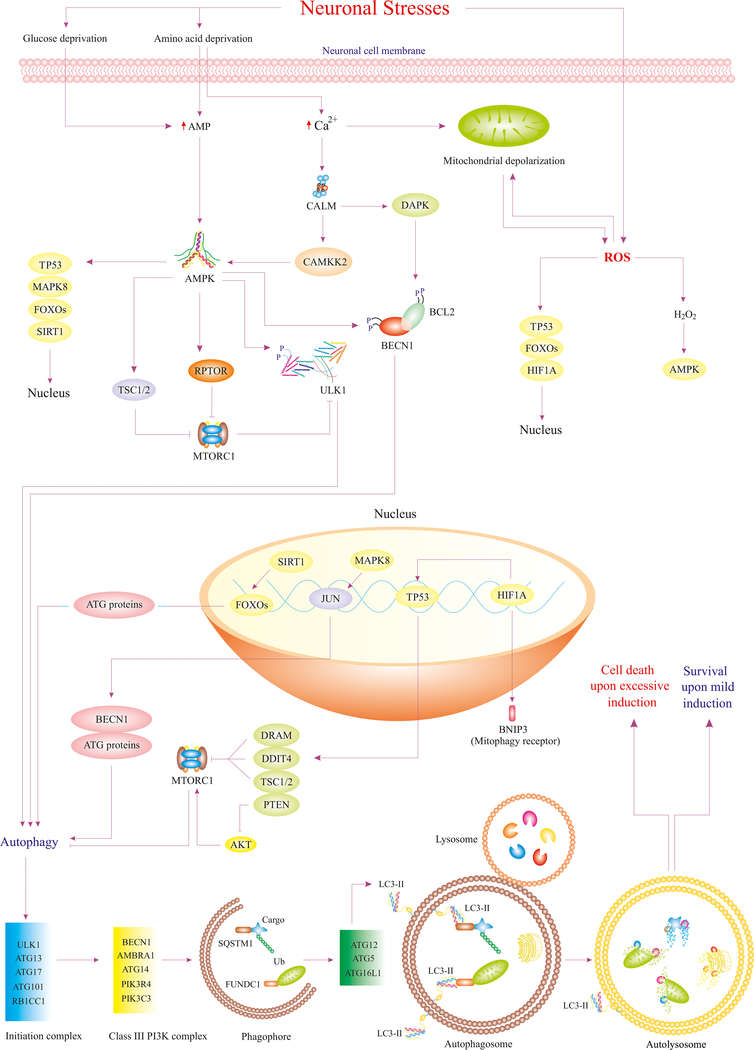
Various neuronal stresses such as nutrient deprivation and ROS trigger diverse pathways that regulate autophagy. Deprivation of amino acids and glucose substantially accelerate cytosolic level of AMP and Ca2+ in neurons. Enhanced AMP level triggers activation of AMPK (master regulator of autophagy), which upregulates ATG genes, blocks MTORC1, and activates ULK1, ultimately leading to autophagy initiation. Increased cytosolic level of Ca2+ also mediates AMPK activation and mitochondrial depolarization, which accounts for ROS production. ROS, in turn, activates certain transcriptional factors and AMPK thus, leading to autophagy. Eventually, ATG proteins are recruited to various steps of phagophore and autophagosome formation, resulting in clearance of protein aggregates and impaired organelles via fusion with lysosome. Although basal autophagy alleviates neurodegeneration, its excessive induction may lead to various styles of cell death ,,,. Abbreviations: DAPK (death associated protein kinase), CAMKK2 (calcium/calmodulin dependent protein kinase kinase 2), JUN/C-Jun (Jun proto-oncogene, AP-1 transcription factor subunit), FUNDC1 (FUN14 domain containing 1), Ub (ubiquitin), AMP (adenosine monophosphate), HIF1A/HIF1α (hypoxia inducible factor 1 subunit alpha), RPTOR/raptor (regulatory associated protein of MTOR complex 1), MAPK8/JNK1 (mitogen-activated protein kinase 8), DDIT4 (DNA damage inducible transcript 4), PIK3R4/VPS15 (phosphoinositide-3-kinase regulatory subunit 4), DRAM (DNA damage regulated autophagy modulator), RB1CC1/FIP200 (RB1 inducible coiled-coil 1), BNIP3 (BCL2 interacting protein 3).
Figure 2.
Figure 2.
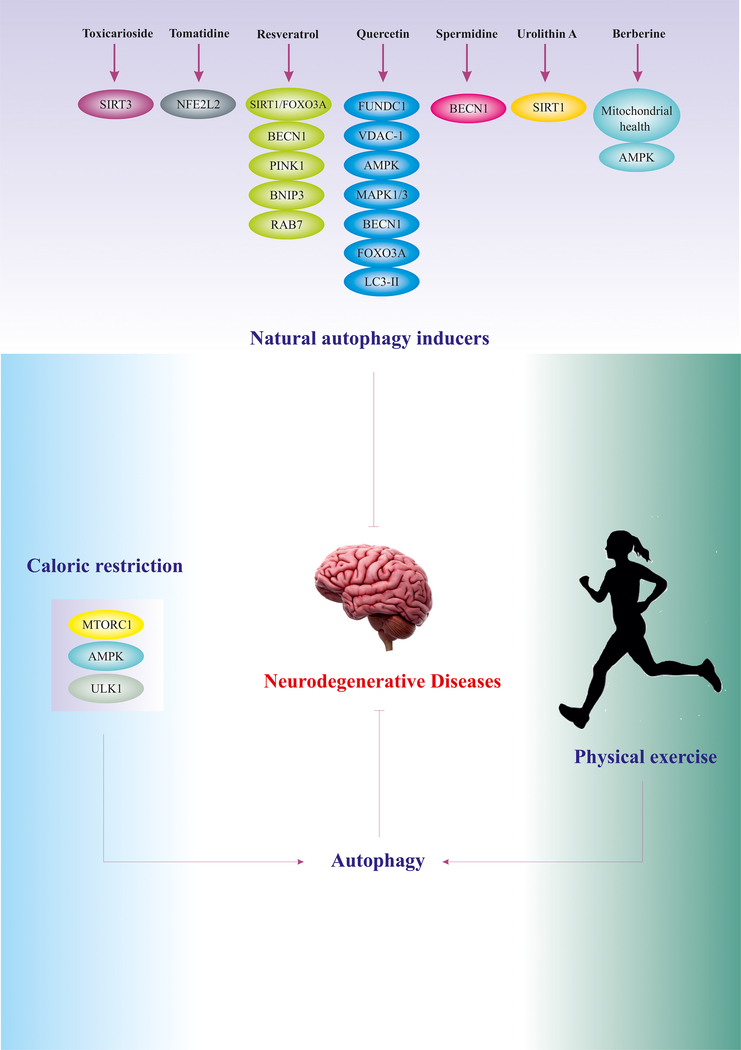
Holistic strategies for targeting autophagy in the management of neurodegenerative diseases. Natural autophagy inducers manipulate autophagy regulators via various mechanisms, leading to basal autophagy induction (likely, in a dose dependent manner). Numerous studies have substantiated the vital role of physical exercise and caloric restriction as non-invasive strategies for autophagy induction ,–. Abbreviations: NFE2L2/NRF2 (nuclear factor, erythroid 2 like 2), FOXO3 (forkhead box O3), SIRT3 (sirtuin 3), RAB7 (RAB7, member RAS oncogene family), VDAC1 (voltage dependent anion channel 1), MAPK1/3 (mitogen-activated protein kinase 1/3), MAP1LC3B/LC3B (microtubule associated protein 1 light chain 3 beta)

References

    1. Ajoolabady A, Aghanejad A, Bi Y, et al. Enzyme-based autophagy in anti-neoplastic management: From molecular mechanisms to clinical therapeutics. Biochimica et Biophysica Acta (BBA)-Reviews on Cancer. 2020:188366. - PubMed
    1. Ajoolabady A, Aslkhodapasandhokmabad H, Aghanejad A, Zhang Y, Ren J. Mitophagy Receptors and Mediators: Therapeutic Targets in the Management of Cardiovascular Ageing. Ageing Research Reviews. 2020:101129. - PubMed
    1. Wang S, Ren J. Role of autophagy and regulatory mechanisms in alcoholic cardiomyopathy. Biochim Biophys Acta Mol Basis Dis 2018;1864(6 Pt A):2003–2009. - PubMed
    1. Zhang Y, Sowers JR, Ren J. Targeting autophagy in obesity: from pathophysiology to management. Nature Reviews Endocrinology. 2018;14(6):356–376. - PubMed
    1. Ren J, Zhang Y. Targeting autophagy in aging and aging-related cardiovascular diseases. Trends in pharmacological sciences. 2018;39(12):1064–1076. - PMC - PubMed

Publication types

MeSH terms