


Health-related quality of life, functional decline, and long-term mortality in older patients following hospitalisation due to COVID-19
- PMID: 33752614
- PMCID: PMC7983098
- DOI: 10.1186/s12877-021-02140-x
Health-related quality of life, functional decline, and long-term mortality in older patients following hospitalisation due to COVID-19
Abstract
Background: Older people are particularly vulnerable to severe COVID-19. Little is known about long-term consequences of COVID-19 on health-related quality of life (HR-QoL) and functional status in older people, and the impact of age in this context. We aimed to study age-related change in health-related quality of life, functional decline and mortality among older patients 6 months following hospitalisation due to COVID-19.
Methods: This was a cohort study including patients aged 60 years and older admitted to four general hospitals in South-Eastern Norway due to COVID-19, from March 1 up until July 1, 2020. Patients who were still alive were invited to attend a six-month follow-up. Change in HR-QoL and functional status compared to before the COVID-19 hospitalisation were assessed using the EuroQol 5-dimensional-5 levels questionnaire (EQ. 5D-5L). A change in visual analogue scale (VAS) score of 7 or more was considered clinically relevant.
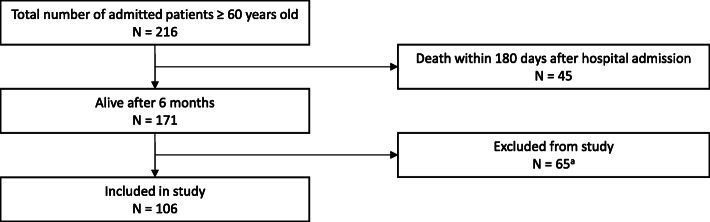
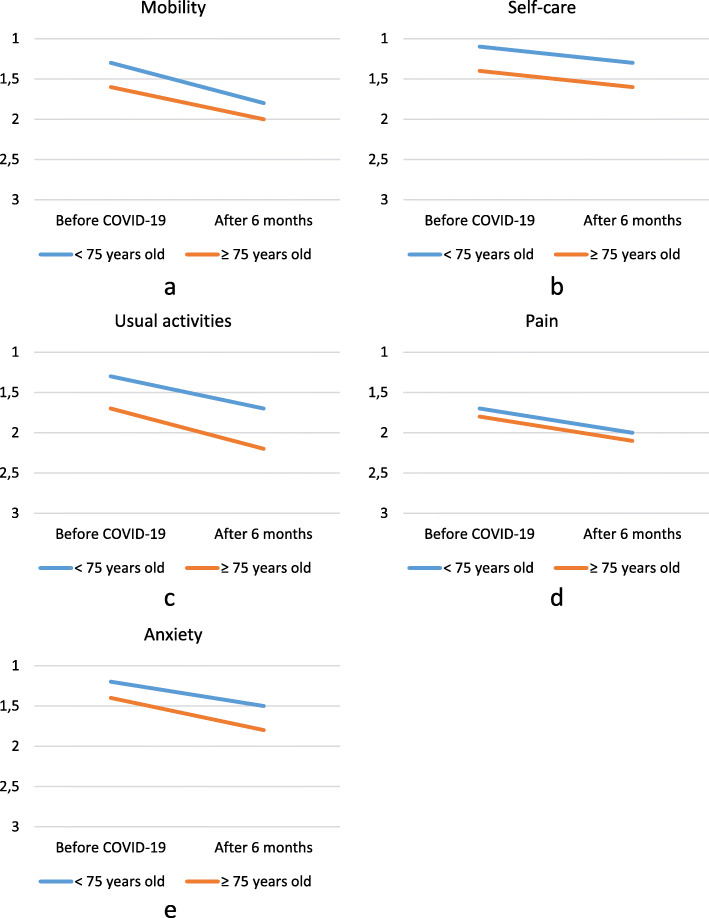
Results: Out of 216 patients aged 60 years and older that were admitted to hospital due to COVID-19 during the study period, 171 were still alive 180 days after hospital admission, and 106 patients (62%) attended the six-month follow-up. Mean age was 74.3 years, 27 patients (26%) had experienced severe COVID-19. Fifty-seven participants (54%) reported a decrease in the EQ. 5D-5L VAS score after 6 months, with no significant difference between persons aged 75 years and older compared to younger. Seventy participants (66%) reported a negative change in any of the dimensions of the EQ. 5D-5L, with impaired ability to perform activities of daily life (35%), reduced mobility (33%) and having more pain or discomfort (33%) being the most commonly reported changes. Forty-six participants (43%) reported a negative change in cognitive function compared to before the COVID-19 hospitalisation. Six-month mortality was 21%, and increased with increasing age.
Conclusions: More than half of the patients reported a negative change in HR-QoL 6 months following hospitalisation due to COVID-19, and one out of three experienced a persistently impaired mobility and ability to carry out activities of daily living. The results suggest awareness of long-term functional decline in older COVID-19 patients.
Keywords: COVID-19; Geriatric medicine; Health-related quality of life; Pandemic.
Conflict of interest statement
The authors declare that they have no competing interests.
Figures


References
-
- Weekly epidemiological update - 3 January 2021: World Health Organization; 2021. https://www.who.int/publications/m/item/weekly-epidemiological-update%2D.... Accessed 9 Jan 2021.
-
- Daily report and statistics about coronavirus and COVID-19: Norwegian Institute of Public Health; 2020. https://www.fhi.no/en/id/infectious-diseases/coronavirus/daily-reports/d.... Accessed 7 Dec 2020.
-
- COVID-19 Ukerapport – uke 48: The Norwegian Institute of Public Health; 2020 [Available from: https://www.fhi.no/contentassets/8a971e7b0a3c4a06bdbf381ab52e6157/vedleg....
-
- Huang C, Wang Y, Li X, Ren L, Zhao J, Hu Y, Zhang L, Fan G, Xu J, Gu X, Cheng Z, Yu T, Xia J, Wei Y, Wu W, Xie X, Yin W, Li H, Liu M, Xiao Y, Gao H, Guo L, Xie J, Wang G, Jiang R, Gao Z, Jin Q, Wang J, Cao B. Clinical features of patients infected with 2019 novel coronavirus in Wuhan, China. Lancet. 2020;395(10223):497–506. doi: 10.1016/S0140-6736(20)30183-5. - DOI - PMC - PubMed
Publication types
MeSH terms
LinkOut - more resources
Full Text Sources
Other Literature Sources
Medical
