


Improved adherence with Medicines Use Review service in Slovenia: a randomized controlled trial
- PMID: 33752647
- PMCID: PMC7986462
- DOI: 10.1186/s12913-021-06223-8
Improved adherence with Medicines Use Review service in Slovenia: a randomized controlled trial
Abstract
Background: Based on several existing patient-oriented activities, Medicines Use Review (MUR) service was standardized and officially adopted in Slovenia in 2015. Service aims to provide adherence support and ensure safe and effective medicines use. Therefore, the aim of the study was to evaluate the benefits of MUR in Slovenia, primarily the impact on medication adherence.
Methods: A randomised controlled trial was performed in community pharmacies to compare MUR with standard care. Patients were randomised into either the test (patients received MUR by a certified MUR provider at visit 1), or control group. The study primary outcome was self-reported adherence to multiple medications, assessed by electronic ©Morisky Widget MMAS-8 Software at the first visit (V1) and after 12 weeks (V2). A sub-analysis of intentional and unintentional non-adherence was performed. MUR impact was defined as the relative difference in ©MMAS-8 score after 12 weeks between the test and control group. A multiple linear regression model was used to predict MUR impact based on baseline adherence (low versus medium and high). Several secondary outcomes (e.g. evaluation of drug-related problems (DRPs)) were also assessed.
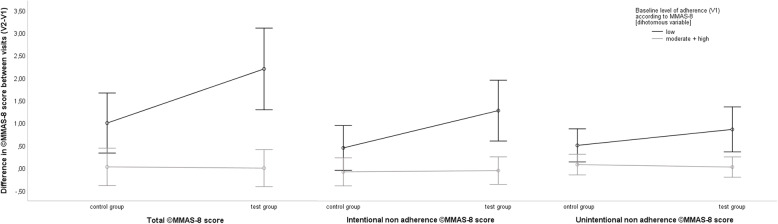
Results: Data from 153 (V1) and 140 (V2) patients were analysed. Baseline adherence was low, moderate and high in 17.6, 48.4 and 34.0% patients, respectively. In the low adherence subpopulation, test group patients showed a 1.20 point (95% CI = 0.16-2.25) increase in total ©MMAS-8 score (p = 0.025) compared to control group patients. A 0.84 point (95% CI = 0.05-1.63) increase was due to intentional non-adherence (p = 0.038), and a 0.36 point (95% CI = - 0.23-0.95) was due to unintentional non-adherence (p = 0.226). Additionally, statistically significant decrease in the proportion of patients with manifested DRPs (p < 0.001) and concerns regarding chronic medicines use (p = 0.029) were revealed.
Conclusion: MUR service in Slovenia improves low medication adherence and is effective in addressing DRPs and concerns regarding chronic medicines use.
Trial registration: ClinicalTrials.gov - NCT04417400 ; 4th June 2020; retrospectively registered.
Keywords: Adherence; Community pharmacy; Drug related problems; Medication review; Medicines Use Review.
Conflict of interest statement
Authors do not report any competing interest.
Figures


References
-
- Imfeld-Isenegger TL, Soares IB, Nabergoj Makovec U, Horvat N, Kos M, van Mil F, et al. Community pharmacist-led medication review procedures across Europe: characterization, implementation and remuneration. Res Social Adm Pharm. 2019. 10.1016/j.sapharm.2019.11.002. - PubMed
-
- Soares IB, Imfeld-Isenegger TL, Nabergoj Makovec U, Horvat N, Kos M, Arnet I, et al. A survey to assess the availability, implementation rate and remuneration of pharmacist-led cognitive services throughout Europe. Res Social Adm Pharm. 2020;16(1):41–47. doi: 10.1016/j.sapharm.2019.02.002. - DOI - PubMed
-
- Horne R, Cooper V, Vvileman V, Chan A. Supporting adherence to medicines for long-term conditions a perceptions and practicalities approach based on an extended common-sense model. Eur Psychol. 2019;24(1):82–96. doi: 10.1027/1016-9040/a000353. - DOI
Publication types
MeSH terms
Associated data
Grants and funding
LinkOut - more resources
Full Text Sources
Other Literature Sources
Medical
