


Experiences with IL-1 blockade in systemic juvenile idiopathic arthritis - data from the German AID-registry
- PMID: 33752669
- PMCID: PMC7986520
- DOI: 10.1186/s12969-021-00510-8
Experiences with IL-1 blockade in systemic juvenile idiopathic arthritis - data from the German AID-registry
Abstract
Background: Systemic juvenile idiopathic arthritis (sJIA) is a complex disease with dysregulation of the innate immune system driven by cytokines. A major role is ascribed to interleukin-1β (IL-1β), supporting the autoinflammatory character of the disease and offering an effective blocking mechanism for treatment. Here we present clinical practice data from the German AID-registry for patients treated with IL-1 inhibition (IL-1i).
Methods: In 2009 a clinical and research consortium (AID-Net) was established, including an online AID-registry. Patients with documented sJIA diagnosis were identified. Data for this retrospective IL-1i study were recorded by 17 centers. Response to treatment was evaluated according to Wallace criteria and additionally by an own classifying clinical response system.
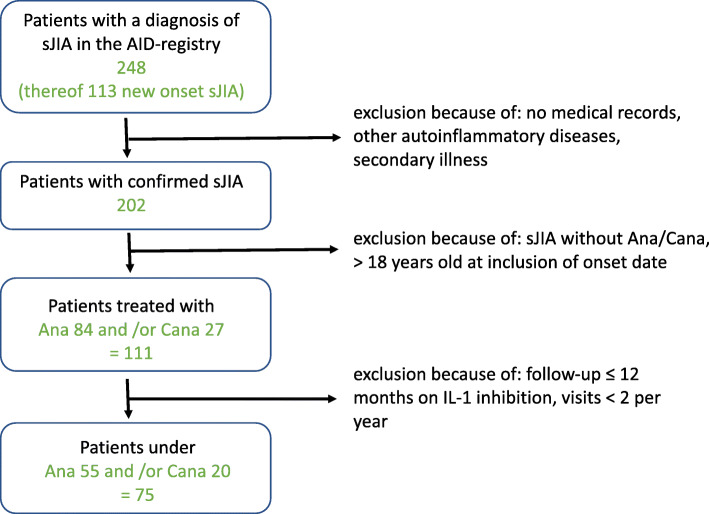
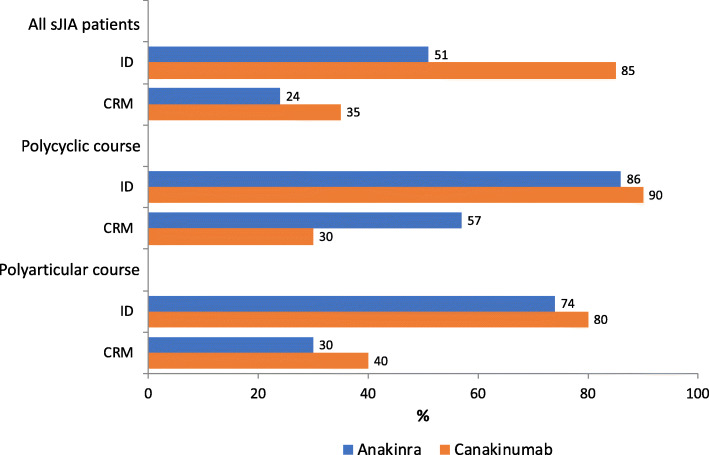
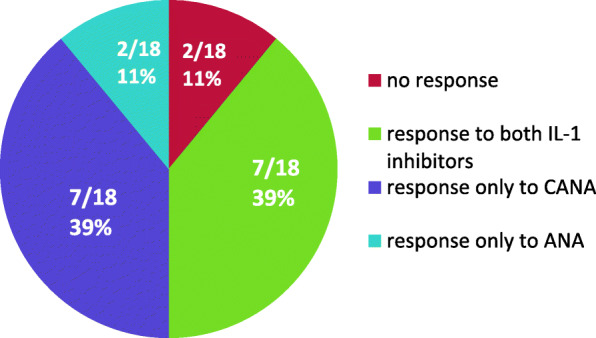
Results: In 6 years, 202 patients with confirmed sJIA were recorded in the AID-registry. Out of these, 111 children received therapy with Anakinra (ANA) (n = 84, 39 f) and/or Canakinumab (CANA) (n = 27, 15 f) at a median age of 8.7 y (range 0.6-19.1). During the first 12 months 75/111 (ANA 55, CANA 20) patients were evaluated according to Wallace criteria (achievement of inactive disease 28/55 and 17/20, remission over 6 months under medication 13/55 and 7/20 cases). Over the whole period of time, clinical response was preserved in the majority of patients (ANA 54/80, CANA 20/27). Arthritis mostly persisted in polyarticular (PA) courses. During treatment with IL-1i concomitant medication could be tapered in about 15%. IL-1i was discontinued in 59/111 patients. 45 (15) adverse events (AE)s in ANA (CANA) treated patients (19.7 (26.6) AE/100 ANA (CANA) exposure years, 95%CI: 14.4-26.4 (14.9-43.9)) were reported.
Conclusion: In a large cohort of sJIA patients from Germany, we can confirm an overall favorable clinical response to both available IL-1 blocking agents. IL-1i was well tolerated with acceptable safety and effectiveness in a real-life clinical setting.
Keywords: Anakinra; Autoinflammatory disease; Canakinumab; Interleukin-1; Proinflammatory cytokines; Systemic juvenile idiopathic arthritis.
Conflict of interest statement
EL received speaker honoraria from Novartis and SOBI. TK received speaker honoraria from Novartis, SOBI and Roche as well as research report from Novartis. HW received speaker honoraria from Novartis, Shire/Takeda and CSL-Behring. GH received support for scientific studies from Abbvie, Chugei, MSD, Novartis, Pfizer, Roche and honoraria from Abbvie, Chugai, GSK, Pfizer and Novartis. UN received speaker honoraria from Roche and support for 2 meetings by SOBI. PTO received research funding from Novartis. KT received support from SOBI, grants from Pfizer and Novartis Medical Foundation. CH received honoraria from Novartis. RB, CR, TL, BH, NF, MB, BR, RMK, JK, JPH, EL, GLH declare that they have no conflict of interest. DW received speaker honoraria from Abbvie and Pfizer as well as research support from Novartis and Roche. DF received speaker honoraria from Novartis, SOBI and Roche as well as research report from Novartis, SOBI and Pfizer.
EWR received honoraria for advisory boards and travel support from Novartis, SOBI and Roche. FWH received speaker honoraria from Novartis, SOBI and Roche. TN received authorship fees from
Figures
References
-
- Petty RE, Southwood TR, Manners P, et al. International league of associations for rheumatology classification of juvenile idiopathic arthritis: second revision, Edmonton, 2001. J Rheumatol. 2004;31(2):390–392. - PubMed
MeSH terms
Substances
LinkOut - more resources
Full Text Sources
Other Literature Sources
Medical
