


Why do some inter-organisational collaborations in healthcare work when others do not? A realist review
- PMID: 33752755
- PMCID: PMC7984506
- DOI: 10.1186/s13643-021-01630-8
Why do some inter-organisational collaborations in healthcare work when others do not? A realist review
Abstract
Background: Inter-organisational collaboration is increasingly prominent within contemporary healthcare systems. A range of collaboration types such as alliances, networks, and mergers have been proposed as a means to turnaround organisations, by reducing duplication of effort, enabling resource sharing, and promoting innovations. However, in practice, due to the complexity of the process, such efforts are often rife with difficulty. Notable contributions have sought to make sense of this area; however, further understanding is needed in order to gain a better understanding of why some inter-organisational collaborations work when others do not, to be able to more effectively implement collaborations in the future.
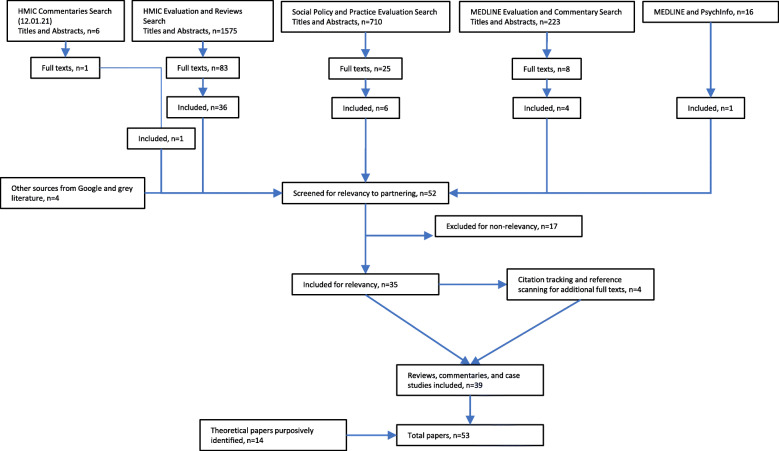
Methods: Realist review methodology was used with the intention of formulating context-mechanism-outcome configurations (CMOCs) to explain how inter-organisational collaborations work and why, combining systematic and purposive literature search techniques. The systematic review encompassed searches for reviews, commentaries, opinion pieces, and case studies on HMIC, MEDLINE, PsycINFO, and Social Policy and Practice databases, and further searches were conducted using Google Scholar. Data were extracted from included studies according to relevance to the realist review.
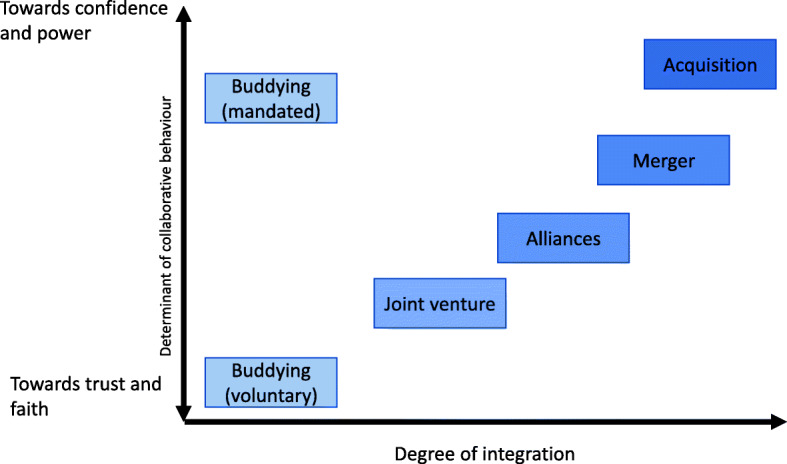
Results: Fifty-three papers were included, informing the development of programme theories of how, why, and when inter-organisational collaborations in healthcare work. Formulation of our programme theories incorporated the concepts of partnership synergy and collaborative inertia and found that it was essential to consider mechanisms underlying partnership functioning, such as building trust and faith in the collaboration to maximise synergy and thus collaborative performance. More integrative or mandated collaboration may lean more heavily on contract to drive collaborative behaviour.
Conclusion: As the first realist review of inter-organisational collaborations in healthcare as an intervention for improvement, this review provides actionable evidence for policymakers and implementers, enhancing understanding of mechanisms underlying the functioning and performing of inter-organisational collaborations, as well as how to configure the context to aid success. Next steps in this research will test the results against further case studies and primary data to produce a further refined theory.
Systematic review registration: PROSPERO CRD42019149009.
Keywords: Collaboration; Context; Healthcare; Implementation; Improvement; Integration; Partnership working; Programme theory; Realist review; Realist synthesis.
Conflict of interest statement
The authors declare they have no competing interests.
Figures


References
-
- Dickinson H, Glasby J. “Why partnership working doesn’t work”: pitfalls, problems and possibilities in English health and social care. Public Manag Rev. 2010;12(6):811–828. doi: 10.1080/14719037.2010.488861. - DOI
-
- Elston JM. Oxford handbook of public health. 3. Oxford: Oxford University Press; 2013. Partnerships; pp. 526–538.
-
- Hudson B, Henwood M. The NHS and social care: the final countdown? Policy Polit. 2002;30(2):153–166. doi: 10.1332/0305573022501610. - DOI
-
- Hardy C, Phillips N, Lawrence TB. Resources, knowledge and influence: the organizational effects of inter-organizational collaboration. J Manag Stud. 2003;40(2):321–347. doi: 10.1111/1467-6486.00342. - DOI
Publication types
MeSH terms
LinkOut - more resources
Full Text Sources
Other Literature Sources
Medical
Research Materials
