. 2021 Mar 22;11(3):e042909.
doi: 10.1136/bmjopen-2020-042909.

Why women die after reaching the hospital: a qualitative critical incident analysis of the 'third delay' in postconflict northern Uganda

Affiliations

Why women die after reaching the hospital: a qualitative critical incident analysis of the 'third delay' in postconflict northern Uganda

Gasthony Alobo et al. BMJ Open. .

Abstract

Objectives: To critically explore and describe the pathways that women who require emergency obstetrics and newborn care (EmONC) go through and to understand the delays in accessing EmONC after reaching a health facility in a conflict-affected setting.

Design: This was a qualitative study with two units of analysis: (1) critical incident technique (CIT) and (2) key informant interviews with health workers, patients and attendants.

Setting: Thirteen primary healthcare centres, one general private-not-for-profit hospital, one regional referral hospital and one teaching hospital in northern Uganda.

Participants: Forty-nine purposively selected health workers, patients and attendants participated in key informant interviews. CIT mapped the pathways for maternal deaths and near-misses selected based on critical case purposive sampling.

Results: After reaching the health facility, a pregnant woman goes through a complex pathway that leads to delays in receiving EmONC. Five reasons were identified for these delays: shortage of medicines and supplies, lack of blood and functionality of operating theatres, gaps in staff coverage, gaps in staff skills, and delays in the interfacility referral system. Shortage of medicines and supplies was central in most of the pathways, characterised by three patterns: delay to treat, back-and-forth movements to buy medicines or supplies, and multiple referrals across facilities. Some women also bypassed facilities they deemed to be non-functional.

Conclusion: Our findings show that the pathway to EmONC is precarious and takes too long even after making early contact with the health facility. Improvement of skills, better management of the meagre human resource and availing essential medical supplies in health facilities may help to reduce the gaps in a facility's emergency readiness and thus improve maternal and neonatal outcomes.

Keywords: gynaecology; maternal medicine; public health.


Conflict of interest statement

Competing interests: None declared.

Figures
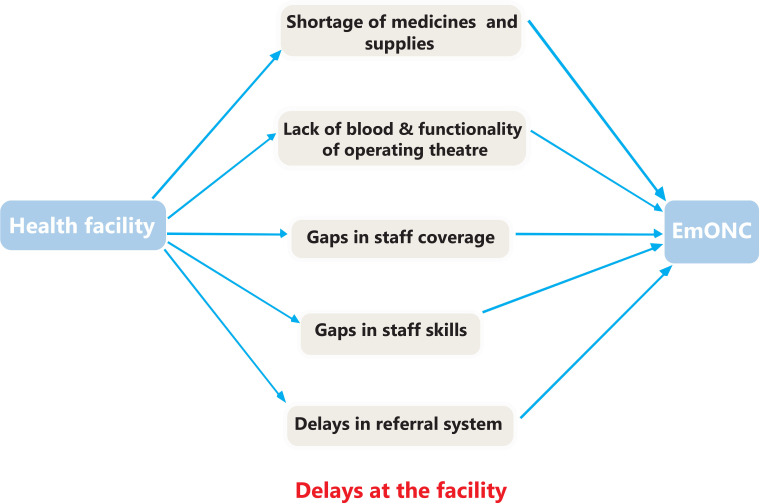
Figure 1
Figure 1
Barriers along the pathway to receive care after reaching the health facility. EmONC, emergency obstetrics and newborn care.
Figure 2
Figure 2
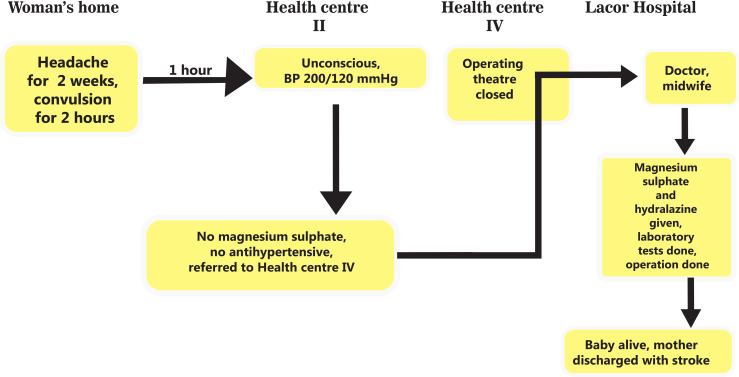
Delayed referral and bypassing non-functional facility. The mother experienced headache for 2 weeks at home before going to H/C II, where a diagnosis of severe pre-eclampsia was made. There were no antihypertensives and anticonvulsants. She was referred to nearby H/C IV, but after calling the midwife in charge they were told that the theatre is closed because there were no anaesthetic drugs. They decided to bypass this H/C and move to Lacor Hospital, about 90 km away. At Lacor Hospital, she received anticonvulsants and antihypertensives. She was taken to the operating room for an emergency caesarean section where a live baby was delivered. The mother was discharged alive but had a stroke (MNM1). BP, blood pressure; H/C, health centre; MNM, maternal near-miss.
Figure 3
Figure 3
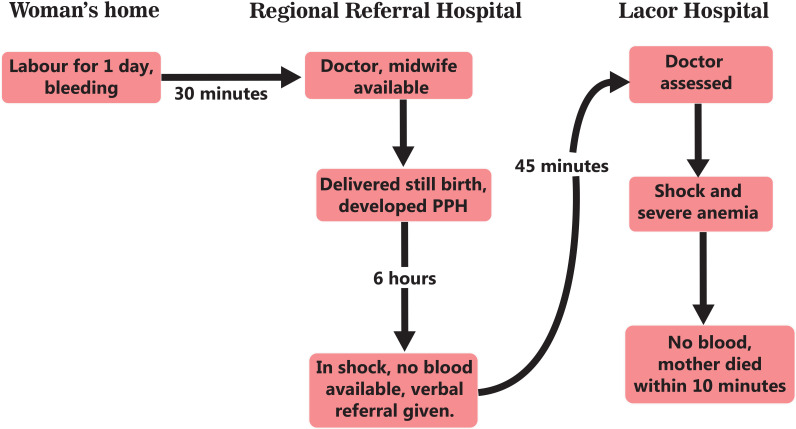
Lack of blood. The mother experienced labour pain for 1 day and bleeding for 4 hours before going to the regional referral hospital. She had fresh stillbirth and developed postpartum haemorrhage. The doctor requested 3 units of blood but there was no available blood. She was referred to Lacor Hospital with severe anaemia. At Lacor Hospital there was no available blood as well. She died at the admission point (MD1). MD, maternal death; PPH, post partum haemorrhage.
Figure 4
Figure 4
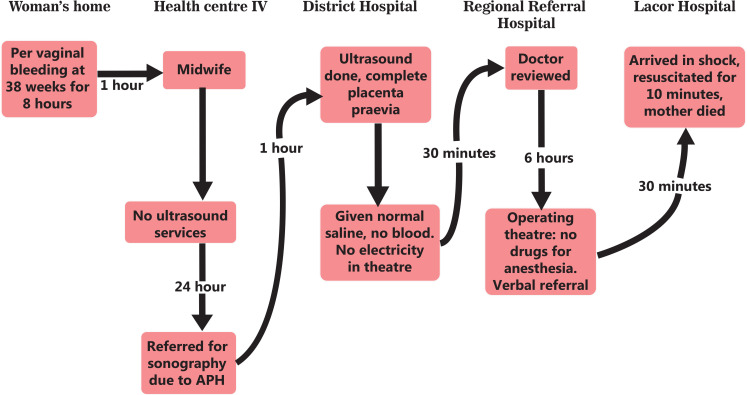
Multiple referrals across non-functional CEmONC facilities. The mother had APH and went to H/C IV, but the midwife referred her to the district hospital for an ultrasound scan; it confirmed complete placenta praevia. A decision to do an emergency caesarean section was made but the operating room did not have electricity, prompting referral to RRH. At RRH she spent 6 hours looking for money to buy drugs for anaesthesia. After failing to get the money, she was verbally referred to Lacor Hospital but had bled a lot and died of haemorrhagic shock (MD2). APH, antepartum haemorrhage; CEmONC, comprehensive emergency obstetrics and newborn care; H/C, health centre; MD, maternal death; RRH, regional referral hospital.
Figure 5
Figure 5
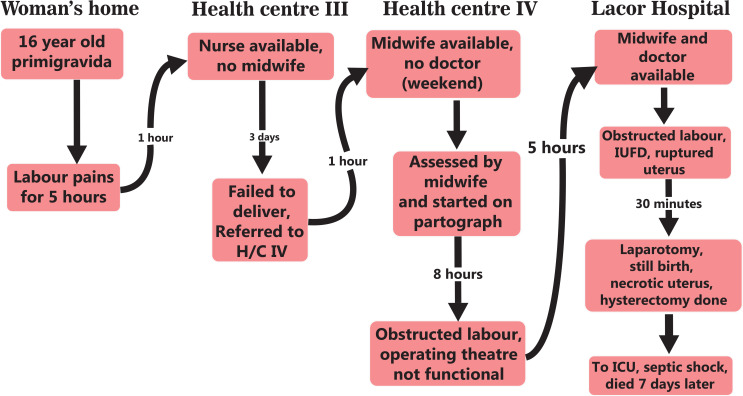
Delayed referral and operation. At H/C III, there was no midwife. The nurse who attended to the patient did not plot a partograph and kept her for 3 days. The patient requested a referral to H/C IV, where she was found to have obstructed labour but there was no doctor to do a caesarean section. She was referred to Lacor Hospital with prolonged obstructed labour and a dead fetus. Emergency caesarean section was done, and she was taken to the ICU, but got sepsis and died (MD3). H/C, health centre; ICU, intensive care unit; MD, maternal death; IUFD, intrauterine fetal death.
Figure 6
Figure 6
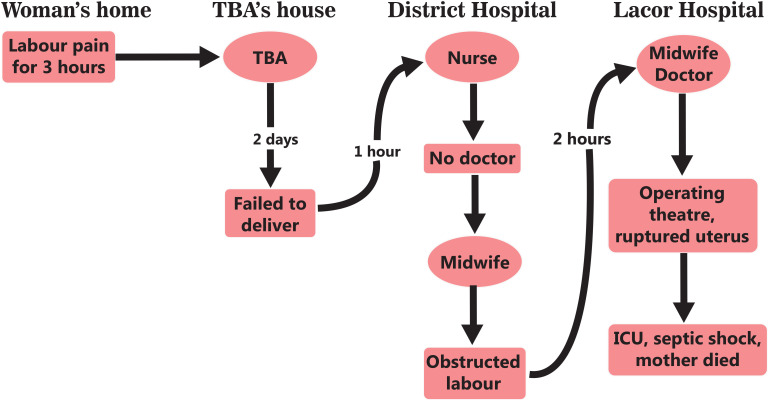
Non-functional facility and seeking care from the TBA. The mother had labour pain for 3 hours then went to TBA because the nearby H/C III had no midwife. The TBA kept her for 2 days until she failed to deliver. She was referred to the district hospital but the doctor was not available over the weekend, prompting referral to Lacor Hospital. She had a ruptured uterus and died of septic shock 4 days after the operation (MD4). H/C, health centre; ICU, intensive care unit; MD, maternal death; TBA, traditional birth attendant.
Figure 7
Figure 7
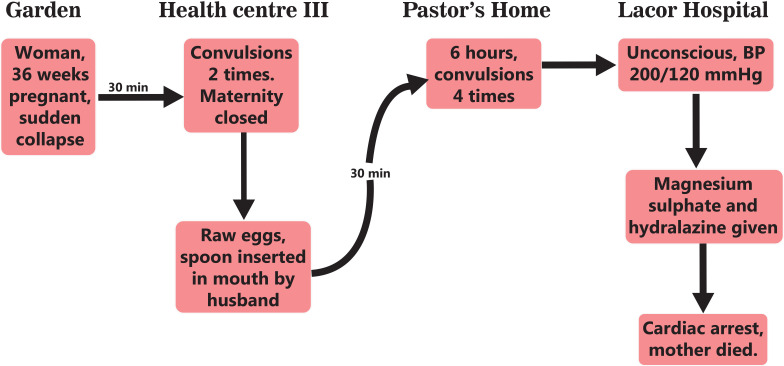
Non-functional BEmONC facility and seeking care from the religious leader. The woman suddenly collapsed from the garden. She was taken to H/C III and found the maternity unit closed because there was no midwife. After two episodes of convulsions, the husband gave her raw eggs and inserted a spoon in the mouth to stop her from biting the tongue. The mother-in-law advised that the woman should be taken for prayers at the pastor’s place since the condition could be related to evil spirits. She spent 6 hours with the pastor but continued to fit. When she deteriorated, the husband rushed her to Lacor Hospital, where her BP was found to be very high. She was given treatment but died after 30 min due to eclampsia. A perimortem operation was done and extracted a live baby (MD5). BEmONC, basic emergency obstetrics and newborn care; BP, blood pressure; H/C, health centre; MD, maternal death.
Figure 8
Figure 8
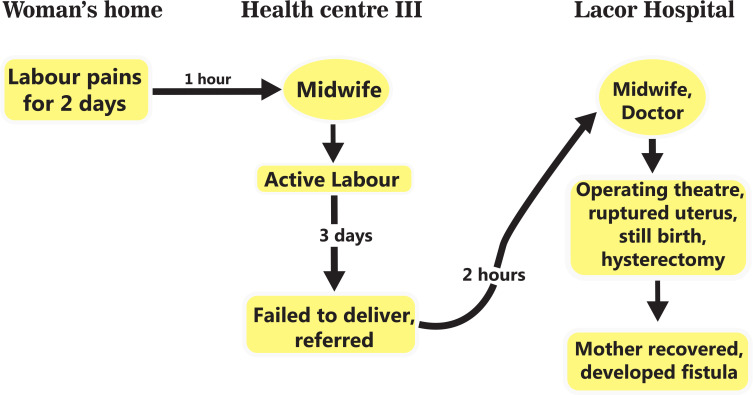
Skills of the health workers. The mother experienced labour pain for 2 days before going to the health centre. The midwife received her and gave her a bed without proper assessment. After 3 days of active contractions and exhaustion, the attendants requested a referral to Lacor Hospital. She arrived at Lacor Hospital with a ruptured uterus and was discharged with a vesicovaginal fistula (MNM2). MNM, maternal near-miss.
Figure 9
Figure 9
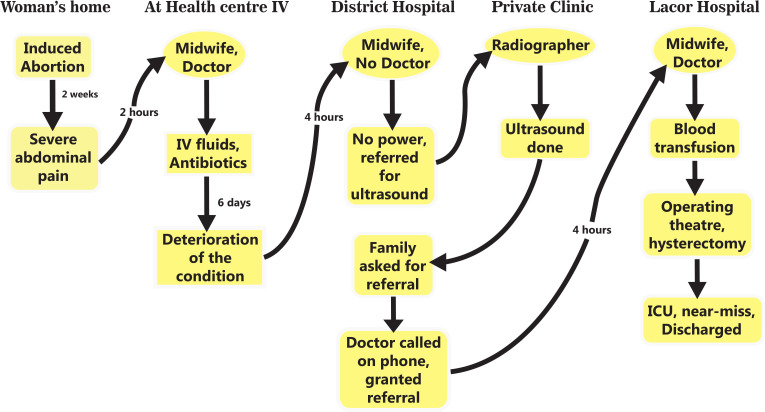
Back-and-forth referral due to lack of diagnostics. The mother had an unsafe abortion then went to H/C IV. The doctor reviewed and started her on antibiotics and intravenous (IV) fluids. She was referred to the district hospital for an abdominal ultrasound scan and complete blood count. Unfortunately, these investigations could not be done. She was again referred to a private medical centre for an ultrasound scan, which showed massive pus in the abdomen. The operation could not be done because there was no electricity. The family requested a referral to Lacor Hospital, where the operation was done. The uterus was removed and she was discharged alive after 5 days (MNM3). H/C, health centre; ICU, intensive care unit; MNM, maternal near-miss.

References

    1. WHO . Trends in maternal mortality 2000 to 2017: estimates by WHO, UNICEF, UNFPA, world bank group and the United Nations population division, 2019.
    1. Alkema L, Chou D, Hogan D, et al. Global, regional, and national levels and trends in maternal mortality between 1990 and 2015, with scenario-based projections to 2030: a systematic analysis by the un maternal mortality estimation Inter-Agency group. Lancet 2016;387:462–74. 10.1016/S0140-6736(15)00838-7 - DOI - PMC - PubMed
    1. Murray CJL, King G, Lopez AD, et al. Armed conflict as a public health problem. BMJ 2002;324:346–9. 10.1136/bmj.324.7333.346 - DOI - PMC - PubMed
    1. UDHS . Uganda demographic and health survey. Kampala Uganda: Uganda Bureau of Statistics, 2011.
    1. Uganda Bureau of Statistics (UBOS) and ICF . Uganda demographic and health survey 2016: key indicators report. Rockville, Kampala, Uganda, and Maryland: UBOS, 2017.

Publication types

LinkOut - more resources