


Comorbidities associated with genetic abnormalities in children with intellectual disability
- PMID: 33753861
- PMCID: PMC7985145
- DOI: 10.1038/s41598-021-86131-3
Comorbidities associated with genetic abnormalities in children with intellectual disability
Abstract
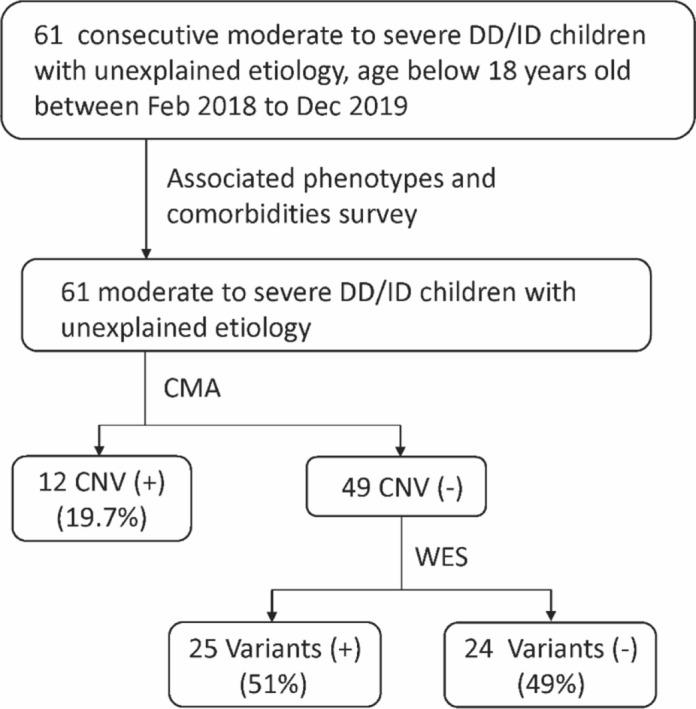
Intellectual disability (ID) has emerged as the commonest manifestation of underlying genomic abnormalities. Given that molecular genetic tests for diagnosis of ID usually require high costs and yield relatively low diagnostic rates, identification of additional phenotypes or comorbidities may increase the genetic diagnostic yield and are valuable clues for pediatricians in general practice. Here, we enrolled consecutively 61 children with unexplained moderate or severe ID and performed chromosomal microarray (CMA) and sequential whole-exome sequencing (WES) analysis on them. We identified 13 copy number variants in 12 probands and 24 variants in 25 probands, and the total diagnostic rate was 60.7%. The genetic abnormalities were commonly found in ID patients with movement disorder (100%) or with autistic spectrum disorder (ASD) (93.3%). Univariate analysis showed that ASD was the significant risk factor of genetic abnormality (P = 0.003; OR 14, 95% CI 1.7-115.4). At least 14 ID-ASD associated genes were identified, and the majority of ID-ASD associated genes (85.7%) were found to be expressed in the cerebellum based on database analysis. In conclusion, genetic testing on ID children, particularly in those with ASD is highly recommended. ID and ASD may share common cerebellar pathophysiology.
Conflict of interest statement
The authors declare no competing interests.
Figures
References
-
- American Psychiatric Association . Diagnostic and Statistical Manual of Mental Disorders. 5. APA Press; 2013.
Publication types
MeSH terms
LinkOut - more resources
Full Text Sources
Other Literature Sources
